
Description
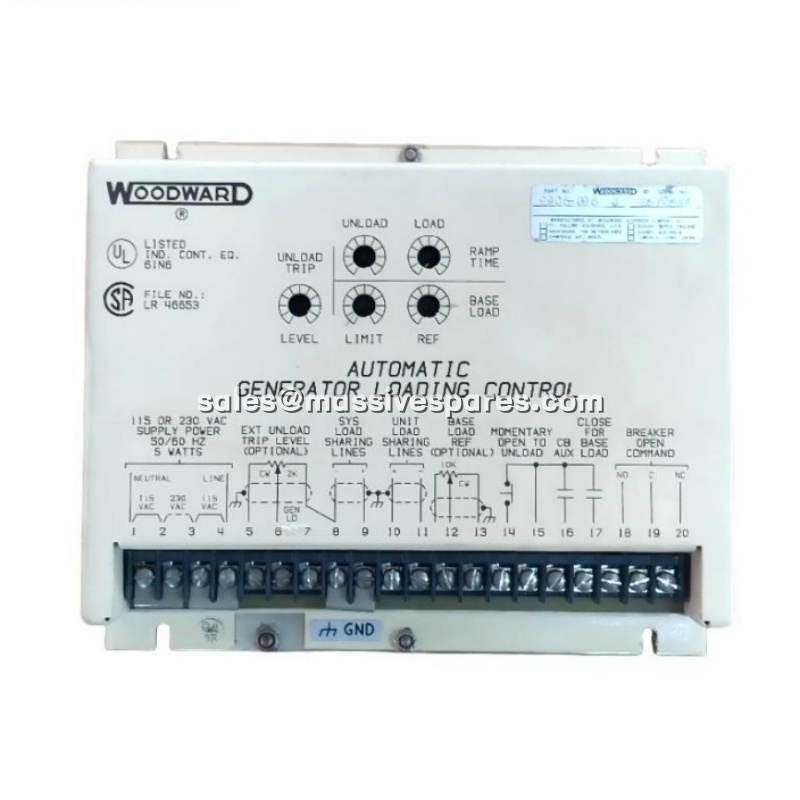
The 9905-096 is an Automatic Generator Loading Control (AGLC) manufactured by Woodward Inc. and identified in the product family as the 82394 AGLC type covered by Woodward product manual 82004. It is a panel-mounted analog load-management control, not a governor: its job is to control how fast a generator set is loaded onto a bus and unloaded from it, while a separate load-sharing and speed control such as a 2301A or an EGCP package handles fuel actuation and frequency control.
The 9905-096 is powered by 170–264 VAC at 50/60 Hz, draws 5 VA and is housed in a metal chassis with 20 screw terminals along the bottom edge. Five front-panel potentiometers provide LOAD LIMIT, BASE LOAD, RAMP TIME, UNLOAD TRIP LEVEL and an auxiliary adjustment, all accessible behind the cover. A panel diagram also shows the LOAD and REF ladder network and a meter drive connection. The unit is UL and cUL Listed and CSA Certified; the 9903-545 variant exists as a replacement-only, unlisted alternative in North America.
In operation the 9905-096 compares the load-sharing line potential of the oncoming generator with the system load-sharing line potential, then ramps the local load at a preset rate until the two voltages match. Because the ramp starts from the generator’s existing load rather than from zero, paralleling produces no sudden “thump” in kW. The reverse sequence is equally deliberate: an unload command ramps the set down to a preset trip point, after which the internal relay issues a breaker-open command. One 9905-096 can base load from one to fifteen engine-generator sets against a utility, or control the soft transition of a single set into and out of a load-sharing group.
Application Scenarios
A food-processing plant operated three 1.2 MW diesel gensets in utility-parallel mode for peak shaving, with a fourth unit on standby. Their original operating rule was simple: close the breaker once the synchronizer declared the phases matched, then manually raise the load setpoint. Twice in one summer the operator raised the setpoint too quickly after a hot restart. The engine lugged, exhaust temperature rose sharply and the protection system removed the set from the bus — at exactly the moment the site was trying to shed demand. The plant fitted a 9905-096 between the synchronizer auxiliary contacts and the existing 2301A load-sharing lines. After that, closing the breaker started an electronic ramp from the set’s actual load toward the selected base load; the rate was set from the RAMP TIME control to match the engine manufacturer’s load-acceptance curve rather than the operator’s reaction time.
The second half of the sequence proved more valuable. During a scheduled utility transfer, the unload contact opened and the 9905-096 ramped the set down at the independent unload rate to a preset trip point. When that point was reached, the internal double-throw relay de-energized and opened the breaker. The remaining three sets did not absorb a sudden block of load, so bus frequency and voltage stayed inside the limits required by the site’s sensitive process drives. The plant’s maintenance logs subsequently recorded the transfer as uneventful rather than as a fault event. That is the specific problem the 9905-096 exists to solve: generator paralleling is not difficult once the phases match, but getting on and off the bus without disturbing the process still requires a controlled ramp and a properly timed breaker command.
Parameter
| Main Parameters | Value / Description |
|---|---|
| Product Model | 9905-096 |
| Manufacturer | Woodward Inc., USA |
| Product Family / Type | AGLC — Automatic Generator Loading Control (82394 AGLC type) |
| Product Manual | Manual 82004 (Revision D, 2/2021) |
| Companion / Replacement | 9903-545 (replacement use only; unlisted in North America) |
| Alternative Version | 9905-063 (for circuits that disconnect when holding contacts are opened) |
| Input Power | 170–264 VAC, 50/60 Hz |
| Power Consumption | 5 VA |
| Number of Terminals | 20 screw terminals |
| Load & Unload Ramp Rate | 20 to 0.33 % of full load per second (approximately 5 seconds to 5 minutes for 100 % load change) |
| Ramp Rate Adjustment | Separate LOAD and UNLOAD ramp adjustments; independently adjustable |
| Maximum Controlled Units | Up to 15 paralleled engine-generator sets against a utility |
| Base Load Setting | Internal potentiometer behind cover or external potentiometer; maximum load limit prevents oversetting |
| Unload Trip Level | Internal or external 2 kΩ potentiometer |
| Breaker Open Relay | Double-throw relay K1; de-energizes automatically at the trip point and resets when breaker auxiliary contacts open |
| Load Tracking | Continuous; ramp starts at the generator set’s existing load for bumpless transfer |
| Meter Drive Signal | 0–1 mA, proportional to the load-sharing line voltage reference level |
| Construction | Metal chassis, open construction, front-panel potentiometer access |
| Dimensions | 8.5 in W × 7.5 in H × 2.0 in D (216 × 190 × 51 mm) |
| Weight | 2.25 lb (1.02 kg) |
| Operating Temperature | –40 to +85 °C (–40 to +185 °F) |
| Storage Temperature | –55 to +105 °C (–67 to +221 °F) |
| Maximum Humidity | 95 % at 38 °C |
| Shock Rating | 60 G |
| Vibration Rating | 4 G, 5–500 Hz |
| Agency Listing | UL and cUL Listed, CSA Certified |
| Typical Compatibility | Woodward 2301A Load Sharing and Speed Control, EGCP packages, SPM-A synchronizer, APTL control and DSLC systems |