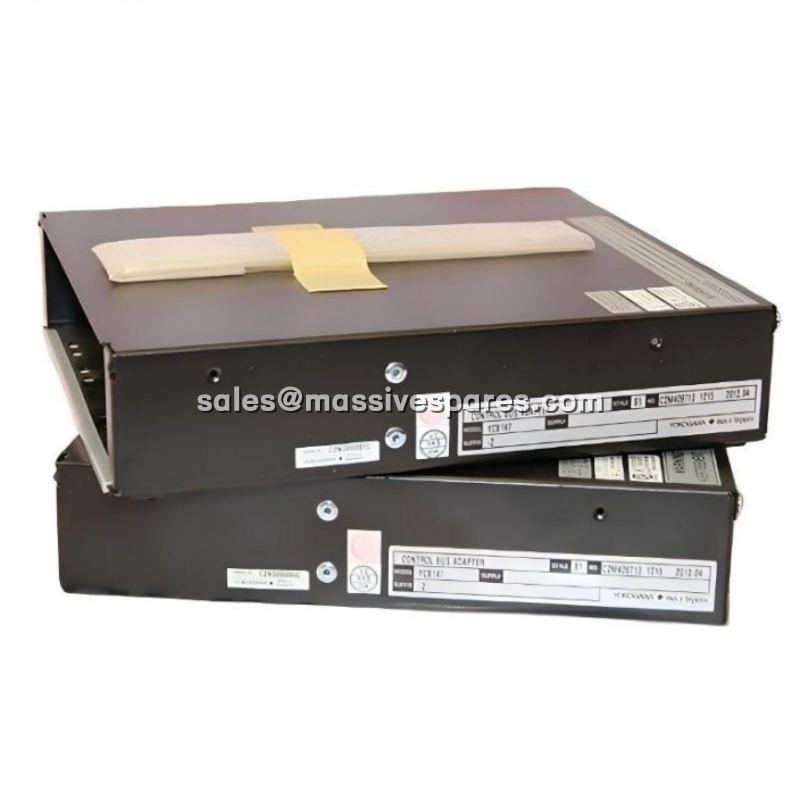
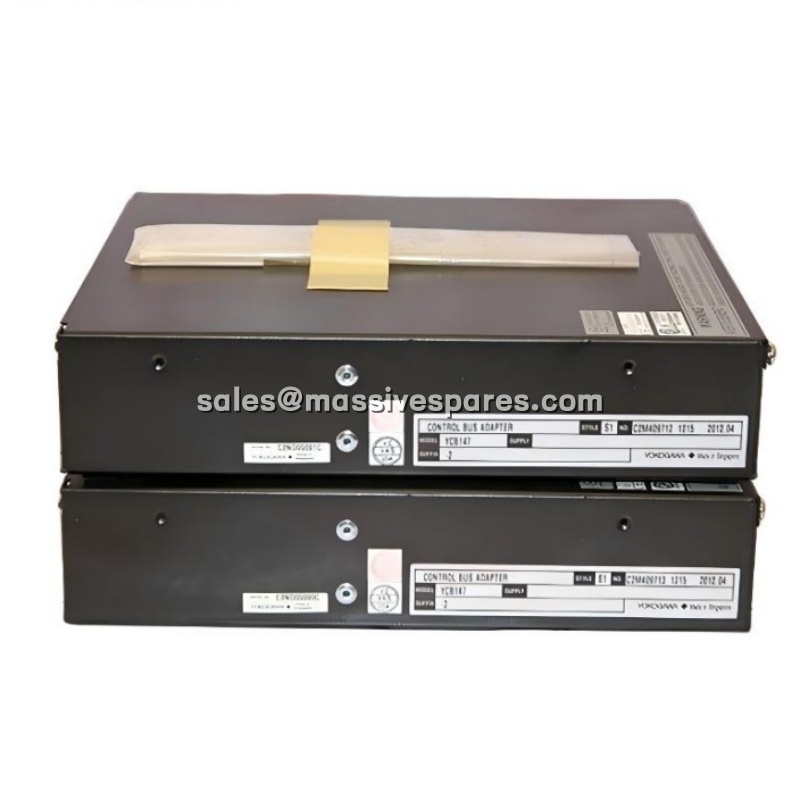
Technical Specifications
| Parameter Name | Parameter Value |
|---|---|
| Product Model | YCB147-2 |
| Manufacturer | YOKOGAWA Electric Corporation |
| Product Type | Control Bus Cable Conversion Adapter / Bus Terminator |
| Series / Platform | CENTUM VP / CENTUM CS 3000 / CS 1000 |
| Suffix Meaning | -2 = two-connector configuration, standard non-explosion-proof |
| Supported Bus Types | Vnet, ESB bus, ER (remote I/O) bus |
| Function | Interface conversion, signal bridging, bus termination |
| Operating Mode | Passive — no external power required |
| Firmware | None (hardware-only device) |
| Configuration Required | None |
| Connector Count | 2 (suffix-specific connector type) |
| Built-in Feature | Bus termination resistor network |
| Mounting | 19″ rack slot / panel or DIN-rail mount (suffix-dependent) |
| Enclosure Rating | IP20 (cabinet-internal installation only) |
| Explosion Protection | None (not ATEX / FM / CSA certified) |
| Typical Dimensions (W×H×D) | Approx. 145 × 42 × 115 mm (may vary by source) |
| Typical Weight | Approx. 0.1–0.32 kg (may vary by source) |
| Operating Temperature | 0 to +55 °C (standard industrial grade) |
| Storage Temperature | -20 to +70 °C |
| Humidity | 5–95% RH, non-condensing |
| Origin | Japan |
| Status | Discontinued original; available as new-surplus / refurbished spare |
Main Features and Advantages
Passive operation with zero configuration overhead. The YOKOGAWA YCB147-2 is a fully passive hardware device. It draws no external power, carries no firmware, and requires no software setup—there is nothing to compile, download, or version-manage. For maintenance teams this means one less point of failure and one less item on the configuration-management checklist during a bus-segment rebuild.
Built-in termination suppresses signal reflection. Long control-bus runs without proper termination are a well-known source of signal “bounce,” which manifests as sporadic node dropouts and CRC errors that are difficult to diagnose. The integrated termination resistor network in the YCB147-2 closes the bus correctly at the conversion point, eliminating reflections and restoring stable communication on marginal segments.
Legacy-to-modern integration without a full rewire. During plant DCS migrations, the YOKOGAWA YCB147-2 bridges the physical connectivity gap between older ESB/ER bus components and current-generation Vnet controllers. This allows existing, still-functional cabling and I/O infrastructure to remain in service, deferring a costly full rewire and preserving validated field wiring.
Redundant-bus deployment support. In a dual-redundant Yokogawa DCS topology, two YCB147-2 adapters are typically deployed—one on Bus A and one on Bus B—so that signal conversion and termination remain available even if one communication path fails. This preserves the fault tolerance that the control system architecture is designed to deliver.
Compact, cabinet-efficient form factor. Its small footprint and rack- or panel-mount construction fit cleanly into standard Yokogawa enclosure slots, keeping cable routing organized and reducing the risk of accidental disconnection during routine maintenance.
Industrial-grade construction. The metal and industrial-PCB construction provides resistance to the electrical noise, thermal cycling, and vibration typical of continuous-process control cabinets.