

Description
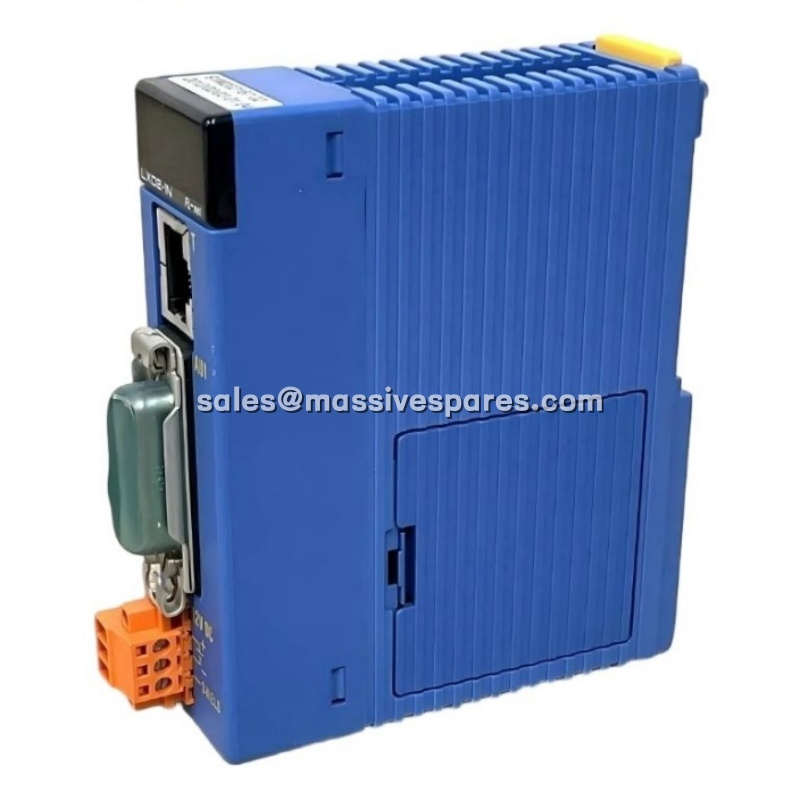
Application Scenarios
An automotive body assembly line integrating robotic welding cells from three different manufacturers faced a persistent data integration bottleneck. Each robot cell used its own controller—FANUC for welding robots, Yaskawa for handling units, and a separate FA-M3 PLC supervising the conveyor and safety interlocks. The line’s original architecture relied on discrete hardwired handshakes for inter-controller communication, which limited coordination to basic start/stop signals and made it impossible to synchronize welding sequences across cells in real time.
By installing the F3LX02-2N in the FA-M3 rack and configuring FL-net communication, the plant achieved cyclic data exchange between all controllers on a single Ethernet-based network. The F3LX02-2N module’s 8,192-word data link capacity per module allowed each robot controller to publish its status, position, and alarm data to a shared memory space that every other node could read at deterministic intervals. Weld sequence coordination improved from a sequential handshake to a synchronized operation, reducing per-vehicle cycle time by approximately 12 seconds. The multi-vendor architecture meant no single controller vendor could dictate the network protocol—FL-net’s open standard ensured interoperability without vendor lock-in.
Parameter
| Parameter | Value/Description |
|---|---|
| Product Model | F3LX02-2N |
| Manufacturer | Yokogawa Electric Corporation |
| Product Category | FL-net (OPCN-2) Communication Interface Module |
| Compatible Systems | FA-M3 / FA-M3R PLC racks |
| Protocol Support | FL-net (OPCN-2) Ver. 2.00 |
| Physical Interface | 10BASE-T / 100BASE-TX (RJ-45) |
| Transmission Speed | 10 Mbps / 100 Mbps |
| Maximum Nodes | 254 per network segment |
| Max Modules per CPU | 6 modules |
| Cyclic Data Capacity | Area 1: 512 words; Area 2: 8,192 words |
| Message Data Size | Up to 1,024 bytes |
| Power Consumption | 330 mA max (backplane powered) |
| Dimensions | 28.9 × 100 × 83.2 mm |
| Weight | 100 g |
| Operating Temperature | 0°C to +55°C |
Technical Principles and Innovative Values
Innovation Point 1: Master-Less Peer-to-Peer Architecture. Unlike many industrial networks that rely on a master station to poll slaves, FL-net operates on a master-less token-passing model. The F3LX02-2N participates as an equal node, meaning any node can be added, removed, or powered down for maintenance without disrupting communication among remaining nodes. This architecture eliminates the single-point-of-failure risk inherent in master-based networks.
Innovation Point 2: RRR (Triple-R) High-Speed Data Refresh. Yokogawa’s proprietary Rapid Refresh Reflection technology accelerates the data path between the F3LX02-2N’s interface processing and the FA-M3 CPU module. This shortens the “delivery time”—the interval between when data is transmitted over FL-net and when it becomes accessible to the ladder application program. The result is deterministic cyclic data updates suitable for real-time control coordination.
Innovation Point 3: Dual Transmission Mode Flexibility. The F3LX02-2N supports both cyclic transmission (periodic data sharing via common memory) and message transmission (event-driven, on-demand communication up to 1,024 bytes). This allows the same module to handle time-critical I/O synchronization and non-critical diagnostic or recipe data transfer without additional hardware.