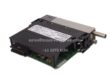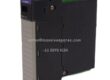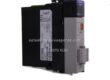
Technical Specifications
| Parameter Name | Parameter Value |
|---|---|
| Product Model | 1771-IBD |
| Manufacturer | Rockwell Automation / Allen-Bradley |
| Product Type | Digital DC Input Module for 1771 I/O Chassis |
| Number of Inputs | 16 discrete input points |
| Input Voltage Range | 10 to 30 V DC |
| Input Circuit Type | Sinking (sourcing field devices) |
| Minimum On-State Voltage | 10 V DC |
| Maximum Off-State Voltage | 5 V DC |
| Minimum Input Current | 4.5 mA @ 10 V DC; 15 mA @ 30 V DC |
| Maximum Off-State Current | 2.0 mA @ 5 V DC |
| Input Impedance | 2.2 kΩ maximum per channel |
| Signal Delay | Low-to-High 1 ms; High-to-Low selectable 1 ms or 6 ms |
| Backplane Current Draw | 130 mA @ 5 V DC (±5%) |
| Power Dissipation | 1.0 W minimum; 7.3 W maximum |
| Chassis Compatibility | All 1771 I/O chassis except 1771-A1, -A2, and -A4 |
| Field Wiring Arm | 1771-WH (screw terminal, 14 AWG stranded maximum) |
| Operating Temperature | 0 °C to 60 °C (32 °F to 140 °F) |
| Storage Temperature | -40 °C to 85 °C (-40 °F to 185 °F) |
| Relative Humidity | 5% to 95% non-condensing |
| Agency Certification | UL Listed; CSA Certified; CSA Class I, Division 2, Groups A, B, C, D |
Main Features and Advantages
The Allen-Bradley 1771-IBD delivers a set of engineering characteristics that have made it a mainstay of PLC-5 discrete input architectures across thousands of industrial installations.
High-density 16-point configuration: By packing sixteen independent input channels into a single 1771 chassis slot, the 1771-IBD allows engineers to maximize the sensing capability of every I/O chassis position. This density reduces chassis count, panel size, and backplane power load compared with lower-density alternatives, which is a meaningful advantage in retrofit projects where existing enclosure space must be preserved.
Flexible input filtering: The selectable off-delay filter jumper on the 1771-IBD lets commissioning engineers choose between a 1 ms high-speed response for fast discrete sensing and a 6 ms filtered response for installations subject to contact bounce, motor-generated noise, or long cable runs through electrically hostile areas. This hardware-level flexibility eliminates the need for external filtering components and simplifies troubleshooting when a particular input point behaves intermittently.
Wide input voltage tolerance: Accepting signals anywhere between 10 and 30 V DC, the Allen-Bradley 1771-IBD accommodates the natural voltage sag that occurs across long cable runs, loaded power supplies, and aging 24 V DC distribution systems, ensuring that inputs register correctly even when field voltage deviates from nominal. This wide operating window reduces nuisance faults and keeps production data flowing under real-world electrical conditions.
Secure field termination through the 1771-WH wiring arm: The module connects to field conductors exclusively through the pivoting 1771-WH field wiring arm, which locks onto the chassis horizontal bar and swings upward into engagement with the module. This arrangement allows the 1771-IBD to be removed and replaced without disturbing a single wire, dramatically reducing MTTR during maintenance events and eliminating the risk of mis-termination during module swaps.
Proven industrial qualification: Carrying UL Listing, CSA Certification, and CSA Class I Division 2 Groups A, B, C, D hazardous-location approval, the 1771-IBD is engineered for the demanding electrical environments found in refineries, chemical plants, and heavy manufacturing. Combined with full electromagnetic compatibility testing under European Union directives, the module offers a level of industrial qualification that many legacy alternative products cannot match, giving maintenance teams confidence that the hardware will perform reliably for years of continuous service.