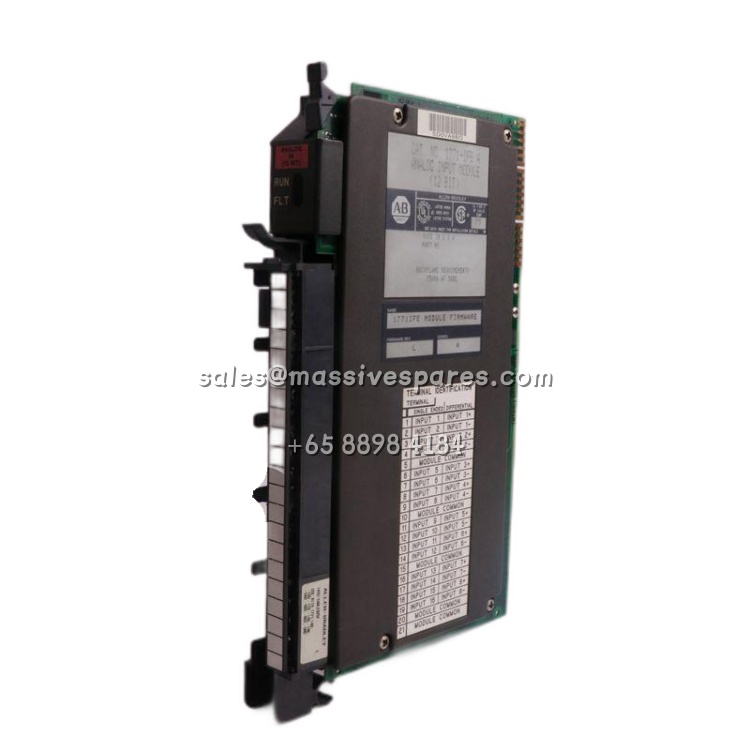
Application Scenarios
In a legacy chemical reactor train still controlled by a PLC-5, temperature monitoring relies on Type J and K thermocouples mounted throughout the vessel jacket and internal baffles. These sensors output only a few millivolts across their operating range, and the electrical environment is hostile—variable-frequency drives on adjacent agitators and large heaters switching nearby. The 1771-IFM addresses this by providing eight differential inputs, each capable of resolving signals as small as 0–50 mV while rejecting common-mode noise that would swamp a single-ended input card. For plants that have not yet migrated off PLC-5, this module remains the practical bridge between thermocouple-level signals and the controller’s data table, preserving temperature visibility without requiring a full I/O platform replacement.
Parameter
| Parameter | Value / Description |
|---|---|
| Product Model | 1771-IFM |
| Manufacturer | Allen-Bradley / Rockwell Automation |
| Product Category | Fast Millivolt Analog Input Module |
| Input Channels | 8, differential |
| Input Voltage Range | 0–50 mV (intrinsically safe connection) |
| Resolution | 12-bit binary |
| Accuracy | 0.1% of range at 25°C |
| Linearity | ±1 LSB |
| Channel Update | 14.5 ms for 8 channels |
| Backplane Current | 750 mA |
| Data Format | ±32,767 binary or ±9999 BCD |
| Dimensions | Approximately 27.9 × 5.1 × 15.2 cm |
| Weight | Approximately 0.6–0.67 kg |
Technical Principles and Innovative Values
- Differential Inputs for Millivolt-Level Signal Integrity: The 1771-IFM uses eight differential input pairs, a design choice that directly addresses the central challenge of thermocouple measurement. Single-ended inputs reference each channel to a shared common, which means any noise on that common appears in every reading. Differential inputs measure the voltage between two dedicated terminals, rejecting common-mode noise and allowing the module to resolve signals in the 0–50 mV range with 0.1% accuracy at 25°C. In practice, this is what makes the difference between a stable temperature trend and a reading that jumps with every nearby contactor closure.
- Intrinsically Safe Connection Architecture: The module is specified for “intrinsically safe connection,” meaning its input circuitry is designed to interface with field devices in hazardous areas when paired with appropriate barriers. For process plants handling flammable materials, this allows thermocouple wiring to run from classified areas to the 1771-IFM without additional isolation hardware at every point, simplifying the wiring topology while maintaining safety integrity.
- Fast Scan for Eight Channels: The 14.5 ms channel update time across all eight inputs is modest by modern standards but was a meaningful specification for PLC-5-era process control. For temperature loops with thermal time constants measured in seconds or minutes, this scan rate is more than sufficient, and it allows the module to service eight thermocouples without introducing perceptible lag into the control loop.