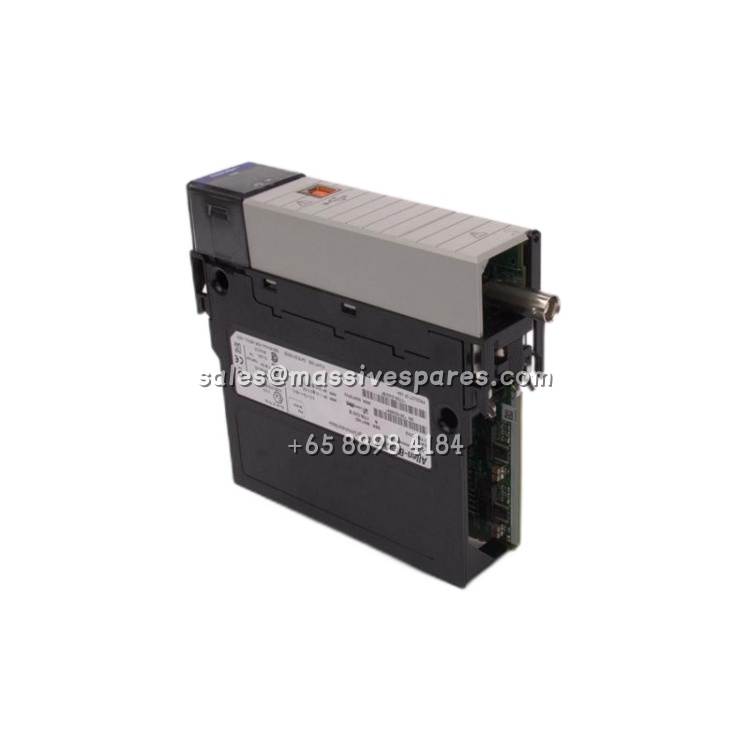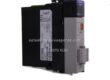
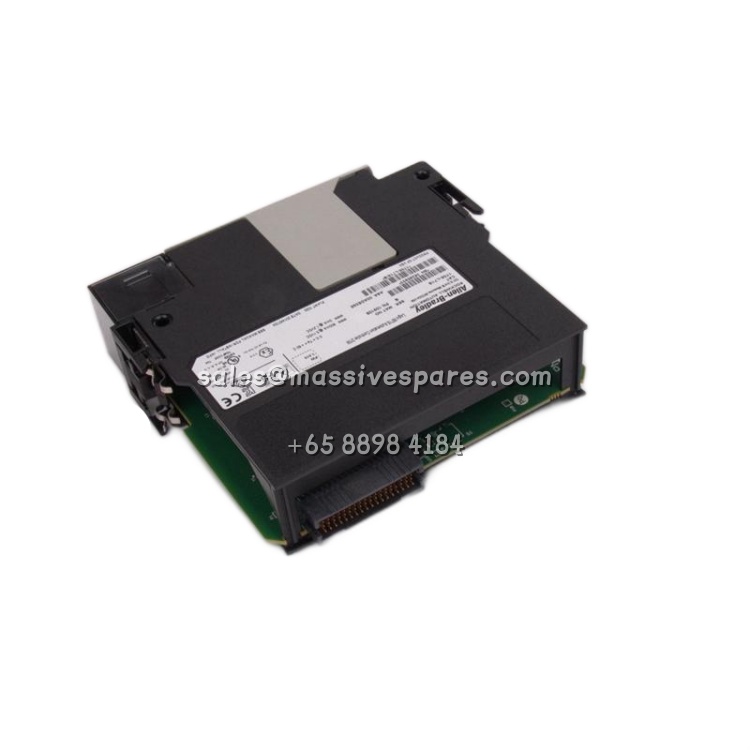
Technical Specifications
| Parameter Name | Parameter Value |
|---|---|
| Product Model | 1794-L34 |
| Manufacturer | Allen-Bradley / Rockwell Automation |
| Product Type | FlexLogix Processor / Controller |
| User Memory | 512 Kbytes |
| Power Supply Voltage | 24 VDC nominal (19.2–31.2 VDC range) |
| Input Current | 0.85 A at 24 VDC maximum |
| Backplane Current | 653 mA maximum @ 5.1 VDC |
| Power Dissipation | 25.5 W max @ 19.2V; 20.4 W max @ 24V DC |
| Thermal Dissipation | 87 BTU/hour @ 19.2V |
| Communication Ports | 1 serial (RS-232, DF1/ASCII); 2 slots for 1788 communication adapters |
| Supported Networks (with adapters) | EtherNet/IP, ControlNet, DeviceNet |
| Task Support | Up to 8 configurable tasks (1 continuous, rest periodic) |
| Programming Software | RSLogix 5000 |
| Mounting | DIN rail (35 × 7.55 mm) or panel mount |
| Operating Temperature | 0°C to 60°C |
| Isolation Voltage | 30 VDC (qualified to 850 VDC for 60 seconds) |
| Weight | 0.91 kg (2.00 lbs) |
Main Features and Advantages
Logix Control Engine in a Compact Form Factor: The 1794-L34 brings the Logix platform’s tag-based programming, Add-On Instructions, and PhaseManager capabilities to a controller small enough for DIN-rail mounting in space-constrained cabinets. Engineers can develop code using symbolic addressing and reusable routines, then deploy the same programming approach across FlexLogix, CompactLogix, and ControlLogix systems, reducing development and maintenance effort in facilities with mixed Rockwell platforms . The controller’s support for structured text, function block, and ladder logic gives programmers flexibility to choose the language best suited to each routine.
Flexible Communication via Adapter Slots: Rather than locking the 1794-L34 into a single network protocol, Allen-Bradley designed the controller with two adapter slots that accept 1788 series communication cards. A facility standardizing on EtherNet/IP can install the appropriate adapter for plant-wide integration, while a site with existing ControlNet infrastructure can use a ControlNet adapter to preserve its current network investment . This modularity extends the controller’s useful life and allows network migration to proceed on the facility’s schedule rather than being forced by the controller’s limitations.
Built-In Serial Port for Programming and Peer Communication: The 1794-L34 includes a non-isolated RS-232 port that supports DF1 full-duplex and ASCII protocols. DF1 is commonly used for programming via RSLogix 5000 and for communication with PanelView operator terminals, while ASCII supports interfacing with barcode readers, weigh scales, and other serial devices commonly found in material handling and assembly applications . This built-in port eliminates the need for a separate communication module in simple configurations, reducing system cost and complexity.
Multitasking for Deterministic Control: The 1794-L34‘s multitasking operating system allows up to 8 tasks with configurable priorities, with one continuous task and the remainder configured as periodic tasks. Each task can contain up to 32 programs with independent local data, enabling engineers to isolate control logic for different machine sections or process areas within a single controller . This architecture supports deterministic execution of time-critical logic while allowing less urgent functions—such as data logging or communication handling—to run at lower priority without interfering with control performance.
Application Field
The 1794-L34 is deployed in applications where a compact, networked controller is needed to handle a focused set of control functions, typically with fewer than 256 I/O points. Material handling systems—including conveyor sortation, palletizing stations, and automated storage and retrieval system interfaces—are common installations, where the 1794-L34 manages photo-eye inputs, motor starters, and divert mechanisms while communicating with a supervisory system over EtherNet/IP or ControlNet . The controller’s serial port is often used in these applications to connect barcode scanners for product tracking, a function that would otherwise require a separate communication module.
HVAC and building automation represent another significant application area. The 1794-L34 can control air handling units, chiller plants, and variable air volume terminal units, using its analog I/O capabilities to monitor temperature, humidity, and pressure sensors while driving damper and valve actuators. The controller’s support for PhaseManager equipment phases, introduced in firmware revision 15.3, allows building automation sequences—such as morning warm-up or economizer changeover—to be modeled as state machines, improving code clarity and maintainability . Small process control applications in food and beverage, water treatment, and chemical dosing also benefit from the 1794-L34‘s combination of PID control instructions, flexible communication, and compact footprint.
Because the 1794-L34 is an obsolete product no longer in active production, its current use is concentrated in maintenance and spares support for existing installations. Facilities that standardized on FlexLogix for distributed control continue to source replacement units through surplus and refurbished channels to avoid the cost and disruption of migrating functioning I/O and wiring to a newer platform .