Product Overview
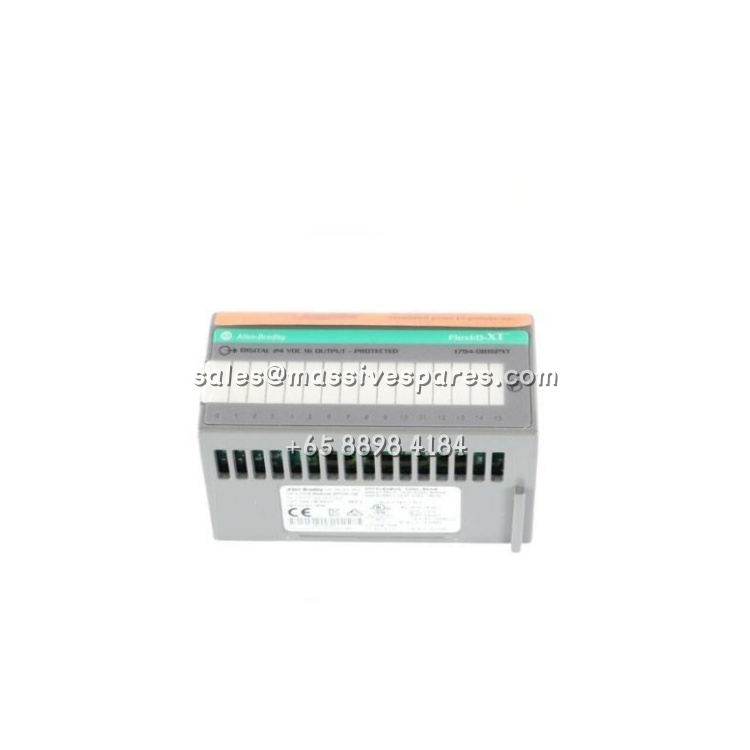
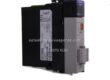
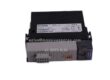
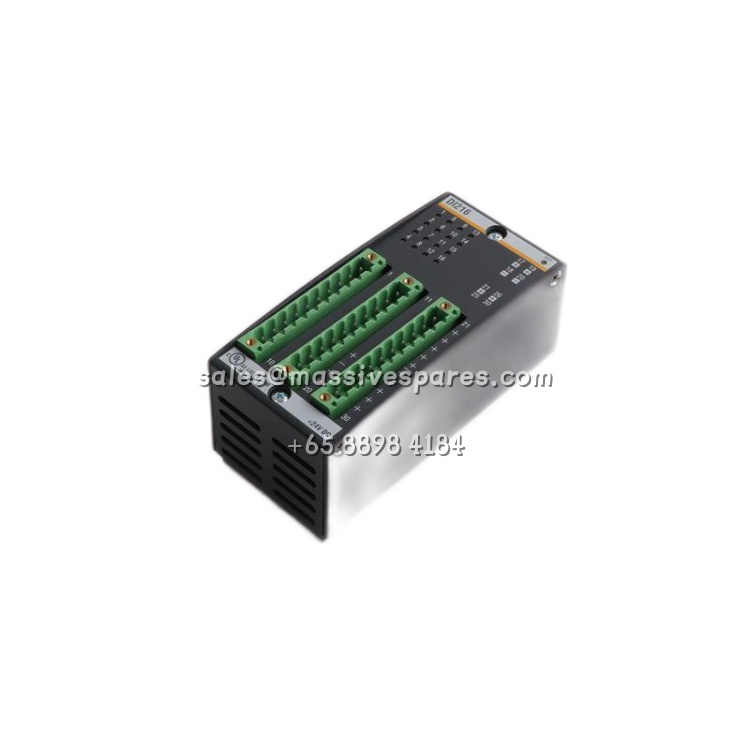
The 1794-OA16 is a 16-point AC digital output module from the Allen-Bradley FLEX I/O platform, designed to sit at the business end of a distributed I/O drop and switch 120V AC field loads directly. It is built around triac (thyristor) output elements rather than electromechanical contacts, which is the architectural fact that defines how the module behaves: there is no arcing, no contact-wear curve, and no mechanical bounce on a high-cycle solenoid, but there is a small off-state leakage current and a half-line-cycle switching delay that anyone wiring inductive loads needs to respect. Each of the 16 outputs on the 1794-OA16 is rated at 500 mA continuous when the ambient is held to 55 °C, for a 4.0 A module total, and the triac stack will absorb a 7 A surge for 40 ms — repeatable every 8 seconds — which is what lets it fire the inrush of a contactor coil or a pilot relay without a snubber.
What makes the 1794-OA16 a FLEX I/O module rather than just another output card is the separation of the electronics from the wiring. The module clicks onto a terminal base unit — 1794-TB3, 1794-TB3S, 1794-TB2, 1794-TBN, or one of the keyed variants — and all 16 load conductors stay put on the base when the module is swapped. In a panel where a blown output used to mean a rewire, the 1794-OA16 turns the repair into a five-minute hot-swap: kill field power, lift the module, seat the spare, confirm the yellow point LED, and the rung is live again. The base also decides the wiring style — the 1794-TB3 and 1794-TB3S bus the L2 commons internally per row, while the 1794-TBN requires auxiliary terminal blocks for per-channel common routing, so naming the base in the listing is not a detail, it is part of the fitment.
On the network side the 1794-OA16 is transport-agnostic. It presents as a standard 1794 digital output profile — AB:1794_DO16:O:0 for the output word and AB:1794_DO:I:0 for the fault/status validation — behind whatever FLEX I/O adapter owns the station: 1794-AENT or 1794-AENTR for EtherNet/IP, 1794-ADN for DeviceNet, 1794-ACN15 for ControlNet, or an 1794-ASB Remote I/O adapter. That is the real value proposition of the platform. A 1794-OA16 installed in 2005 behind a DeviceNet scanner can be moved behind an EtherNet/IP adapter in 2026 without changing a single rung or a single terminal assignment.
The safety-state story is worth stating plainly. Like every 1794 digital output, the 1794-OA16 supports a configured safe state: on loss of connection or when the controller drops to Program mode, every triac goes to the state you defined at configuration time, not to whatever the last electrical transient left it in. For a module switching 120V AC contactor coils and solenoid banks, that one bit of determinism is the difference between a controlled shutdown and a cylinder you have to explain to the safety officer.
Technical Specifications
| Parameter | Value |
|---|---|
| Product Model | 1794-OA16 |
| Manufacturer | Allen-Bradley / Rockwell Automation |
| Product Type | FLEX I/O Digital AC Output Module, triac (thyristor) |
| Output Points | 16, non-isolated from one another; isolated from backplane in groups |
| Nominal Output Voltage | 120V AC, 50/60 Hz |
| Output Voltage Range | 74–132V AC (some Series C/D documentation extends to 85–132V AC; verify label) |
| Output Current, per Point | 500 mA maximum @ 55 °C; 250 mA nominal continuous derate profile |
| Output Current, Module Total | 4.0 A maximum (16 points) |
| Minimum On-State Current | 5 mA per point |
| On-State Voltage Drop | ≤ 1.5V AC @ 0.5 A |
| Off-State Leakage | ≤ 2.25 mA per point |
| Surge Current | 7 A for 40 ms, repeatable every 8 s |
| Response Time | ≤ ½ line cycle, both on-to-off and off-to-on (≈8.3 ms at 60 Hz) |
| Protection | Outputs are not individually fused on the module; module-level fusing per OEM spec (2.5 A, 150V AC normal-blow MQ2 type). Use 1794-TBNF base for integrated fusing |
| Isolation Voltage | 120V AC continuous field-to-backplane; 1250V AC tested 60 s; 2150V DC tested 1 s (system-to-user) |
| FlexBus Current | 80 mA @ 5V DC |
| Power Dissipation | 4.7 W maximum @ 0.5 A/point (≈16.1 BTU/hr) |
| Keyswitch Position | 8 (module identification/configuration) |
| Data Format | 16-bit INT-based module-defined types; AB:1794_DO16:O:0 output word, AB:1794_DO:I:0 fault/status, AB:1794_DO16:C:0 config/safe state |
| Status Indicators | 16 yellow LEDs, one per output point |
| Terminal Base Compatibility | 1794-TB2, 1794-TB3, 1794-TB3S, 1794-TBN, 1794-TBNF, 1794-TBKD, 1794-TBNK, 1794-TBNFK, 1794-TB3K, 1794-TB3SK |
| Compatible Adapters | 1794-AENT, 1794-AENTR, 1794-ADN, 1794-ACN15, 1794-ASB, 1794-AND |
| Hot-Swap Capable | Yes — module may be replaced online provided field power is removed first |
| Wire Size (per base) | 0.34–3.3 mm² (22–12 AWG); insulation ≤ 1.2 mm; screw torque 0.56–0.79 Nm (5–7 lb-in) |
| Enclosure Rating | Open-style module, IP20 when installed in listed enclosure; requires appropriate cabinet |
| Dimensions | 94 × 94 × 69 mm (3.7 × 3.7 × 2.7 in) |
| Weight | ≈ 96 g (0.21 lb) module only; base adds ≈ 260 g |
| Operating Temperature | 0 to +55 °C (32 to 131 °F) |
| Storage Temperature | −40 to +85 °C (−40 to 185 °F) |
| Humidity | 5% to 95% RH, non-condensing |
| Shock / Vibration | 30 g operating / 50 g non-operating; 5 g @ 10–500 Hz |
| EMC / ESD | IEC 61000-6-4 emissions; 6 kV contact / 8 kV air discharge immunity |
| Hazardous Location | cULus Class I, Division 2, Groups A–B–C–D, T4 temperature code (on units so marked) |
| Certifications | UL (E322657), CSA (174182), CE, EAC, KC, RCM, RoHS |
| Country of Origin | Malaysia / Mexico (date-code dependent) |