Technical Specifications
| Parameter | Value |
|---|---|
| Product Model | 2711P-T6M20D |
| Manufacturer | Allen-Bradley / Rockwell Automation |
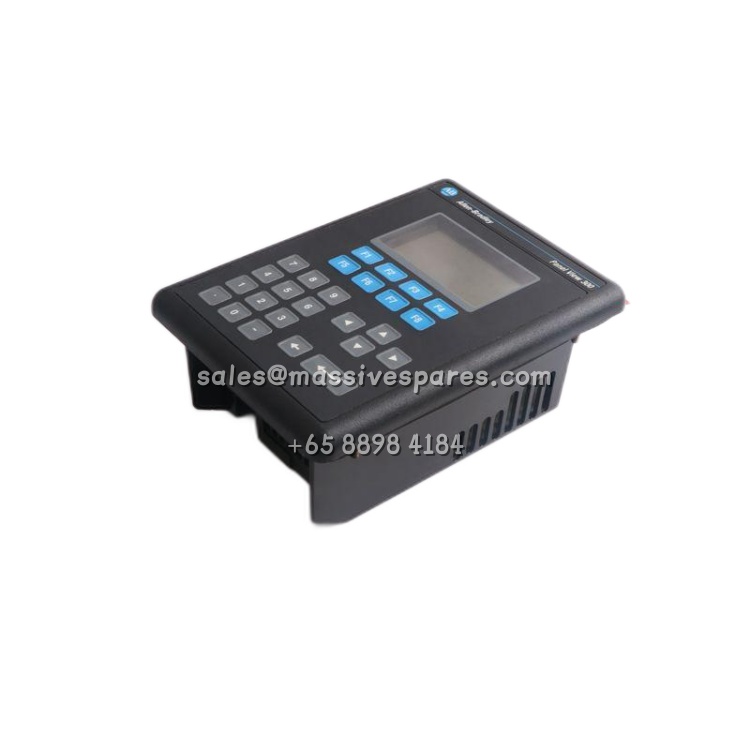
| Product Type | PanelView Plus 600 Operator Terminal (HMI), touch-only |
| Platform / Family | PanelView Plus 6, 600 class; Windows CE 6.0 runtime |
| Display | 5.7 in. grayscale TFT LCD, 320 × 240 QVGA, 16-level grayscale |
| Active Display Area | 112 × 84 mm (4.4 × 3.3 in) |
| Luminance | 440 cd/m² (nits) |
| Touchscreen | 4-wire analog resistive; operating force 10…110 g; 1 million actuations |
| Processor / Memory | 1 GHz class ARM; 256 MB RAM, 512 MB nonvolatile flash (~73 MB free user/project memory) |
| Communication Ports | 1 × Ethernet 10/100Base-T (Auto-MDI/MDI-X), 1 × RS-232 (DB9) |
| USB / Storage | 1 × USB host (Type A), 1 × USB device (Type B); hot-swappable SD card slot, 1784-SDx / 1784-SDHCx |
| Supported Protocols | EtherNet/IP (CIP), TCP/IP; serial DF1, Modbus RTU/ASCII and DH-485 configurable through the application and cable/adapter |
| Input Power | 18…30 V DC, 24 V DC nominal; SELV/PELV Class 2 supply required |
| Power Consumption | 15 W max (0.6 A @ 24 V DC), 9 W typical (0.375 A @ 24 V DC) |
| Backlight | White LED, not field-replaceable, 25,000 hours minimum at 25 °C |
| Real-Time Clock | Battery-backed RTC, ±2 min/month; CR2032 field-replaceable, 4 years minimum at 25 °C |
| Application Software | FactoryTalk View Machine Edition 6.10 or later; .MER runtime, 67 online languages supported |
| Enclosure Rating | NEMA Type 12, 13, 4X (indoor); IEC IP65/IP66 front panel, IP20 rear |
| Operating Environment | 0…+55 °C, 5…95% RH non-condensing, up to 2000 m altitude |
| Shock / Vibration | 15 g @ 11 ms; 2 g peak @ 57…500 Hz |
| Mechanical Dimensions | 152 × 185 × 68 mm (5.98 × 7.28 × 2.68 in) |
| Panel Cutout | 123 × 156 mm (4.84 × 6.14 in) |
| Weight | Approximately 0.91 kg (2.0 lb) net |
| Certifications | UL, cULus, CE, RoHS; ATEX/IECEx subject to terminal revision and label |
| Lifecycle Status | Discontinued by OEM (30 Sep 2021); no planned direct replacement |
Main Features and Advantages
Grayscale is a readability choice, not a compromise
The 5.7-inch grayscale TFT on the 2711P-T6M20D earns its keep in text-heavy diagnostic and setpoint screens. Without colour to fight against, status text, alarm banners, bar graphs and numeric readouts hold their contrast under overhead fluorescents, low-angle workshop light and the washed-out conditions of a washdown area. At 440 cd/m² the panel is bright enough to read without being the glare source that tires an operator over a twelve-hour shift. A colour application will still load and run — it simply renders in shades of gray — so a spare 2711P-T6M20D stays useful even if the original graphics were authored in colour.
Two communication paths keep a migration honest
Ethernet carries the EtherNet/IP tag traffic to ControlLogix, CompactLogix and Micro800 family controllers, while the RS-232 port stays free for the older link: a MicroLogix DF1 connection, a serial printer for batch records, a modem, or a third-party instrument speaking Modbus RTU or ASCII. That split is the reason plants can stage a network upgrade without touching the serial device that still does something useful. The SD slot and USB host port complete the practical picture — firmware loads, application backups and recipe exports are copied in the cabinet with the door open, not after a bench visit.
Built for fingers, gloves and the occasional stylus
A resistive touchscreen is forgiving in a way a capacitive panel is not. The 2711P-T6M20D responds through a polyester overlay to any blunt input, which is why it suits oily, dusty, wet and gloved hands. The 10…110 g actuation force is light enough for repeated use but firm enough to reject the casual brush that would register as a false press on a sensitive panel. Combined with the one-million-press rating and a front seal that meets NEMA 4X and IP65, the input surface is one of the few parts of the terminal that can actually be cleaned aggressively rather than coddled.
Small power, small footprint, no fan
At 15 W maximum and 24 V DC nominal, the 2711P-T6M20D slips onto the same isolated SELV/PELV rail that feeds the safety and I/O electronics, with no 120/240 V AC run and no fan drawing cabinet dust through the enclosure. The 123 × 156 mm cutout and 68 mm depth make it viable in shallow doors and crowded desk-mounted enclosures where a 10.4-inch unit would force a panel redesign. It is an unglamorous set of virtues, and exactly the reason this terminal is still specified as the cheapest form of risk control on a mature machine.
Application Field
The natural habitat of the 2711P-T6M20D is the compact machine that needs a real graphic interface but has no space, no AC supply and no appetite for a touchscreen the size of a tablet. Standalone packaging machines, small fillers, labelers, indexing tables and screw-feed stations typically expose a half-dozen setpoints, a running count, a fault list and a manual-step ribbon. On those panels the 320 × 240 grayscale screen is enough to show the mimic and the alarm banner on one page, and the resistive touch target is large enough that operators stop hunting for the right pixel.
In process and utility skids the terminal is used differently. A water-treatment skid, chemical dosing panel or compressor local station often places the 2711P-T6M20D at the edge of the process, where an Ethernet drop reaches the PlantPAx or Logix backbone and the RS-232 port still talks to a flow computer, a residual-chlorine analyser or a serial printer producing the batch record the auditor wants. The grayscale display is an advantage here: alarm severity is carried by blink pattern, bar weight and text rather than colour, so a panel viewed through a steamy door reads correctly even when the viewing angle is poor.
The third role is the one that matters most today — lifecycle continuity. Because Rockwell has discontinued the PanelView Plus 6 600 family with no planned like-for-like replacement, the 2711P-T6M20D is now the unit that prevents a forced HMI project from turning into a control-system project. A failed terminal swapped for a tested, firmware-matched 2711P-T6M20D restores the exact screen set, alarm history behaviour, recipe layout and operator path the plant was using the day before. That preserves validation paperwork in regulated lines and avoids retraining a shift team mid-production. It also buys the engineering department time: the modernization can be designed around the process, instead of being dictated by a dead display on a Friday night.
Related Products
2711P-T6M20A8 — The AC-input version of the same 5.7-inch grayscale touch, Ethernet-plus-RS-232 PanelView Plus 6 600 terminal. Fit it where the panel is already fed from 100–240 V AC and there is no 24 V DC rail available for the 2711P-T6M20D.
2711P-T6M20D8 — Later-generation PanelView Plus 6 600 terminal carrying the “8” hardware/OS suffix; mechanically and electrically aligned with the 2711P-T6M20D but on a newer CPU/CE build. Firmware and application revision must be checked before a direct exchange.
2711P-K6M20D8 — Keypad-only 600 grayscale terminal with the same Ethernet, RS-232 and DC-power configuration. It is the right related unit when the failed panel used function keys and a numeric pad rather than a touchscreen.
2711P-B6M20D8 — Keypad-plus-touch 600 variant. Where the original operator workflow mixes numeric entry with screen navigation, this is the model that matches both input methods while keeping the 2711P-T6M20D display and communication fit.
2711P-T6M5D8 — Smaller-communication 600 grayscale touch terminal: RS-232 only, no onboard Ethernet. Useful as a budget or serial-only spare, but not a drop-in for the 2711P-T6M20D where EtherNet/IP traffic is required.
2711P-T6C20D8 — Colour 5.7-inch touch PanelView Plus 6 600 with the same Ethernet, RS-232 and 24 V DC architecture. It is the closest visual upgrade path when the application can tolerate a colour screen and a different grayscale-rendering behaviour.
2711PC-T6M20D8 — The PanelView Plus 6 compact-styling variant of the same configuration. Often specified on newer doors for appearance, though bezel and cutout compatibility with the original 2711P-T6M20D must be verified before swapping.
2711P-RY2032 — Replacement CR2032 real-time-clock battery. A flat cell is the most common cause of clock drift and lost timestamp integrity on a stored 2711P-T6M20D, and the part is field-replaceable without a board removal.
1784-SDHC32 — 32 GB SDHC media for the 2711P-T6M20D application, firmware and recipe transfer slot. Keep a labelled card with a known-good image in the cabinet so a recovery is a reboot, not a search.
2711P-T10C4D8 — The 10.4-inch colour touch PanelView Plus 6 1000 that commonly appears on the same line as the 2711P-T6M20D, usually as the main HMI while the 600 handles the local station. It is a migration target, not a form-fit replacement.