Application Scenarios
A chemical plant runs a continuous reactor on a ControlLogix rack with a single 1756-PA75. The rack holds the controller, two EtherNet/IP bridges, a redundancy module and fourteen I/O modules, and the PSU fault alarm is acknowledged every Tuesday morning because the panel builder left no room for a second supply. When the PA75 finally fails at 02:00, the reactor loses its backplane, the safety PLC has to take over, and the batch is written off.
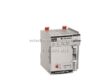
The same plant, six months later, runs the identical load on a 1756-PA75R A A pair mounted on a 1756-PSCA2 in the same slot. When one supply fails, the redundant unit carries the full load with no interruption to the backplane; the fault appears as a status-bit change and a maintenance ticket, not as a trip. The controller does not know that anything happened, which is exactly the point. The electrician replaces the failed supply during the next shift change, and the batch continues.
Parameter
| Main Parameters | Value / Description |
|---|---|
| Product Model | 1756-PA75R A A (冗余 connector, Series A) |
| Manufacturer | Allen-Bradley / Rockwell Automation |
| Product Category | Redundant AC power supply module for ControlLogix 1756 chassis |
| Number of Slots | 1 (one slot houses the 1756-PSCA2 with two supplies) |
| Nominal Input Voltage | 120/240 V AC |
| Input Voltage Range | 85 … 265 V AC (some documentation states 85 … 132 / 170 … 265 V AC, auto-ranging) |
| Input Frequency | 47 … 63 Hz |
| Input Current | 2.5 A @ 120 V AC, 1.25 A @ 240 V AC |
| Inrush Current | 25 A @ 120 V AC, 40 A @ 240 V AC |
| Input Protection | 10 A, 250 V slow-blow fuse (replacement specified in the user manual) |
| Hold-Up Time | 20 ms @ 120 V AC, 15 ms @ 240 V AC |
| Nominal Output Voltage | 5.1 V DC (backplane supply) |
| Output Current | 3.5 A continuous @ 60 °C (4.0 A @ 25 °C; 5.0 A peak) |
| Output Power | 18 W @ 60 °C, 20.4 W @ 25 °C |
| Nominal Output Power Rating | 75 W |
| Efficiency | 82 % at full load |
| Isolation Voltage | 1500 V AC |
| Inrush Current to Backplane | 100 A (typical), 150 A (maximum) |
| Line Regulation | 1 % for an input change of 85 … 265 V AC |
| Load Regulation | 2 % for a load change of 0 … 100 % |
| Ripple / Noise | 50 mV peak to peak |
| Status Indicators | AC OK, DC OK, Fault (per supply) plus a combined status LED on the 1756-PSCA2 |
| Ambient Operating Temperature | 0 … 60 °C (32 … 140 °F) |
| Storage Temperature | -40 … 85 °C (-40 … 185 °F) |
| Relative Humidity | 5 … 95 % non-condensing |
| Shock / Vibration | 30 g operating, 50 g non-operating; 2 g at 10 … 500 Hz |
| Power Dissipation | 4.2 W (14.3 BTU/hr) |
| Heat Dissipation | 28.4 BTU/hr |
| Dimensions (H × W × D) | 139 × 31 × 140 mm (5.47 × 1.22 × 5.51 in) |
| Weight | 2.3 kg (5.07 lb) |
| Mounting | 1756 chassis, via 1756-PSCA2 redundant power supply adapter (one slot) |
| Enclosure Type | Open-style module |
| Certifications | UL 508, cUL, CE, C-Tick, ATEX, FM, KC, IECEx, ABS marine |
| Compatible Chassis | 1756-A4, A7, A10, A13, A17, A4K, A7K, A7R, BERRY (see the 1756 selection guide for the full list) |
| Compatible Products | 1756-PA72, PA75, PB72, PB75 (non-redundant); 1756-PA75R, PB75R (redundant, other suffixes); 1756-PSCA2, 1756-PSCAP, 1756-PSCA2K redundant adapters |
| Required Accessory | 1756-PSCA2 redundant power supply adapter — the 1756-PA75R A A cannot be installed redundantly without it |
| Country of Origin | United States |
A note on the documentation conflict that matters: Rockwell’s technical data publication 1756-TD002 states the output current as 3.5 A continuous at 60 °C, 4.0 A at 25 °C and 5.0 A peak, with corresponding output powers of 18 W and 20.4 W. Third-party listings and the older user-manual wording often quote 5.5 A, 10 A or 15 A output, or a 65 W rating. Those figures do not match the current technical data and should not be used to size the rack. The “75 W” in the catalog number is the nominal rating; the usable current at operating temperature is 3.5 A, and that is the number to put into the chassis power budget.
Technical Principles and Innovative Values
- Innovation Point 1 — Two supplies, one slot, no interruption. The 1756-PA75R A A is fitted with the redundant-style DC output connector, which lets two supplies plug into a 1756-PSCA2 adapter in the same chassis slot. Both supplies float on the same backplane, so when one is removed the other is already carrying the load — there is no transfer switch and no break in the 5.1 V DC.
- Innovation Point 2 — A 20 ms hold-up that covers the real failure. At 120 V AC the supply holds the output for 20 ms after the input disappears; at 240 V AC, 15 ms. That is long enough for the redundant partner to become the sole source, and it is also long enough for a UPS transfer or a generator pickup to go unnoticed by the controller.
- Innovation Point 3 — Fault isolation instead of fault propagation. Each supply has its own AC OK, DC OK and Fault indicators, and the 1756-PSCA2 adds a combined status LED. A failed supply is identified at the rack without opening the panel, and it can be removed while the other supply continues to run the chassis. Compare that with a non-redundant supply, where the only diagnostic is a dead backplane.
- Innovation Point 4 — A 1500 V AC isolation barrier. The isolation rating separates the AC input from the DC backplane, so a supply-side transient does not propagate into the I/O. In a plant with VFDs and contactors on the same feeder, this is the barrier that protects the controller and the I/O modules.
- Innovation Point 5 — Load regulation that lets the rack stay predictable. With 2 % load regulation over a 0–100 % load change, the backplane voltage does not sag when a bank of outputs switches on together. That stability is what keeps analogue input modules and communication modules within their specified operating window.
- Innovation Point 6 — It forces a power budget, which is healthy. Because the 1756-PA75R A A can only support 3.5 A at 60 °C, the plant must calculate the chassis load rather than assume the supply is “big enough”. That exercise prevents the far more expensive failure: a rack that boots, runs for six months, and then trips the supply on a hot afternoon when the panel door is closed.