Application Scenarios
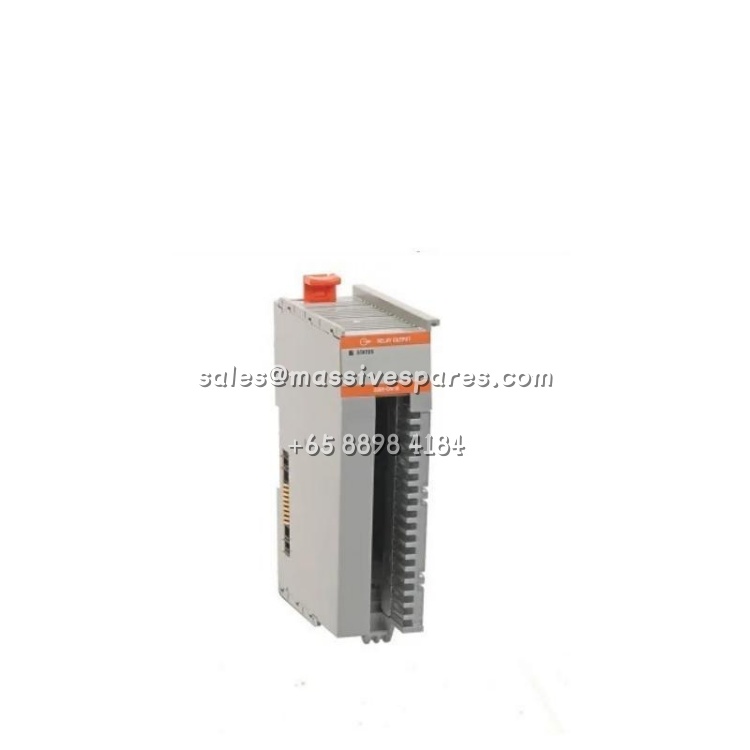
A packaging OEM ships a rotary filler with three voltage worlds in one panel: 24 V DC pilot valves, 230 V AC conveyor starter coils and a 125 V DC annunciator string that the end user’s electrical spec insists must be galvanically separated from the PLC. The old design used three output cards and a terminal‑block forest. On the new build they land the whole离散 output set on a single 5069‑OW16.
Commissioning day, a valve coil welds its contactor. The maintenance tech doesn’t pull the rack apart or re‑wire a single terminal — he unclips the removable terminal block (ordered separately, and that is the one mistake new buyers make), swaps the 5069‑OW16 in about four minutes, and the line is running before the quality manager finishes the paperwork. The dry contact never argued with the coil’s flyback, and the controller never knew the difference because the fault‑state behavior was set to “hold last state” during the changeover.
That is the product’s real job: it is the card you install so the rest of the system can stop caring what voltage the load happens to be.
Parameter
| Parameter | Value / Description |
|---|---|
| Product Model | 5069‑OW16 — Rockwell orderable, UPC 889508141633, current revision train A / B / C (label SER before you order) |
| Manufacturer | Allen‑Bradley / Rockwell Automation |
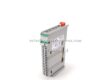
| Product Category | Compact 5000 I/O digital output module — relay, 16 channels, non‑isolated |
| Contact form | Form A, SPST normally open. “Off” is a genuine open circuit, so off‑state leakage is effectively 0 mA — the load is electrically disconnected, not just pulled low |
| Output groups | 16 points in 2 groups of 8, one common per group. Load voltages can differ between groups; channels within a group share the return |
| Output voltage range | 5…125 V DC and 5…264 V AC, 50/60 Hz. One card covers the DC and AC load classes that would otherwise need an 5069‑OB16 plus an 5069‑OA16 |
| Current per point | 2 A resistive at 5…30 V DC and at 5…264 V AC. At 125 V DC the rated value drops to roughly 0.27 A — do not size from the “2 A” headline alone |
| Current per group / module | 8 A per 8‑point group, 16 A total across the module. It is a sum‑of‑loads budget, not a license to run sixteen 2 A channels forever |
| Pilot duty | C300 at 5…240 V AC, R150 at 5…125 V DC — the rating that actually describes a contactor coil, which is what most of these points end up driving |
| Switch timing | ≤ 10 ms off‑to‑on and on‑to‑off; mean contact bounce ~500 µs. Fast enough for a valve, deliberately not a PWM device |
| Switching frequency | One operation every 3 seconds at rated load (≈0.3 Hz). This is a contactor‑and‑valve card, not a high‑speed counter output — run it hard and you buy contacts, not downtime |
| Contact life | ~300,000 cycles resistive, ~100,000 cycles inductive; mechanical life is an order of magnitude higher. Fit suppression across inductive loads and those numbers get a lot friendlier |
| Protection | Outputs are not fused and there is no built‑in load detection. External fusing per point and a suppression network are part of the design, not an option |
| Module power | MOD/SA power 18…32 V DC. Series A/B draw 75 mA (MOD) and 150 mA (SA); Series C draws 225 mA (MOD) with no SA current. A Series C card in a Series A budgeted rack is a very real way to trip the 24 V supply |
| Fault behavior | Per‑point programmable: hold last state, force on, or force off. Fault‑duration timer (1 / 2 / 5 / 10 s or forever) plus Delay‑to‑Fault, both set in Studio 5000 |
| Diagnostics | 16 channel LEDs plus module status; module flashes red on loss of field power. Unlike the 5069‑OB16, it cannot tell you “no load present” — a healthy but unloaded point still looks unhappy on the LED, so verify with a meter during bench work |
| Isolation | 250 V continuous basic isolation, type‑tested at 1800 V AC for 60 s. Isolation is contact‑to‑backplane, not channel‑to‑channel |
| Environment / physical | 0…+60 °C operating, −40…+85 °C storage, 5–95% RH non‑condensing, 30 g operating shock; open‑style module, IP20 once installed in the panel, 39.56 × 144.57 × 109.09 mm, ~240–300 g |
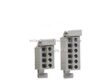
| Mounting / wiring | DIN‑rail mounted beside the controller; 5069‑RTB removable terminal block ordered separately, minimum 18 AWG / 105 °C load wiring. Spring‑clamp and screw‑clamp RTB options exist |
| Communications | Compact 5000 backplane, Producer/Consumer model — the module produces its status without being polled, so I/O updates are deterministic rather than scan‑round‑robin |
| Software / certification | Studio 5000 Logix Designer, AOP v5.011 / EDS and firmware v5.011 published; UL Listed, CE, UKCA, RCM, KC, ATEX/IECEx/UKEX only below 125 V AC or 30 V DC. Hazardous‑area claims past those limits are not supported |
Technical Principles and Innovative Values
Innovation point 1 — The contact is the isolation barrier. A solid‑state output fights ground loops with optos and hopes the flyback doesn’t take the driver. The 5069‑OW16 puts a mechanical air gap between the 24 V backplane and whatever the contactor coil is doing on the other side. That is why one card can switch AC and DC indifferently: the semiconductor family tree simply isn’t in the path.
Innovation point 2 — Two commons, sixteen possibilities. Grouping the 16 points as 2 × 8 instead of 16 independent commons is the quiet efficiency move. You can put “all 24 V DC valves” on group 0 and “all 230 V AC starters” on group 1, keep the return currents out of each other’s wiring, and still only burn one slot. It is mixed‑voltage switching without mixed‑voltage spaghetti.
Innovation point 3 — Producer/Consumer instead of polled I/O. The 5069‑OW16 publishes its state; the controller and any other Logix device on the network consume it. For a packaging line where a divert gate has to see the same “coil energised” bit as the safety controller, that eliminates the old “who got the scan first” arguments. Update timing becomes a network property, not a ladder property.
Innovation point 4 — Fault state is a safety decision, not a register default. Most generic relay cards default to “everything opens when the bus dies,” which is fine until it isn’t — a cooling fan that must not stop, or a lockdown solenoid that must stay made. The 5069‑OW16 lets you pick per point and then pick how long the controller has to disagree before the rule fires. That is configuration doing real work instead of just filling a dialog box.
Innovation point 5 — The RTB turns a failure into a coffee break. Because the terminal block is removable and separate, replacing a 5069‑OW16 never means stripping sixteen load wires. Wire once, label once, and the next swap is a clip, a lift and a click. On a skid with no hot spare, that is the difference between a shift’s production and a shift’s paperwork.
Innovation point 6 — It is the backward‑compatible escape hatch. Plants sitting on 1769 I/O hate the word “migration.” The 5069‑OW16 gives them relay behavior they already understand on the Compact 5000 backplane, with the faster I/O and native Studio 5000 integration of the newer platform. You modernise the rack without re‑training the electrician or re‑writing the valve map .