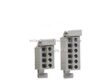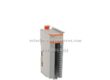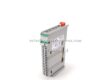
Description
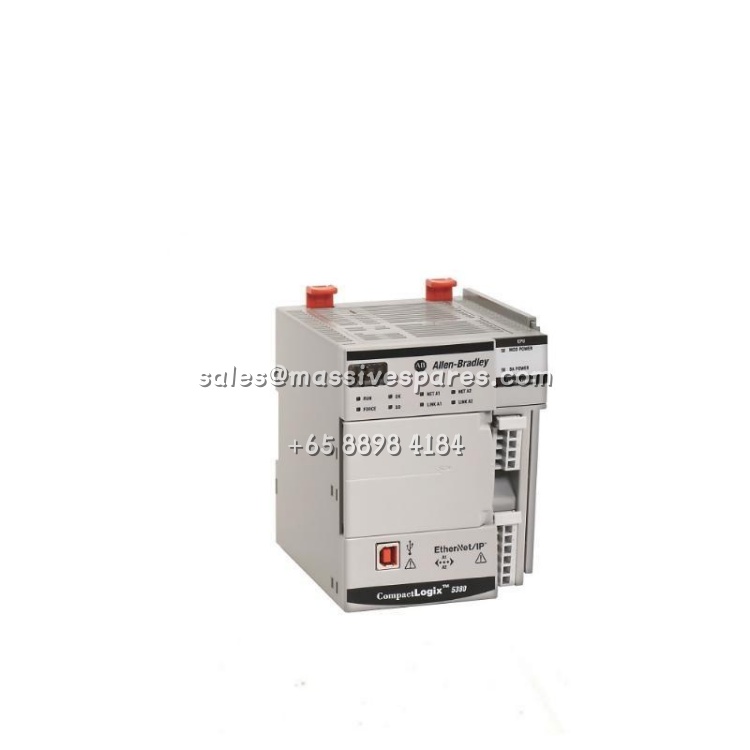
The Allen-Bradley 5069-L320ERM is a CompactLogix 5380 controller with integrated CIP Motion — a quad-core, 2 MB user-memory CPU that runs your ladder, function-block and structured-text logic in the same rack where it closes the position loop on up to eight EtherNet/IP drives.
It is the difference between buying a logic PLC and a separate motion controller and wiring them together, versus one Compact 5000 backplane, one Studio 5000 project and one fault log. The 5069-L320ERM gives machine builders and plant engineers coordinated motion without the panel space, the cross-cable and the “which controller owns the axis” argument.
Application Scenarios
Watch a cartoner at the end of a filling line. The infeed conveyor has to match the filler’s random jitter, the pusher cam has to hit a moving target, and the reject gate has to fire in the same scan window — all while the plant network is hammering the cell with recipe downloads and OEE tags. Put the servos on a dedicated motion card and the logic on a separate PLC, and you spend commissioning week tuning the hand-off between two scan cycles. Put a 5069-L320ERM in the cubicle and the axis objects, the conveyor interlocks and the HMI pop-ups all live in one tag database. The gearing ratio changes in one place; the drive fault and the guard-door interlock show up on the same diagnostics screen.
The second, quieter win is the network split. Port A1 can stay on the machine cell running the Kinetix drives and the local I/O; port A2 faces the site network for the HMI and the historian. In Dual-IP mode that is two separate fault domains. A misconfigured uplink or a broadcast storm from the enterprise side cannot stall the servo update, and a drive-reset storm cannot crawl past the cell boundary. On a line where a two-second hick-up is a thousand rejected cartons, that segregation is a production number, not a networking preference.
Parameter
| Parameter | Value / Description |
|---|---|
| Product Model | 5069-L320ERM — the M is the motion suffix; ER alone means no integrated motion |
| Manufacturer | Allen-Bradley, Rockwell Automation (CompactLogix 5380 family) |
| Product Category | Integrated-motion programmable automation controller (CPU), 5069 Compact form factor |
| User Memory | 2 MB — for logic, tag data, motion objects, recipes and trend buffers. Size the project with online-change headroom, not just the compiled count |
| Processor | Quad-core; 32 tasks, up to 1000 programs per task — the motion thread and the logic thread do not queue behind each other |
| Integrated Motion | 8 CIP drive axes maximum, coordinated (gear, cam, motion profile) over EtherNet/IP. A 9th axis is a project-change rejection, not a warning |
| Total Axis Headroom | Up to 256 axis objects in the architecture, but only 8 are position-looped by this CPU — the rest are references/remotes, so read the manual before you budget a 20-axis line here |
| Local I/O | 16 Compact 5000 (5069) modules on the local backplane — digital, analog, safety, specialty; density is much higher than the old 1769 racks |
| EtherNet/IP Nodes | 40 devices maximum, but only when controller firmware and the Studio 5000 project are v31 or later; v30 silently caps you at 20 regardless of the project setting |
| Ethernet Interfaces | 2 × RJ45, 10/100/1000 Mb/s auto-sensing. Modes: Dual-IP (two networks, two addresses) or Linear/DLR (one logical network, embedded switch / ring resilience) |
| USB | 1 × USB 2.0 Type-B, 12 Mb/s — programming and firmware only; not a field-bus port, not for production traffic |
| Non-Volatile Storage | 1784-SD1 / 1784-SD2 slot, 2 GB card supplied typical, supports up to 32 GB — holds the load image, the project and the firmware bundle for recovery |
| Programming | Studio 5000 Logix Designer, v29.00.00 or later for the -L320ERM; firmware major revision must equal the project’s major revision or the download is refused |
| MOD Power | 18…32 V DC, 450 mA controller demand typical, ~8.5 W dissipation. This powers the CPU; it does not power the field-side I/O |
| SA Power | Separate 0…32 V DC or 0…240 V AC, 47…63 Hz, depending on the terminal-block configuration fitted to the rack — the most commonly mis-wired terminal in a 5380 swap |
| Isolation | 300 V continuous system isolation; the two ENET ports share a common domain, so do not assume galvanic separation between A1 and A2 |
| Supported Topologies | Linear, star, DLR (Device Level Ring) under the Linear/DLR mode; Dual-IP for segmented machine-vs-plant designs |
| Environmental | 0…+60 °C operating (open-type equipment — must live inside a suitable enclosure); storage −40…+85 °C; 5–95 % RH non-condensing; 5 m/s² vibration, 30 g shock per IEC 60068 |
| Mechanical | 143.97 × 98.10 × 136.81 mm (H × W × D), horizontal DIN rail mount; ~0.768 kg (packaged weights vary to ~0.99 kg) |
| Certifications | CE, UL, cUL, KC, RCM, ATEX, IECEx, CCC, Eurasian EAC — relevant when the cabinet is destined for a hazardous-area or marine classification |
| Lifecycle | Active, repairable, 1-year standard warranty; Series letter is read from the product label (SER A/B) and matters for the firmware file you load |
| Safety Note | Not a safety-rated controller. If the axis or the estop needs SIL 2 / PL d, Category 3, the hardware answer is a Compact GuardLogix 5380 (the S2 / MS2 suffix family), not this CPU |