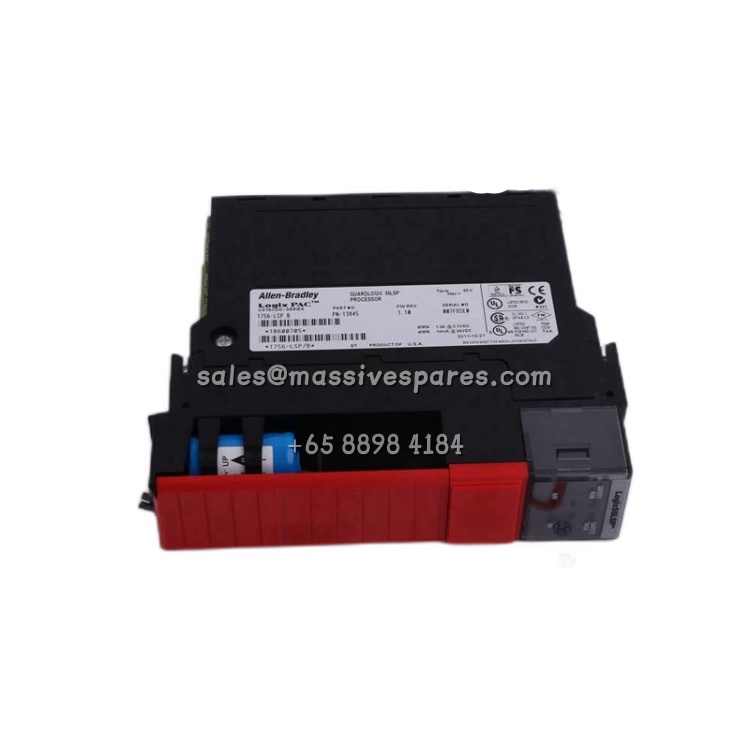
Application Scenarios
On a steel pipe cut-to-length line, the feed roller encoder generates pulse signals that must be precisely counted to control the cutting machine’s action position. Traditional digital input modules cannot accurately capture high-frequency pulse edges, resulting in cumulative errors in cut lengths and frequent adjustments to the production line. After deploying the 1794-VHSC, the encoder’s A/B/Z differential signals are directly connected, and the module counts in quadrature mode, accurately identifying the feed direction and position. When the count value reaches the preset value, the module’s output signal triggers the cutting action, and cut length consistency is significantly improved. For electrical maintenance personnel, the 1794-VHSC‘s on-board diagnostic indicators and status bits can distinguish between signal loss, configuration errors, or hardware faults, reducing the time spent on “blind troubleshooting” of encoder issues.
Parameter
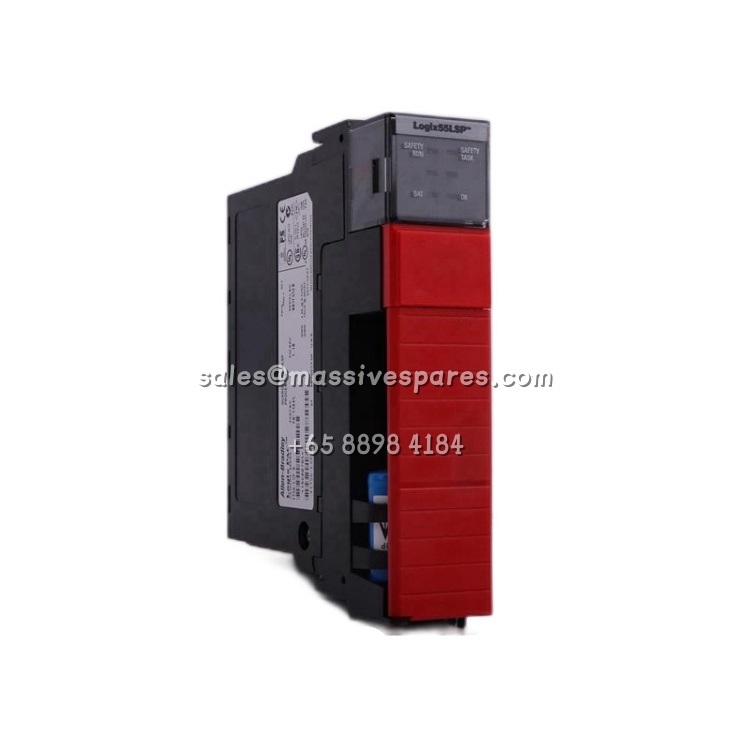
| Main Parameters | Value/Description |
|---|---|
| Product Model | 1794-VHSC |
| Manufacturer | Allen-Bradley / Rockwell Automation |
| Product Category | Flex I/O 2-Channel Very High Speed Counter Module |
| Number of Channels | 2 independent counter channels |
| Input Frequency | 1 MHz (counter/pulse mode); 500 kHz (encoder ×2); 250 kHz (encoder ×4) |
| Input Signal Types | Differential A/A̅, B/B̅, Z/Z̅; supports 5 VDC or 15–24 VDC |
| Outputs | 2 groups, 2 outputs each; 5–7 VDC or 10–31 VDC |
| Operating Modes | Quadrature encoder, pulse/direction, up/down counter, period/rate |
| Backplane Current | 100 mA @ 24 VDC |
| Power Dissipation | 5.375 W (full load 100%) |
| Terminal Base | 1794-TB3G or 1794-TB3GS |
| Isolation | Field side to logic side isolated (via terminal base) |
| Lifecycle Status | Active Mature |
Technical Principles and Innovative Values
- Innovation Point 1: Differential Input Design for Noise Immunity. The 1794-VHSC accepts differential A/A̅, B/B̅, and Z/Z̅ signals rather than single-ended inputs. In industrial environments with variable frequency drives and welding equipment, differential transmission effectively suppresses common-mode interference, ensuring that encoder pulses are not lost or miscounted due to ground potential differences. This is a key advantage over standard digital input modules, which treat A and B signals as independent inputs and cannot reliably decode quadrature phase relationships .
- Innovation Point 2: Multi-Mode Flexibility for Diverse Motion Tasks. The 1794-VHSC supports quadrature (×1/×2/×4), pulse/direction, up/down counting, and period/rate measurement modes. A single module can serve different application requirements—for example, Channel 0 configured for quadrature position feedback on a conveyor, while Channel 1 operates in period/rate mode to measure motor speed. This flexibility reduces the variety of spare modules a plant must stock.
- Innovation Point 3: On-Board Outputs for Local Decision-Making. The 1794-VHSC includes two output groups that can be configured to activate based on counter preset values, comparison windows, or PWM settings . This allows simple “count-and-act” logic to execute locally in the module rather than requiring a round trip to the controller, reducing response latency for applications such as cut-to-length triggering or high-speed sorting gates.
Application Cases and Industry Value
A material handling system integrator encountered position drift issues on a high-speed diverter conveyor. The original setup used a standard Flex I/O digital input module to read a rotary encoder, but at conveyor speeds above 50 m/min, the module’s input filter and scan-time limitations caused missed counts, resulting in products being diverted to the wrong lane. The integrator replaced the input module with a 1794-VHSC and configured Channel 0 in quadrature ×4 mode. The differential encoder signals were connected directly to the module, and the on-board output was configured to trigger the diverter solenoid when the count reached the preset lane position. After commissioning, the diverter’s position accuracy improved to within ±1 pulse, and the missed-count issue was eliminated. The integrator noted that the 1794-VHSC‘s ability to handle the counting locally and fire the output without controller scan delay was “the difference between a working sorter and a pile of misrouted boxes” .