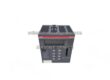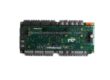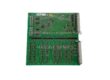
Application Scenarios:
A control room operator reaches for the hard “STOP” pushbutton on the console during a process upset. It is the one input that does not depend on a mouse, a screen, a Windows session or a network — the one command that must work every single time, instantly, regardless of what else has failed. When that button stops responding, the console does not merely lose a convenience; it loses its last line of local, deterministic manual intervention, and the operating crew is left managing an upset through whatever software interface is still alive.
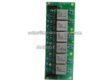
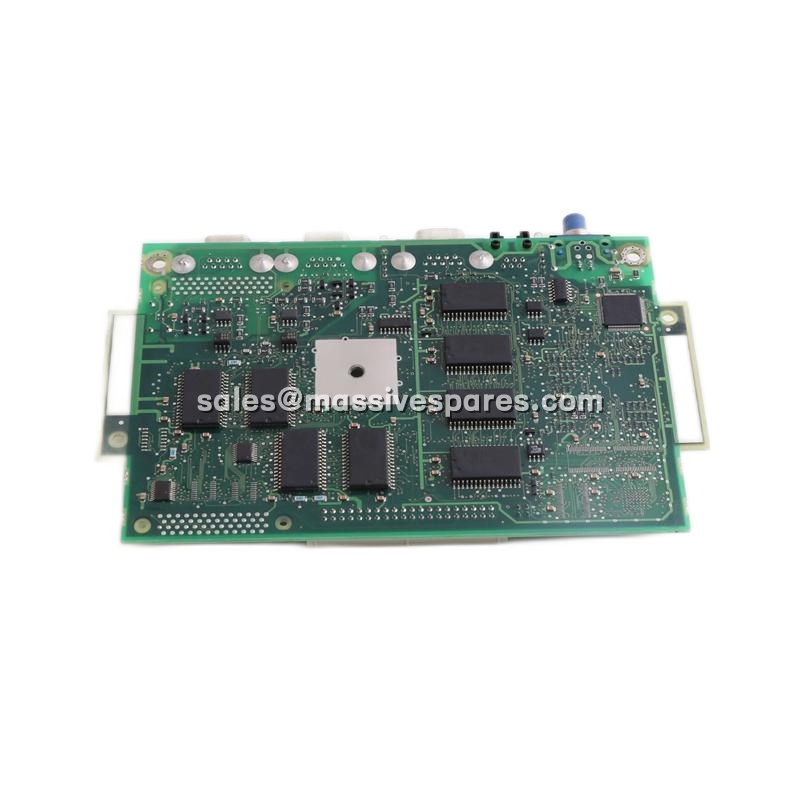
That is the failure the 086351-504 / 086351-004 prevents. It sits behind the console’s hard-button array, continuously scanning the pushbutton contacts and converting each actuation into a serial command the controller understands. Its serialised architecture is the reason a console can carry dozens of buttons and indicators without dozens of individual wires running back to a marshalling cabinet — one board, one multi-pin harness, one serial link.
The second scenario is the maintenance one, and it is where most of the real-world pain sits. A console button that “sometimes doesn’t respond” gets reported as a board failure far more often than it actually is one. The genuinely useful diagnostic discipline here — and the one that saves the most money — is to check the harness continuity, connector seating and mechanical actuation path before condemning the 086351-004. Wiring and connector faults account for a large share of “dead button” complaints, and replacing a healthy board does not fix them. When the board genuinely has failed — worn contacts, no scan output, no LED drive — the 086351-504 restores full local control in a single bench-level swap, without touching the console structure, the controller configuration or the application software.
Parameter:
| Main Parameters | Value/Description |
|---|---|
| Product Model | 086351-504 and 086351-004 (same functional family) |
| Manufacturer | ABB |
| Product Category | Serial pushbutton interface board — printed wiring assembly (PWA, SPB) |
| ABB Catalogue Designation | “PWA, SPB, SERIAL PUSHBUTTON” under HKQCS parts on line |
| Core Function | Scans operator pushbutton inputs, encodes them as serial data to the controller, and drives panel LED status indicators from controller feedback |
| Supply Voltage | 24 V DC typical industrial control supply (verify against the board label on your installed revision) |
| Signal Inputs | Multiple digital pushbutton / switch inputs, matrix-scanned or direct depending on wiring design |
| Communication Interface | Serial interface on the operator console bus — console-specific, not a generic RS-232/RS-485 pinout |
| Indicator Output | Drives console-mounted LED status lamps from controller feedback |
| Net Dimensions | 272 mm (depth/length) × 142 mm (width) × 21 mm (height) |
| Net Weight | 0.19 kg |
| Operating Temperature | 0 °C to +55 °C standard panel ambient; some references cite −20 °C to +60 °C |
| Storage Temperature | −40 °C to +85 °C |
| Humidity | 5% to 95% RH, non-condensing |
| Protection | IP20 — board assembly for installation inside a console or cabinet, not a standalone enclosure |
| Mounting | Internal console mounting plate or dedicated slot; secured to the board mounting frame |
| Country of Origin | Malta (MT) or China (CN), depending on production batch |
| Customs Tariff | HS 85389000 |
| Predecessor / Cross-Reference | 086351-003 superseded by 086351-004; replaced identifiers Y086351-004, Y086351-001, Y086351-003 |
| Compatible Systems | HKQCS operator consoles, ABB Advant OCS, System 800xA, Procontrol P14, AC800M environments |
Technical Principles and Innovative Values:
Innovation Point 1: Serialisation instead of point-to-point wiring.
The 086351-004 converts a whole array of physical pushbuttons into a single serial data stream. Rather than running individual conductors from every button back to a digital input module, the board scans locally and transmits encoded commands over one harness. That is a reduction in console wiring, termination hardware, cabinet space and — most importantly — in the number of individual connections that can loosen or corrode over a twenty-year console life.
Innovation Point 2: Bidirectional operation — commands up, status down.
The 086351-504 does not only read buttons. It also receives controller status and drives the console’s LED indicators, closing the feedback loop at the panel itself. An operator sees lamp confirmation of the command they just issued without needing to look at a screen, which is exactly the behaviour a control room depends on during an upset.
Innovation Point 3: Debounced, filtered scanning for electrically noisy environments.
Mechanical pushbutton contacts bounce, and control rooms and console interiors are electrically hostile places. The board’s scan-and-filter approach resolves each physical actuation into a single valid command, suppressing the chatter and induced noise that would otherwise register as multiple or spurious operations. In a start/stop context, suppressing a false trigger is not a refinement — it is the whole point.
Innovation Point 4: An engineered revision chain rather than arbitrary part numbers.
The progression from 086351-003 to 086351-004, with the earlier Y086351-001 / Y086351-003 / Y086351-004 identifiers consolidated into it, is ABB managing a long-lived spare part through its lifecycle. For a maintenance organisation this is valuable: it means the replacement path is documented and traceable, rather than a guessing game across vendor listings.
Innovation Point 5: Compact, low-mass board engineered for console interiors.
At 272 × 142 × 21 mm and 0.19 kg, the 086351-504 fits the shallow internal spaces of an operator desk without structural modification. Console interiors are constrained by ergonomics, cable management and cooling; a board that drops into the existing mounting footprint is the difference between a one-hour swap and a console rebuild.
Innovation Point 6: Console-native design with no driver or configuration layer.
The 086351-004 is not a USB or PS/2 peripheral and does not need driver installation, address assignment or software configuration. It is a purpose-built interface on the console bus, which means replacement is a physical and electrical action, not an IT one — a meaningful advantage in a control room where change control on operator workstations is expensive and slow.