Application Scenarios
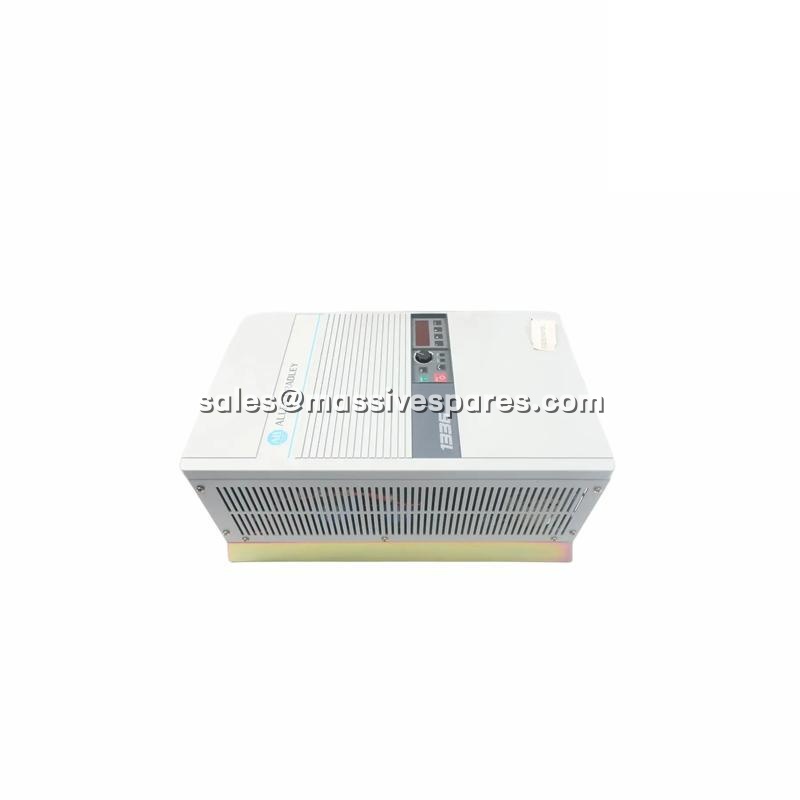
A bottling plant was running its main conveyor on a fixed-speed motor with a mechanical variator. The variator was adjusted by hand at the start of each shift, belts slipped in warm weather, and product spacing at the fillers was never quite right. Replacing the variator with a 1336-B005-EAD-FA2-L1-S1 changed the nature of the problem: speed became a parameter in the PLC instead of a mechanical setting. The two independent acceleration and deceleration ramps let the line start gently when the bottles were empty and stop more firmly when the line was full, which removed the worst of the container tipping at transfer points. Output frequency could then be tied to the filler demand signal, so the conveyor tracked production rather than being over-driven all day.
The second part of that installation involved the drive’s other option — the factory-installed serial port. Local operators used the FA2 keypad for day-to-day speed changes, but maintenance needed access to all 90 parameters for diagnostics, not the 71 exposed on the keypad. Connecting the S1 serial interface to the plant’s serial network gave the engineering workstation full visibility without giving every operator full authority. That separation — local convenience, remote depth — is what made the drive acceptable to both the production and maintenance teams.
Parameter
| Main Parameters | Value / Description |
|---|---|
| Product Model | 1336-B005-EAD-FA2-L1-S1 |
| Manufacturer | Rockwell Automation (Allen-Bradley brand) |
| Product Category | Adjustable Frequency AC Drive (VFD) |
| Product Line | Bulletin 1336, 1336 PLUS family |
| Nominal Output Power | 5 HP / 3.7 kW (constant torque) |
| Rated Output Current | 9.6 A |
| Apparent Power Output | 6.3 kVA at 380 V / 6.9 kVA at 415 V / 7.6 kVA at 460 V |
| Input Voltage | 380 / 415 / 460 V AC |
| Input Phases / Frequency | 3-phase, 50 / 60 Hz |
| Control Method | Volts per Hertz (V/Hz), sine-coded PWM output waveform |
| Overload Capability | 180 % of rated current |
| Output Voltage Range | 0 to applied input voltage, adjustable |
| Enclosure Rating | NEMA Type 1 (IP20) |
| Ambient Operating Temperature | 0 to +40 °C |
| Storage Temperature | -40 to +85 °C |
| Mechanical Shock Rating | 15 G for 11 ms |
| Approximate Weight | 15.9 kg |
| Approximate Dimensions | 283 × 477 × 223 mm |
| Standards Compliance | CE, UL, CSA |
| Operator Interface | FA2 factory option control panel (local) |
| Communication | S1 factory-installed serial port connector |
| Product Lifecycle | Discontinued / obsolete |
Technical Principles and Innovative Values
- Voltage and frequency change together. Innovation Point 1: the drive varies output frequency to set motor speed and simultaneously adjusts output voltage to keep the V/Hz ratio correct. If only frequency changed, flux would collapse at low speed and the motor would lose torque; if voltage were held high, core saturation and overheating would follow. The relationship is automatic and is the reason the drive can deliver full rated torque across the speed range without an external controller.
- Sine-coded PWM instead of a stepped approximation. Innovation Point 2: the output waveform is generated by pulse-width modulation shaped toward a sine pattern, which reduces harmonic distortion at the motor terminals. A cleaner waveform means less additional heating in the motor windings for a given torque, so the same motor can often run closer to its nameplate rating than it could on a rougher output.
- 180 % overload capacity built into a 5 HP frame. Innovation Point 3: the overload rating exists for the breakaway condition — a loaded conveyor, a full hopper under an extractor, or a pump starting against a closed valve. The drive carries that short-duration current without tripping, then returns to rated load. Oversizing the drive for the entire duty cycle is therefore unnecessary.
- Two acceleration and deceleration profiles, not one. Innovation Point 4: the drive stores two independently programmable ramp times and allows the active ramp to be selected by a digital input or a serial command. A conveyor can use a long, gentle ramp during a product changeover and a shorter ramp during steady running, without rewriting parameters or stopping the drive.
- Two seconds of ride-through on a supply interruption. Innovation Point 5: the DC bus holds enough energy to keep the output alive through a momentary loss of line voltage, which is long enough to clear most transfer-switch and utility flicker events. The protected equipment never sees the disturbance as a stop, so upstream and downstream machines do not sequence down and back up again.
- Surge protection is placed where surges actually arrive. Innovation Point 6: metal oxide varistors are connected line-to-line and line-to-ground on the input, suppressing both phase-to-phase and ground-transient events. The drive also detects voltage and current imbalance that can indicate a developing ground fault, rather than waiting for a full fault to declare itself.
- Local control and full parameter access are deliberately separated. Innovation Point 7: the FA2 panel gives access to roughly 71 of the 90 user parameters — enough for normal operation and commissioning. The S1 serial port unlocks all 90 parameters plus diagnostics. An operator can change speed locally; a technician can see what is happening inside the drive remotely. That split is a genuine security and maintainability feature, not an inconvenience.
- Fast-acting current limiting protects the motor and the drive simultaneously. Innovation Point 8: when load current rises, the drive limits the output rather than allowing an uncontrolled overcurrent that would trip the upstream protection or damage the motor windings. The limit works in concert with the 180 % overload capability, so normal process upsets are handled and only genuine faults take the drive offline.