Application Scenarios
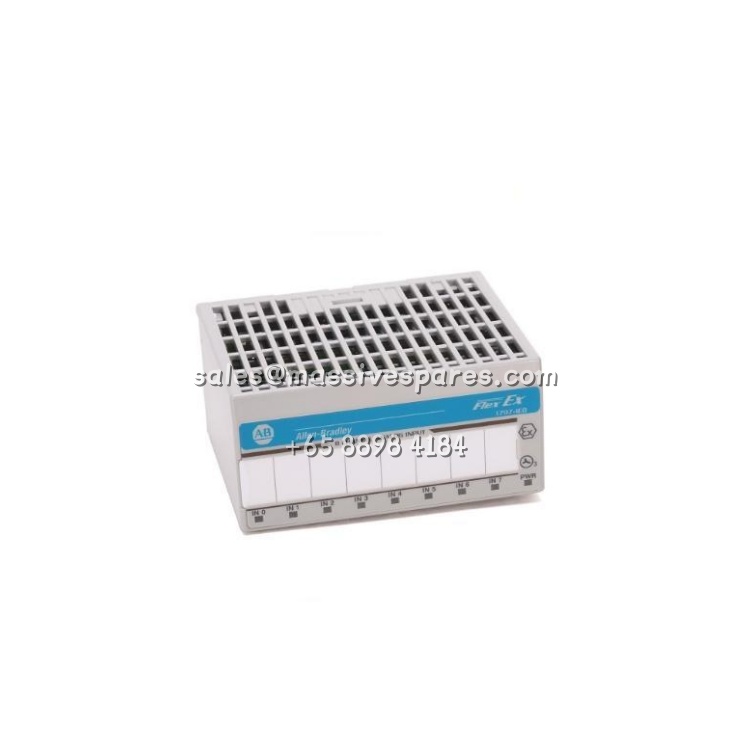
An ethylene cracking unit at a petrochemical plant requires continuous monitoring of furnace tube skin temperatures within a Zone 1 hazardous area to prevent localized overheating and tube failure. Conventional approaches route thermocouple signals through long intrinsic safety barriers into a safe-area cabinet, introducing wiring complexity and signal degradation risk. By installing the 1797-IRT8 in a FLEX Ex remote station near the furnace, the plant lands eight Type K thermocouples directly onto the module. When a thermocouple breaks due to tube vibration, the 1797-IRT8 channel fault alarm triggers immediately and forces the data value to maximum, allowing operators to identify the exact channel from the control room without sending personnel into the hazardous zone for manual troubleshooting. This approach compresses temperature monitoring response from hours to seconds while eliminating personnel exposure to explosive environments.
Parameter
| Main Parameters | Value / Description |
|---|---|
| Product Model | 1797-IRT8 |
| Manufacturer | Allen-Bradley / Rockwell Automation |
| Product Category | FLEX Ex Intrinsically Safe Analog Input Module |
| Input Channels | 8 channels (grouped as 0–3 and 4–7, independently configurable) |
| Supported Sensors | Thermocouple: B, E, J, K, N, R, S, T, TXK/XK(L), mV; RTD: Pt 100/200/3916, Ni 100/120/200/672, Cu 10 |
| Input Range | Thermocouple: -40 to 100 mV; RTD: 0 to 500 Ω |
| Cold Junction Compensation | External (CJC sensor), Internal (fixed reference 0–70°C), No Compensation, Differential |
| Wire-Off Detection | Per-channel enable; data forced to maximum on fault |
| Input Filter Cutoff | Hardware filter plus selectable 25 ms / 100 ms / 250 ms / 500 ms / 1 s / 2 s / 5 s |
| Intrinsic Safety Ratings | Ui < 5.8 V dc, Ii < 400 mA, Ci < 1.35 µF |
| Field-Side Power Consumption | 1.6 W at 24 V |
| Operating Temperature | -20°C to 60°C |
| Dimensions (H×W×D) | 46 × 94 × 75 mm |
| Compatible Terminal Bases | 1797-TB3 or 1797-TB3S |
| Hazardous Area Certifications | ATEX, IECEx, cULus (Zone 1/21) |
Technical Principles and Innovative Values
- Intrinsically Safe Energy-Limiting Architecture: The 1797-IRT8 circuitry restricts energy delivered to the hazardous area within intrinsic safety parameters (Ui < 5.8 V, Ii < 400 mA). Even under internal fault conditions, the field terminals cannot release sufficient energy to ignite explosive gases. This allows thermocouples to be wired directly into the hazardous zone, eliminating the per-channel intrinsic safety barriers required by conventional architectures and substantially simplifying system design.
- Balanced Group Configuration with Per-Channel Diagnostics: The module divides its 8 channels into two groups (0–3 and 4–7), each sharing sensor type and mode settings, while every channel retains independent overrange, underrange, and wire-off alarm bits. This design strikes a practical balance between configuration flexibility and diagnostic granularity: engineers avoid writing individual configuration words for each channel, yet no single sensor failure is buried in a group-level alarm.
- Hazardous Environment Endurance: The module is tested to ISA-S71.04-1985 G3 severity for corrosive gases, enabling stable operation in environments containing hydrogen sulfide, sulfur dioxide, and similar industrial corrosives. For petrochemical and chemical applications, this certification means long-term reliability does not depend on additional air purging or sealed enclosures.