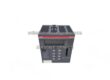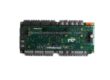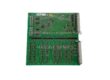
Application Scenarios:
A cement plant runs a 6 kV PowerFlex 7000 drive on a kiln induced-draft fan. The fan cannot stop without stopping the kiln, and a kiln stop is a multi-day event with refractory thermal-cycling consequences. One morning the drive trips and the HMI reports a loss of motor voltage feedback — a communication failure between the motor control section and the voltage feedback board.
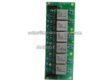
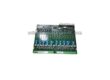
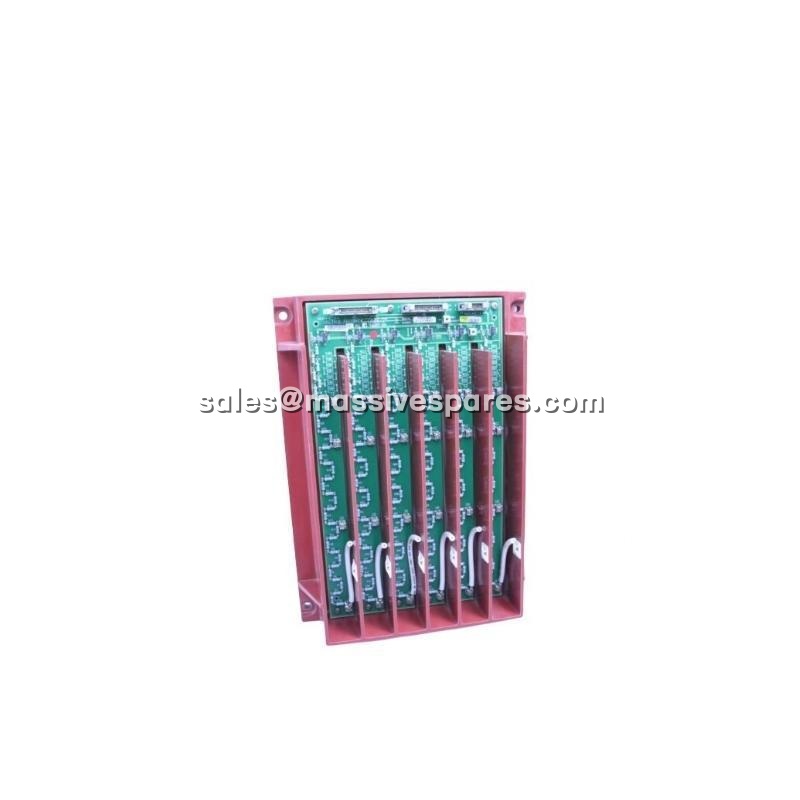
The failure mode is instructive, because the underlying cause is rarely the board itself. In a medium-voltage drive the voltage feedback path runs from the high-power sensing point, through the attenuation and isolation stage on 81000-199-53-R, across a fiber-optic link, and into the control processor. A fault on that path can originate in a contaminated fiber connector, a cable bent past its minimum radius, a degraded 24 VDC control supply, or an actual sensing-channel failure. The experienced technician does not simply swap the board: the drive event log is read first, the fiber connectors are cleaned and reseated, control power is verified, and the sensing connections are inspected. Only when those are clean does the board itself come under suspicion — and for a plant holding 81000-199-53-R as a planned spare, that decision point is reached in an hour rather than after a multi-week OEM lead time.
The same dependency exists across the PowerFlex 7000 installed base: mine conveyor and hoist drives, slurry and booster pumps, boiler feed and cooling water pumps, refiner drives in pulp and paper, rolling mill main drives in steel, and compressor drives on gas pipelines and offshore platforms. In every one of them the board is small relative to the drive, and the consequence of not having one is large relative to its cost.
Parameter:
| Parameter | Value / Description |
|---|---|
| Product Model | 81000-199-53-R |
| Manufacturer | Allen-Bradley / Rockwell Automation (USA) |
| Product Category | Interface board — voltage feedback / sensing assembly for a medium-voltage variable speed drive |
| Drive Family | PowerFlex 7000 medium-voltage AC drives; also identified as SENSING ASSY VSD 150-CC-001, and cross-referenced against 80190-series drive assemblies |
| Primary Function | Voltage detection and feedback: captures motor, line and DC bus voltages in the power section, attenuates and isolates them, and delivers low-voltage feedback to the drive control system for regulation, protection and diagnostics |
| Input Stage | Analog differential voltage input, ±10 V DC class; input impedance approximately 1 MΩ; continuous overvoltage protection to ±15 V |
| Signal Conversion | Precision divider attenuation feeding a 16-bit conversion path — roughly 0.15 mV resolution across the input span, which is what makes the feedback usable for closed-loop regulation rather than just alarming |
| Isolation | Galvanic isolation rated 1500 V AC between the high-voltage sensing side and the low-voltage control side — the barrier that stops power-stage transients reaching the controller |
| Output / Communications | Buffered 0–10 V DC feedback signal; fiber-optic link to the High Power Fiber Optic Interface board (ports J4 / J5); bus communication to the motor control board |
| Control Power | 24 V DC (±10%), approximately 50 mA; backplane current approximately 410 mA — a stable control supply is a precondition for reliable feedback |
| Environmental | Operating 0 °C to +55 °C; storage –40 °C to +85 °C; humidity 5–95% non-condensing; ruggedized multi-layer PCB for drive cabinet mounting |
| Physical & Lifecycle | Chassis-mounted board assembly, shipping class approximately 3.4 kg in the insulated enclosure; discontinued by the manufacturer, supplied as new, new-surplus or remanufactured stock |
Technical Principles and Innovative Values:
- Innovation Point 1: Measurement across a 1500 V isolation barrier. 81000-199-53-R sits electrically between two worlds — the medium-voltage power section and the low-voltage control electronics. Its high-impedance input and precision divider attenuate the sensed voltage into a safe range, and the galvanically isolated signal path means a switching transient or a fault current on the power side cannot propagate into the controller. In a drive whose power stage switches kilovolts, that barrier is what makes the measurement possible at all.
- Innovation Point 2: Fiber-optic signalling instead of copper. The board talks to the High Power Fiber Optic Interface board over fiber rather than copper. Fiber is immune to the electromagnetic interference that medium-voltage switching generates by definition, and it provides galvanic separation as a physical property rather than as a circuit design. The practical payoff is timing integrity: gate firing and feedback signals arrive synchronized, which protects the power semiconductors from the phase unbalance and cross-conduction that desynchronized signalling causes.
- Innovation Point 3: Diagnosable failure, not silent drift. When the feedback path fails, 81000-199-53-R does not degrade quietly — the drive raises a specific loss-of-feedback condition naming the communication failure between motor control and the voltage feedback board. For maintenance that is the difference between hunting an intermittent process problem and being handed a directed fault: read the event log, check the fiber path and control power, then decide on the board.
- Innovation Point 4: Revision-level engineering discipline. The -R suffix marks a revised production release, and revision matching is not optional in this platform. Power stage, control board and feedback board must be at compatible revision levels, because signal scaling and interface behaviour are defined at the assembly level. Specifying 81000-199-53-R correctly — rather than “a voltage feedback board” — is what prevents the frustrating outcome of a new board that installs mechanically and still does not measure correctly.
- Innovation Point 5: Continuity for a discontinued platform. PowerFlex 7000 drives were built for twenty-to-thirty-year service lives, and many are well into that window with no direct OEM replacement path. 81000-199-53-R is the lever that keeps them running: a single stocked board converts a potentially weeks-long outage into a same-shift recovery, which is why it belongs on the critical spares list of every plant still operating these drives.