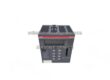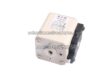
Product Overview
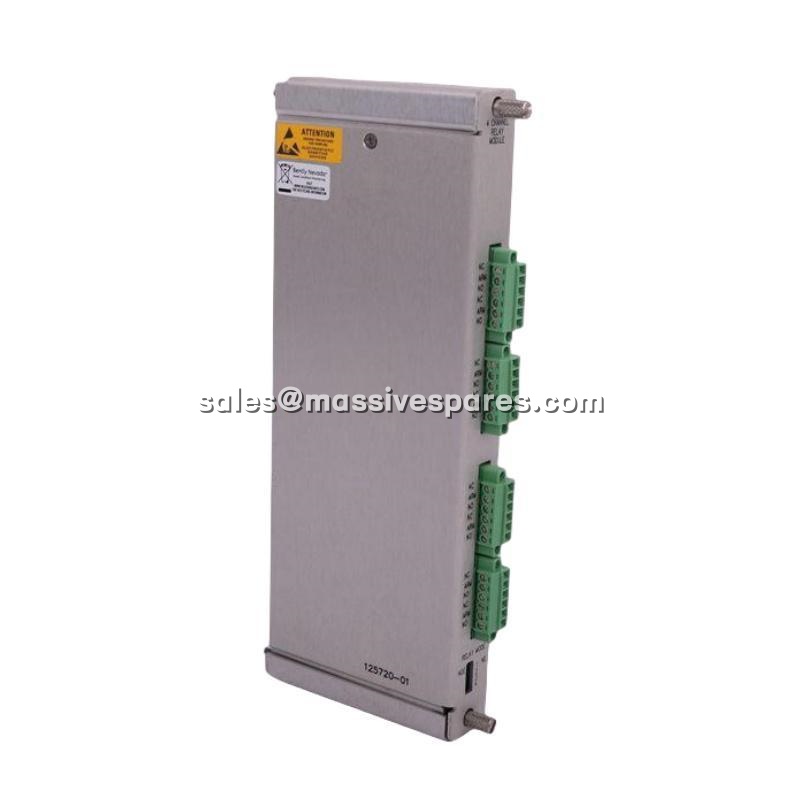
The Bently Nevada 24765-02-00 is a DC-powered Case Expansion Transducer Assembly, a direct-current Linear Variable Differential Transformer (DC-LVDT) built for Turbine Supervisory Instrumentation (TSI) on large steam turbines, gas turbines and heavy industrial drivers. Its job is to answer one deceptively simple question with high precision: how far has the machine casing grown away from its foundation as it heats from cold iron to full-load temperature? The Bently Nevada 24765-02-00 answers that question by converting the axial travel of a rod — mechanically coupled to the machine casing — into a conditioned DC voltage that a 3300 or 3500 series monitor can display, trend and alarm on.
Decoding the part number explains exactly what is being supplied. The 24765 base is the DC LVDT case expansion family; the -02 linear range option specifies a 50.8 mm (2.00 in) total linear range, corresponding to roughly ±25.4 mm about the electrical null; and the -00 spring option indicates the assembly is supplied without spring return, meaning the rod must be rigidly coupled to the sliding foot or casing so that it faithfully follows movement in both directions. Electrically, the Bently Nevada 24765-02-00 runs from +24 Vdc with at least 30 mA of supply current, delivers a nominal scale factor of 0.404 V/mm (10.25 V/in), and holds a −3 dB frequency response of 15 Hz — comfortably faster than any real thermal growth transient.
In practice this measurement is a start-up parameter above all. A casing and its rotor must grow at nearly the same rate; if they diverge, rotating and stationary parts can rub, and if one sliding foot jams, the casing can distort. For that reason Bently Nevada recommends a dual transducer arrangement, and the Bently Nevada 24765-02-00 is routinely installed in pairs, one per side, feeding a 3500/45 Position Monitor configured to alarm on differential case expansion.
Technical Specifications
| Parameter Name | Parameter Value |
|---|---|
| Product Model | 24765-02-00 |
| Manufacturer | Bently Nevada (Baker Hughes) |
| Product Type | Case Expansion Transducer Assembly, DC LVDT |
| Ordering Code Breakdown | 24765 base; -02 = 50.8 mm linear range; -00 = without spring return |
| Measurement Principle | Linear Variable Differential Transformer (LVDT) in weatherproof enclosure |
| Input Power | +24 Vdc, 30 mA minimum |
| Scale Factor | 0.404 V/mm (10.25 V/in) nominal |
| Linear Range | 50.8 mm (2.00 in) total, approximately ±25.4 mm about null |
| Output Impedance | 7 kΩ nominal |
| Minimum Load Resistance | 100 kΩ |
| Output Ripple | Less than 1% of full scale |
| Linearity | ±0.5% of full range |
| Stability | 0.125% of full scale |
| Scale Factor Temperature Coefficient | 0.07%/°C (0.04%/°F) |
| Frequency Response | −3 dB at 15 Hz |
| Operating Temperature | −18 °C to +71 °C (0 °F to +160 °F) |
| Storage Temperature | −54 °C to +93 °C (−65 °F to +200 °F) |
| Shock / Vibration | 250 g for 11 ms / 10 g at 0 to 2 kHz |
| Construction | Series 400 magnetic stainless steel body, laminated glass epoxy coil housing |
| Lead Wire | 25 AWG stranded copper, Teflon insulated, 31 cm (12 in) |
| Mechanical Dimensions (H × W × L) | 88.9 mm × 117 mm × 241 mm (3.50 × 4.60 × 9.50 in) |
| Thread Specification | 6-40 UNF-2B core end; 1/4-20 UNC-2A machine end |
| Weight | Approximately 2.3 kg (5.0 lb) |
| Compatible Monitors | Bently Nevada 3300 series and 3500/45 Position Monitor |
| EMC Compliance | EN 61000-6-2 immunity, EN 61000-6-4 emissions |
Main Features and Advantages
DC operation removes an entire layer of instrumentation: Traditional LVDT systems require external AC excitation and a separate demodulator card to turn an AC ratio into a usable position signal. The Bently Nevada 24765-02-00 integrates that conditioning internally, accepting +24 Vdc and outputting a clean, low-impedance DC voltage proportional to displacement. For the instrument technician this means fewer devices in the loop, fewer calibration steps, no excitation amplitude to trim, and a signal that travels to the monitor rack without an intermediary whose drift becomes the transducer’s drift.
Scale factor matched to a real turbine stroke: At 0.404 V/mm, the Bently Nevada 24765-02-00 produces roughly 10 volts of output across a one-inch travel, a sensitivity that resolves the small differential movements that matter most during the early part of a start-up — when the casing is first moving off its cold position and an asymmetry between left and right sliding feet is easiest to miss and most damaging to ignore. The 50.8 mm full span is generous enough to cover the complete cold-to-hot growth of mid and large casings without the transducer ever leaving its linear region.
Accuracy that survives the turbine deck: The Bently Nevada 24765-02-00 holds ±0.5% full-range linearity and 0.125% full-scale stability, with a scale factor temperature coefficient of only 0.07%/°C. On a turbine deck where ambient temperature swings with load and season, that last figure is what separates a sensor whose alarm setpoints stay trustworthy from one that must be re-verified every outage. Output ripple below 1% of full scale keeps the signal quiet enough for meaningful trending rather than just alarming.
Weatherproof construction for the mounting location it actually gets: Case expansion transducers are mounted on the foundation, frequently at the opposite end from where the casing is anchored, which means oil mist, humidity, washdown water and thermal cycling. The Bently Nevada 24765-02-00 houses its LVDT in a protective weatherproof enclosure built from series 400 magnetic stainless steel, and the unit is rated for 250 g shock and 10 g vibration, so it tolerates the environment instead of requiring a shelter to be built around it.
No spring return, by design: The -00 option on the Bently Nevada 24765-02-00 means there is no internal spring biasing the rod. With a rigid mechanical coupling to the sliding foot or casing, the rod follows movement in both directions without spring tension fighting the measurement or introducing a preload that varies with stroke position. For installations where the machine relationship demands a spring-biased rod, the -01 variant exists — but for rigidly coupled bidirectional service, -00 is the correct and cleaner choice.