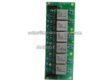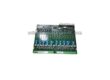
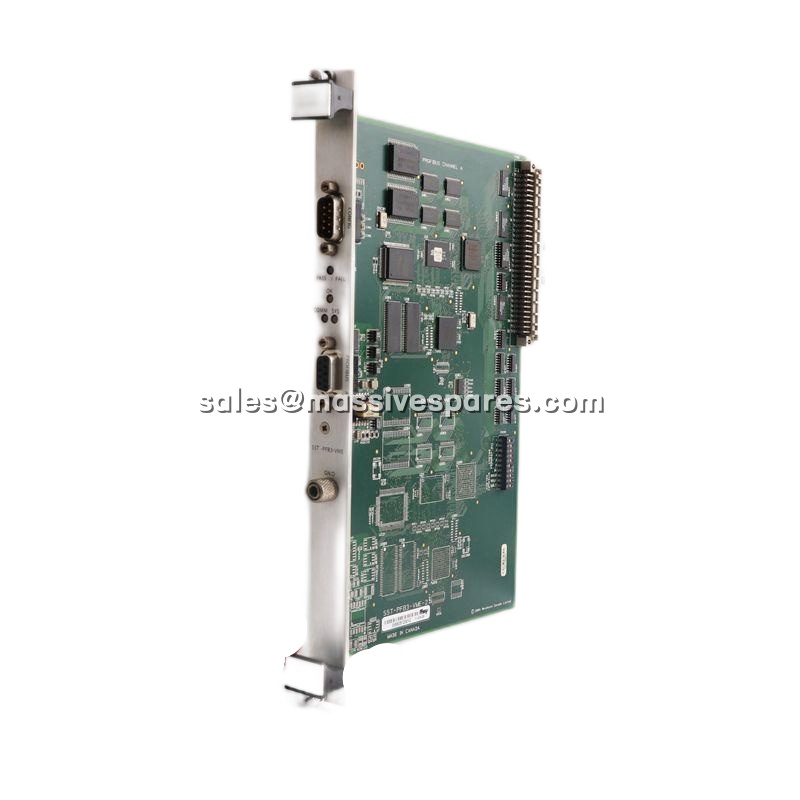
Product Overview
The FANUC A16B-1000-0220 is a DC Dual Axis Control Board — a dedicated motion-control printed circuit board belonging to FANUC’s classic A16B-1000 series of CNC system electronics. In its basic definition, the FANUC A16B-1000-0220 is the two-axis servo-control engine within a FANUC numerical-control architecture: it receives command trajectories from the CNC main processor, executes the real-time position and velocity loops for two independent axes, and drives the servo amplifier stages that ultimately position the machine’s axes. In simpler terms, it is the hardware that turns a programmed toolpath into precisely coordinated motion of two machine axes.
The A16B-1000 series traces its lineage to the FANUC 3T/M, F, and F Mate TC control families — the generation of compact, modular CNC systems that established FANUC’s dominance in machine-tool control through the 1980s and 1990s and remain in productive service in large installed bases worldwide. The FANUC A16B-1000-0220 fits into this architecture as an add-on control PCB, working alongside the system master board, axis control cards, I/O modules, and servo amplifier units. Its dual-axis capability means a single board manages two channels of servo control — for example, the X and Z axes of a lathe, or two axes of a machining center — making efficient use of the limited card-cage real estate that characterizes these legacy systems.
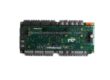
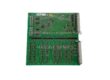
Physically, the FANUC A16B-1000-0220 is a multi-layer printed circuit board populated with logic ICs, DACs, timing and pulse-generator circuitry, edge connectors, and I/O headers. It operates from a 24 V DC control supply and is designed for panel/card-cage mounting inside the CNC cabinet. As a member of the A16B series, it follows FANUC’s disciplined modular philosophy: boards can be identified, exchanged, and tested as discrete units, which is exactly what keeps decades-old CNC systems serviceable today. For machine shops, contract manufacturers, and maintenance teams managing legacy FANUC equipment, a verified ANUC -0220 in the spare-parts inventory is often the key to recovering an axis fault without replacing the entire control — preserving the substantial embedded investment in machine mechanics, field wiring, and application programs.
Technical Specifications
| Parameter Name | Parameter Value |
|---|---|
| Product Model | ANUC -0220 (also A16B10000220) |
| Manufacturer | FANUC (FANUC Corporation) |
| Product Type | DC Dual Axis Control Board (motion-control PCB) |
| Series | series |
| Control Family | FANUC 3T/M, F, F Mate TC / related legacy CNC families |
| Primary Function | Two-axis (dual-axis) servo / motion control within the CNC |
| Number of Controlled Axes | 2 (dual axis) |
| Supply Voltage | 24 V DC (control / logic supply; typical for A16B-series boards) |
| Compatible Servo Interfaces | FSSB / serial servo interface; compatible with αi / βi series servo motors and amplifiers |
| Control Architecture | Position loop, velocity loop, and pulse-generation per axis |
| Processor | Onboard motion-control microprocessor (speed varies by revision; see Accuracy Note) |
| Memory | Onboard program/data memory (capacity revision-dependent) |
| I/O Channels | Digital inputs and outputs for axis control and interlocks (counts revision-dependent) |
| Communication | FSSB (Fiber Serial Servo Bus); MDI/CRT and serial spindle interfaces on related boards |
| Connectors | Card-edge and pin-header (per A16B-1000 card-cage standard) |
| Mounting | CNC cabinet card cage / panel mount |
| Operating Temperature | 0 °C to +55 °C (typical industrial; confirm per revision) |
| Storage Temperature | −20 °C to +85 °C |
| Humidity | 5 % to 95 % RH, non-condensing |
| Dimensions (approx.) | 150 × 100 × 30 mm (representative; verify against physical board) |
| Weight (approx.) | 0.5 kg |
| Country of Origin | Japan (batches also sourced from Germany / USA production; origin is non-deterministic) |
Main Features and Advantages
True two-axis control in one board. The central capability of the ANUC is its management of two independent servo axes from a single, compact PCB. By integrating both position and velocity-loop processing for two channels, the board reduces card-cage slot count and simplifies the control architecture — an important efficiency in the dense, modular cabinets of the 3T/M, F, and F Mate TC families. For a two-axis lathe or a dedicated machining operation, this often means one board handles the complete servo-control requirement.
Seamless fit within the A16B-1000 architecture. Because the ANUC is a standard member of the A16B-1000 series, it integrates without modification to the card cage, backplane, or cabling. The edge connectors, pin assignments, and mechanical mounting follow the established FANUC form factor, allowing a qualified technician to replace a failed board directly. This drop-in compatibility is the board’s principal practical value: it turns a potentially catastrophic axis failure into a manageable board-swap procedure.
Stable 24 V DC logic operation. The board operates from the CNC system’s standard 24 V DC control supply, drawing its logic power from the same regulated source that feeds the rest of the A16B card set. This commonality simplifies power distribution and means the ANUC does not require a separate, dedicated converter — one less point of failure and one less item to source.
Compatibility with the FANUC servo ecosystem. Through the FSSB / serial servo interface and compatibility with αi / βi series servo motors and amplifiers, the ANUC fits naturally into the broader FANUC motion-control chain. This compatibility extends to spindle control and PMC (programmable machine control) integration, allowing the axis board to participate in coordinated multi-axis operations rather than functioning as an isolated component.
Industrial-grade construction for the cabinet environment. Built on a multi-layer PCB with robust logic ICs, pulse-generator circuitry, and controlled-impedance signal paths, the board is engineered for the electrical noise, temperature cycling, and vibration of a machine-tool cabinet. Its conformal-sensitive component selection and disciplined layout support long-term stable operation — the reason so many A16B-series boards remain functional decades after manufacture.
Lifecycle continuity for legacy assets. Perhaps the most important advantage of the ANUC is what it represents strategically: a targeted, economical repair path for a CNC system that is otherwise still mechanically and application-sound. Rather than undertaking a full control retrofit — with all the rewiring, re-parameterization, and production-loss that entails — a verified replacement board can restore axis function in hours. For shops running proven parts programs on mature machines, this preserves both capability and capital.