Technical Specifications
| Parameter | Value |
|---|---|
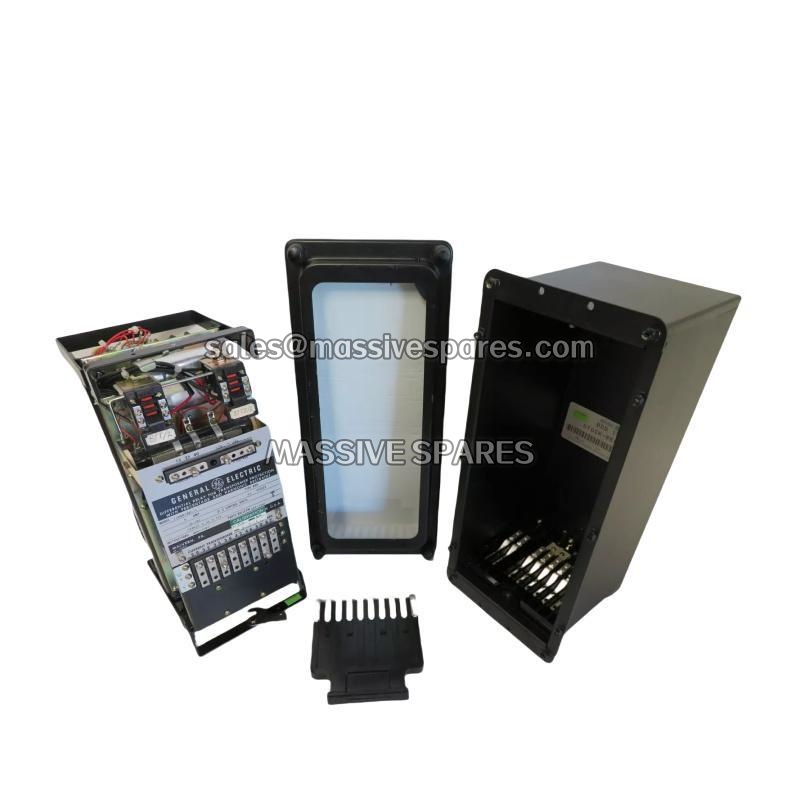
| Model number | 12BDD15B11A |
| Relay type | Type BDD15B — Transformer Differential with Percentage & Harmonic Restraint |
| Protective function | ANSI 87T (percentage differential + 2nd-harmonic restraint + instantaneous) |
| Rated CT secondary current | 5 A |
| Rated frequency | 60 Hz (50 Hz variants exist) |
| Control / trip voltage | 125 or 250 V DC |
| CT ratio taps | 2.9 – 8.7 A |
| Minimum pickup (zero restraint) | 0.3 × tap |
| Percentage slope taps | 15 % / 25 % / 40 % (front-panel selectable) |
| Instantaneous (high-set) unit | 8 × tap |
| Number of restraint circuits | 2 (for two-winding transformers) |
| Harmonic restraint | 2nd harmonic (100 Hz on a 60 Hz system) |
| Output contacts | 2 N.O. (Form “B”), closing rating 30 A at ≤ 250 V |
| Operating time (internal fault) | ≤ 20 ms |
| Short-time thermal rating | 220 A for 1 s (I²t = 48 400) |
| Burden (operating circuit, 5 A, 60 Hz) | ≈ 2.9 VA / 0.128 Ω |
| Burden (restraint circuit, 5 A, 60 Hz) | ≈ 3.2 VA / 0.052 Ω |
| Case | GE drawout panel-mount case |
| Approximate weight | ≈ 10 – 11 kg net |
| Authoritative documentation | GEH-2057 (BDD15B & BDD16B instruction book); GEI-98349C supplement |
Working Principle
- Percentage (slope) restraint — the operating coil sees the *differential* current (vector difference of the CT secondaries), while the restraint coils see the *through* current. On external faults or through-load the restraint dominates, so CT errors and saturation cannot force a trip; on internal faults the differential current exceeds the slope threshold and the polarized operating unit closes its trip contacts in under 20 ms.
- Second-harmonic restraint — magnetizing inrush produced a highly distorted, harmonic-rich waveform, whereas genuine fault current is essentially fundamental-frequency. The BDD uses internal electric filters to separate the harmonic content from the fundamental and routes the harmonic component into a restraining coil, so energizing a transformer does not cause a false trip while true internal faults still operate at fundamental speed. GE’s own GEH-1816 instruction book documents the rationale: inrush waves contain “a considerable amount” of harmonics, while fault waves contain “only a very small percentage.”
- Instantaneous (high-set) unit — set at 8 × tap, this element bypasses the restraint logic to trip fast for heavy internal faults regardless of harmonic content.