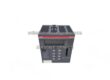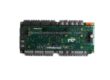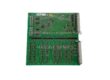
Technical Specifications
| Parameter Name | Parameter Value |
|---|---|
| Product Model | 5441-691 |
| Manufacturer | Woodward |
| Product Type | Relay Field Terminal Module (FTM) |
| Compatible Platforms | MicroNet Simplex, MicroNet Plus, 505 / 505E |
| Relay Channels | 16, socket-mounted |
| Contact Form | DPDT (double-pole, double-throw) |
| Coil Supply | 24 VDC |
| Coil Current | Approximately 80 mA per relay |
| Nominal Input Range | 18–32 VDC |
| Isolation | 1000 Vrms control-to-field separation |
| Field Interface | Low-density discrete cable daisy-chain |
| Safety Feature | Integrated I/O lockout relay |
| Mounting | Panel or cabinet-mounted within MicroNet enclosure |
| Status Indication | LED indication for relay, relay power and control power |
Main Features and Advantages
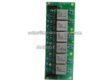
The Woodward 5441-691 is built around the practical realities of turbine-control cabinet design: outputs must be easy to trace, easy to replace and electrically separated from the controller they serve. Its sixteen socket-mounted DPDT relays provide two independent poles per channel, which is particularly useful when a single logic condition must simultaneously drive a field device and report status or confirmation back to the control system. Because each relay plugs into a socket rather than being hard-soldered to the board, a suspected failed channel can be swapped without dismantling the entire module or disturbing unrelated wiring.
A defining feature of the Woodward 5441-691 is its magnetic blow-out arc suppression. When an inductive load such as a solenoid valve, motor starter or contactor coil is de-energized, the resulting arc is actively interrupted and quenched. This reduces contact erosion, limits electrical noise and extends relay service life in applications where outputs switch frequently or must operate reliably over many years of continuous duty.
Integrated I/O lockout capability:
The module incorporates a dedicated I/O lockout relay that can remove field-side power or disable outputs as part of a system-level interlock, emergency shutdown or maintenance isolation scheme. This allows safety and protection logic to be implemented cleanly, without adding a separate external relay bank for every output group.
The 24 VDC coil supply and approximately 80 mA per-relay operating current make the Woodward 5441-691 straightforward to integrate with standard industrial control power. Daisy-chain field interfacing through low-density discrete cables keeps point-to-point wiring manageable, while LED indicators for relay state, relay power and control power give maintenance personnel immediate visual confirmation during commissioning, fault-finding or operational checks. Together, these characteristics make the module a dependable, serviceable choice for high-integrity discrete-output termination.
Application Field
In power generation, the Woodward 5441-691 is typically installed in steam turbine, gas turbine, generator and compressor control panels, where it terminates the discrete outputs that operate lube-oil solenoid valves, starting contactors, field alarms, breaker trip or close circuits and sequencing relays. By physically separating these field circuits from the control processor, the module protects expensive control electronics from the voltage transients and inductive kickbacks commonly generated by industrial switching devices.
Oil and gas applications place the Woodward 5441-691 in compressor stations, pipeline metering skids, drilling packages and engine-driven generator sets. Here its value lies in providing organized, replaceable relay termination for permissive, shutdown and alarm logic where availability is critical and unplanned downtime carries a high cost. Its construction is suited to the vibration, temperature variations and harsh electrical environment encountered in these installations.
Marine propulsion, heavy-duty locomotive control and industrial engine management also make extensive use of the Woodward 5441-691. In these systems it drives fuel shutoff solenoids, starter motors, auxiliary contactors and status/alarm annunciation while maintaining a well-defined interface between the control system and the vehicle or vessel’s higher-voltage auxiliary electrical network. In process plants, the module can serve as a reliable bridge between control logic and pumps, dampers, agitators, emergency shutdown devices and audible or visual alarm circuits. Across all these scenarios, the module solves the same core problem: delivering rugged, isolated, easily maintained discrete-output switching in systems where failure is not an acceptable option.