
Description
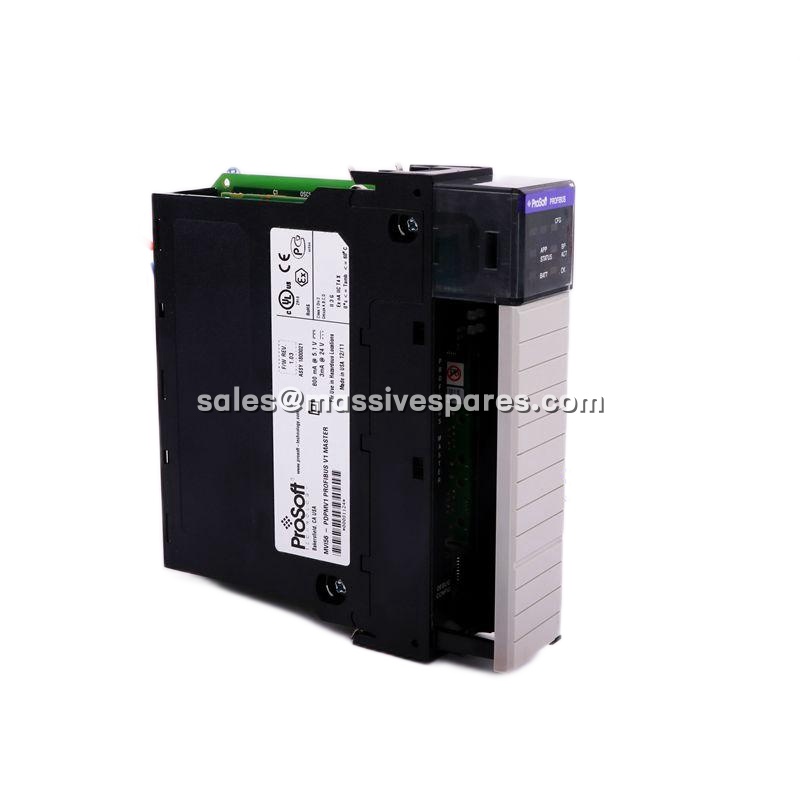
Technical Specifications
The parameters in this table are reference values intended as a structural template only. No manufacturer datasheet or credible parts record could be located for this exact part number, and indexed reseller listings conflict with one another. Do not treat these figures as guaranteed published specifications; confirm against the unit nameplate, the host system documentation or the original procurement record before ordering or commissioning.
| Parameter | Reference value |
|---|---|
| Product Model | A413294 BOR86 |
| Manufacturer | Neles Automation |
| Product Type | Remote I/O communications module |
| Function | Field I/O aggregation and host communications |
| Bus interface | Fieldbus / remote I/O link, protocol to be confirmed |
| Supported I/O | Dependent on connected I/O slice or terminal assembly |
| Supply voltage | To be confirmed from nameplate (typical 24 V DC class) |
| Mounting | DIN rail or proprietary rack, to be confirmed |
| Operating temperature | To be confirmed (industrial grade) |
| Enclosure / protection | To be confirmed against installation environment |
| Diagnostics | Bus status and I/O health indication, model-dependent |
| Status indication | LED per channel or bus state, model-dependent |
| Certification | To be confirmed (CE where applicable) |
Main Features and Advantages
Distributed I/O architecture
The strongest case for the A413294 BOR86 is the move from centralised wiring to distributed I/O. By locating the interface near the process equipment, analogue and discrete signals travel only a short distance in their native form before being digitised and transmitted on a communications link. This shortens the vulnerable analogue run, reduces screening and termination work, and keeps the main cabinet footprint under control even as the plant grows.
Fieldbus consolidation
A remote I/O communications module exists to make many field points addressable through one logical connection. The A413294 BOR86 is therefore most useful where a controller must oversee numerous instruments across a wide area: rather than provisioning individual inputs for every device, the field I/O is grouped locally and presented to the host as a coherent node on the automation network.
Simplified expansion and reconfiguration
Once a remote-I/O structure is in place, adding points generally means extending the local I/O assembly and updating the configuration, not re-cabling to the control room. The A413294 BOR86 supports that model by acting as a stable interface between new field equipment and an existing controller, which is particularly valuable during revamps, skid integration and modular plant builds.
Serviceability and spare-part strategy
In operating plants, module-level replacement is usually faster than redesign. The A413294 BOR86 is suited to a stock-and-swap maintenance policy: keeping a verified spare on the shelf allows a failed communications node to be changed in the time it takes to power down the segment, exchange the module and reload or re-establish the configuration.
Application Field
The A413294 BOR86 belongs in automation architectures where field devices are physically separated from the central control system. Typical settings include process skids, tank farms, pump stations, compressor houses and extended conveyor or material-handling installations, where grouping I/O at the equipment and linking it back over a communications path is more practical than running every conductor to a central marshalling area. In these applications the module reduces installed cable length, limits exposure to electromagnetic interference on long analogue runs and makes fault tracing easier because the communications status is visible at the field node.
Within a process plant, the is relevant wherever valves, actuators, limit switches, transmitters and local panels must be supervised from a PLC or DCS without dedicating a separate controller to each location. Water and wastewater treatment, bulk material handling, energy distribution and general manufacturing all use this pattern of remote I/O to keep field wiring local while maintaining centralised supervision and alarm handling.
The value is most visible during plant changes. When a new skid or process area is added, the lets the existing host system absorb additional I/O through the established fieldbus arrangement rather than through major cabinet rework. That makes it attractive both for new modular installations and for extending older systems whose original I/O capacity has been exhausted. Because the part is encountered primarily as a replacement item, correct identification of the exact module revision, bus type and I/O slice is essential — fitting a mechanically similar but protocol-incompatible unit can bring the entire remote node offline.