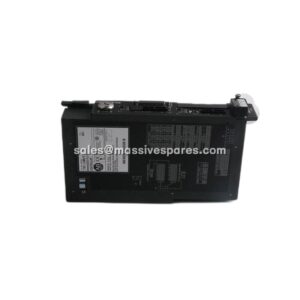
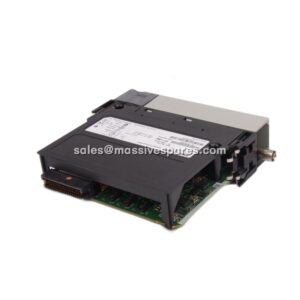
Description
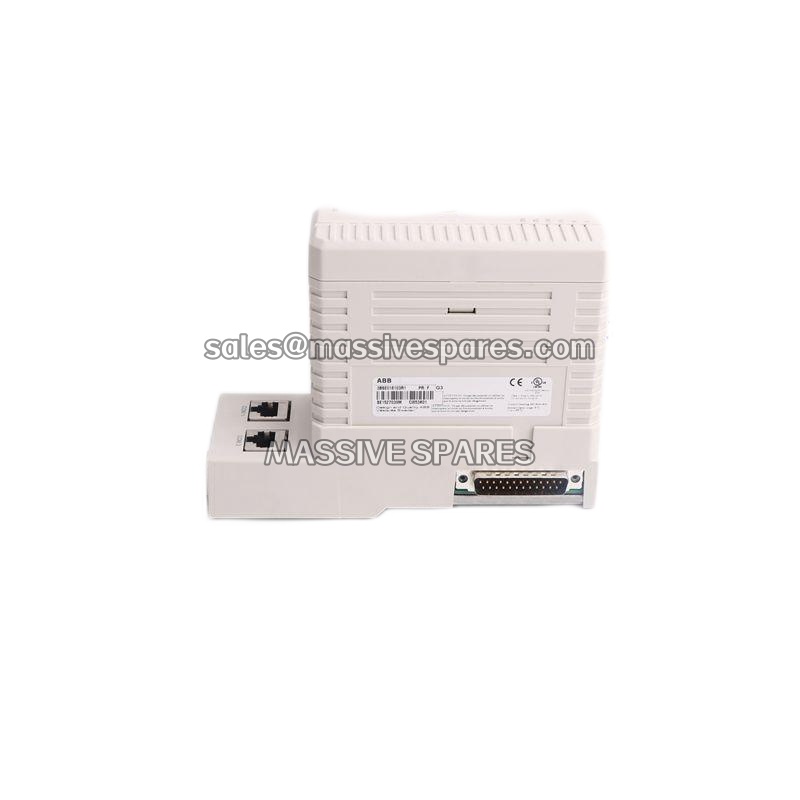
Technical Specifications
| Parameter Name | Parameter Value |
|---|---|
| Product Model | ABB 07AC91 |
| Order Number | GJR5252300R0101 |
| Manufacturer | ABB |
| Product Type | Analog Input / Output Module (combined) |
| Platform / Series | Advant Controller 31 (AC31), CS31 remote I/O |
| System Bus | CS31 system bus (EIA RS-485, electrically isolated) |
| Channels (12-bit mode) | 8 analog inputs + 8 analog outputs |
| Channels (8-bit mode) | 16 channels, configurable in pairs as AI or AO |
| Input Signal Ranges | ±10 V, 0–10 V, 0–20 mA (per channel) |
| Output Signal Ranges | ±10 V, 0–10 V, 0–20 mA (per channel) |
| Resolution | 12-bit + sign (input), 12-bit (output) in 12-bit mode; 8-bit in density mode |
| Conversion Error | Typical ±0.5 % of full scale, maximum ±1.0 % |
| Rated Supply Voltage | 24 V DC (permissible range 19…30 V DC) |
| Current Consumption | Maximum 0.2 A |
| Power Dissipation | Maximum 5 W |
| Output Load (current) | 0…500 Ω |
| Input Impedance | >100 kΩ (voltage), approx. 330 Ω (current) |
| Isolation | CS31 bus isolated from unit; binary enable input isolated |
| Diagnostic Display | 17 LEDs: power/ready + 16 channel diagnostics |
| Mounting | 35 mm DIN rail (DIN EN 50022) or 4 × M4 screws |
| Dimensions (W × H × D) | 120 × 140 × 85 mm |
| Weight | Approx. 0.45 kg (0.81 kg with terminals) |
| Operating Temperature | 0 °C to +55 °C |
| Storage Temperature | -25 °C to +75 °C |
| Protection Rating | IP20 (cabinet interior) |
| Approvals | CE, CSA, ABS marine certification |
Main Features and Advantages
Two modes, one module, zero compromise on cabinet space:
The headline feature of the ABB 07AC91 is configurability without complexity. Set the internal DIL switches to 12-bit mode and you get eight true analog inputs and eight true analog outputs, each addressed individually on the CS31 bus — a complete small-scale loop field in a single 120 mm wide housing. Flip to 8-bit mode and the module yields sixteen channels by pairing them, halving the bus bandwidth per point. No jumpers on the terminal side, no daughter cards, no firmware download required. For a plant modernizing a pump station or a skid-mounted package unit, that flexibility is the difference between ordering three different module types and standardizing on one.
Signal fidelity that holds up in a noisy panel:
Every input channel accepts either a voltage or a current loop, and the conversion error stays within ±0.5 % typically, ±1.0 % maximum, across nonlinearity, resolution, and factory calibration. The voltage input stage presents a high impedance (>100 kΩ), so it does not load the source; the current input uses an internal sense resistor of roughly 330 Ω. The conversion cycle for the eight-input, eight-output scan is 8 ms, which keeps PID execution predictable even when several ABB 07AC91 modules share a CS31 segment. Input filtering is built in — 470 μs time constant for voltage inputs, 100 μs for current inputs — suppressing the kind of HF ripple that turns a stable level loop into a chattering control valve.
Galvanic isolation and a hardware output enable:
The CS31 bus side is isolated from the module’s internal and analog circuitry, so a ground loop on the field side cannot propagate onto the communication backbone. More importantly, terminal 25/26 is a dedicated binary enabling input: apply +13 to +30 V and the outputs are released; pull it to -30 to +5 V and every voltage output goes to 0 V and every current output to 0 mA, instantly and without software intervention. Wire it across a safety relay contact, an emergency-stop chain, or a permissive from a safety PLC, and you have a hardware-level guarantee that the final element returns to its safe state. That is a capability many modern “smart” I/O modules have actually lost in the name of software configurability.
Diagnostics you can see from the aisle:
Seventeen LEDs on the front panel report module readiness, bus health, overload, wire break, and out-of-range conditions at channel level. A Test pushbutton forces a test condition for loop checking. The ABB 07AC91 therefore reduces mean time to repair: the technician does not need a laptop, a cable, and a seating in the control room to learn that channel 3 has an open 4–20 mA loop. On a Saturday night, that is not a minor convenience — it is the difference between a two-hour outage and a twelve-hour one.
Lifecycle and sourcing realism:
The AC31 platform is mature, and the ABB 07AC91 is correspondingly in the legacy phase of its product life. That is precisely why a guaranteed-supply, functionally tested, correctly revisioned spare matters. A module that is “close enough” will not do: the DIL switch map, the terminal block generation, and the CS31 scan-table layout must match the installed base. We test every ABB