Description
Application Scenarios
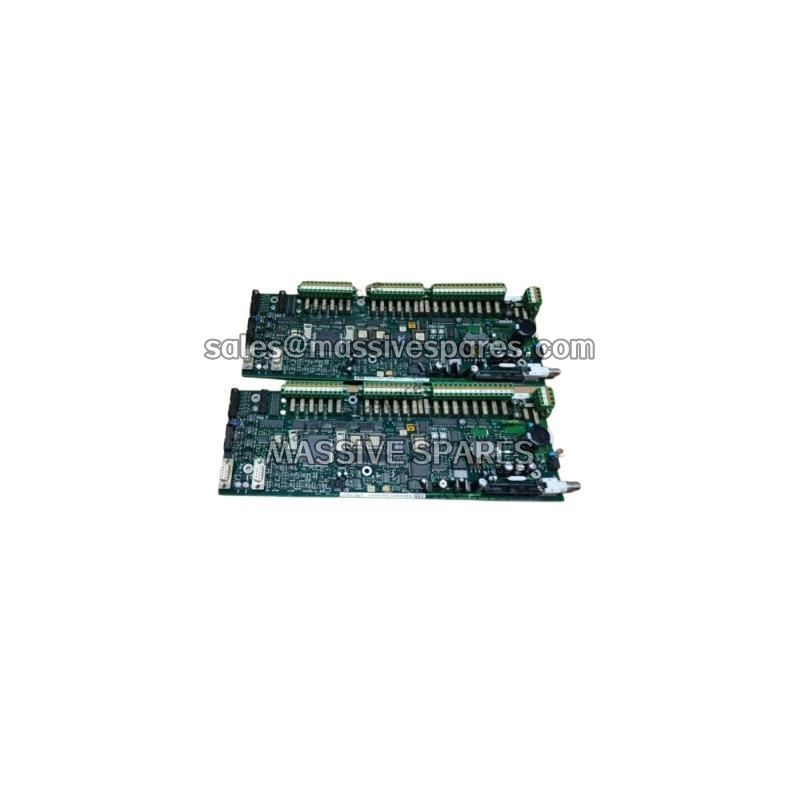
At a 300 MW thermal power plant, the excitation system suddenly reported a “CIN COMM FAULT” alarm, and the generator’s reactive power began oscillating cyclically. Operators initially suspected a loose communication cable between the COB main control board and the CIN board, but the fault persisted after cable replacement. Further investigation revealed intermittent frame drops at the fiber-optic transceiver interface on the 3BHB005922R0001 board—trigger pulses occasionally failed to reach the GDI gate driver board, causing certain-phase thyristors to “misfire” or “miss fire” within half a cycle. This distorted the excitation current waveform, ultimately manifesting as reactive power oscillation through the AVR’s closed-loop voltage regulation .
After replacing the spare UNS0880A-P V1, the trigger pulse chain stabilized, and reactive power fluctuation converged within three sampling cycles. This case reveals a critical fact: 3BHB005922R0001 failures often do not manifest as “complete shutdown” but rather as “performance degradation” that emerges gradually. Early detection relies on continuous monitoring of excitation current waveform quality.
Parameter
| Parameter | Value/Description |
|---|---|
| Product Model | 3BHB005922R0001 |
| ABB Type Designation | UNS0880A-P V1 (CIN Board) |
| Manufacturer | ABB |
| Product Category | Converter Interface Board / Firing Board |
| System Compatibility | UNITROL 5000 / UN5000 Excitation Systems |
| Core Function | Trigger pulse isolation & amplification; dynamic current sharing |
| Companion Modules | COB (Control Board), GDI (Gate Driver), CUS (Current Sensor) |
| Supply Voltage | 24 V DC (via backplane) |
| Isolation | Galvanic isolation (opto-coupler + magnetic) |
| Dimensions (L×W×H) | 445 × 230 × 45 mm (bridge-arm rack format) |
| Weight | Approx. 0.62–0.70 kg |
| Operating Temperature | -20°C to +70°C |
| Hot-Swap | Supported (recommend de-energizing power cabinet) |
| Lifecycle Status | Discontinued — available via surplus/refurbished channels |
| Origin | Switzerland |
Technical Principles and Innovative Values
- Innovation Point 1: Trigger Pulse Isolation as a “Firewall” Between Weak and Strong Circuits. The 3BHB005922R0001 sits physically and electrically between the low-voltage COB control board and the high-voltage thyristor bridge. It performs galvanic isolation using opto-couplers and magnetic isolation barriers, preventing voltage spikes, ground loops, and surge events from the thyristor side from propagating back into the sensitive control electronics . Without this isolation layer, a single commutation failure on the bridge could destroy the COB—an expensive and hard-to-source board. The UNS0880A-P V1 sacrifices itself (via the isolation barrier’s voltage breakdown rating) to protect the upstream control chain.
- Innovation Point 2: Millisecond-Level Dynamic Current Sharing. In UNITROL 5000 / UN5000 excitation systems, multiple thyristors are paralleled per bridge arm to handle excitation current (often 2000–4000 A DC). If one thyristor conducts more current than its neighbors, it heats disproportionately, derates rapidly, and eventually fails—a cascading risk for the entire bridge . The 3BHB005922R0001 continuously monitors each parallel branch via CUS current sensors and adjusts individual firing angles in real time (sub-millisecond resolution) to equalize conduction across all devices. This is not a passive “gate driver” function; it is an active closed-loop control running on the CIN board itself.
- Innovation Point 3: Field-Repairable Modularity in a Legacy Platform. The UNITROL 5000 / UN5000 platform is widely deployed in aging power plants and large industrial drives that remain in service. Because the 3BHB005922R0001 is a discrete plug-in board (not potted or integrated into a sealed assembly), a plant can stock a single spare and swap it in during a scheduled outage . No re-calibration of the excitation system is required after replacement—the firing parameters and current-sharing coefficients are stored in the COB, not on the CIN board. This decoupling of configuration from the firing hardware is a deliberate design choice that extends the platform’s operational life.