
Description
Technical Specifications
| Parameter Name | Parameter Value |
|---|---|
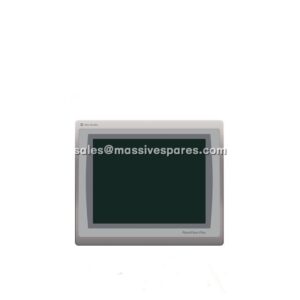
| Product Model | Allen-Bradley 2711P-T7C4D8 (Series A / B) |
| Manufacturer | Allen-Bradley (Rockwell Automation) |
| Product Type | Operator interface terminal, HMI graphic terminal |
| Series / Platform | Bulletin 2711P PanelView Plus 6, 700 display class |
| Display Size | 6.5 in diagonal color active-matrix TFT |
| Display Resolution | 640 x 480 pixels (VGA), 18-bit color graphics |
| Display Area | 132 x 99 mm (5.2 x 3.9 in) |
| Luminance | 300 cd/m² |
| Backlight | CCFL, 50,000 h minimum at 25 °C, field replaceable |
| Operator Input | 8-wire analog resistive touchscreen, 1 million actuations, 10-110 g operating force |
| Processor / Memory | 1 GHz class CPU; 512 MB RAM, 512 MB nonvolatile memory (approx. 79 MB free user memory) |
| Operating System | Windows CE 6.0, standard feature set (no extended features or file viewers) |
| Runtime Software | FactoryTalk View Machine Edition Station runtime, version 6.0 or later, preloaded and activated |
| Communication Ports | 1 x Ethernet 10/100 Mbps with Auto-MDI/MDI-X; 1 x RS-232 (DF1, DH-485); 2 x USB 2.0 host; SD card slot |
| Optional Communication Module | Ethernet, DH+/DH-485, or ControlNet interface module |
| Supported Controllers | ControlLogix, CompactLogix, MicroLogix, SLC 500, PLC-5, third-party via serial and KEPServer drivers |
| Input Voltage | 18-32 VDC (24 VDC nominal) |
| Power Consumption | 39 W typical (1.6 A at 24 VDC); 70 W maximum (2.9 A at 24 VDC) |
| Real-Time Clock | Battery-backed, ±2 min/month, CR2032 coin cell (cat. no. 2711P-RY2032), 4-year minimum life |
| External Storage | Secure Digital card (1784-SDx) and USB flash drive, both hot-swappable |
| Enclosure Rating | Front face NEMA Type 12, 13, 4X; IP54, IP65 |
| Operating Temperature | 0 °C to 55 °C; non-operating -25 °C to 70 °C |
| Relative Humidity | 5-95% non-condensing |
| Shock / Vibration | 15 G operating, 30 G non-operating at 11 ms; 10-57 Hz at 0.012 in p-p, 57-500 Hz at 2 G peak |
| Dimensions (H x W x D) | 179 x 246 x 55 mm; panel cutout 154 x 220 mm |
| Weight | Approx. 1.7 kg |
| Certifications | cULus listed, CE, C-Tick, marine and hazardous-location options by catalog variant |
| Lifecycle Status | Discontinued December 30, 2021; replacement 2711P-T7C22D9P |
| Country of Origin | United States of America |
Main Features and Advantages
Native Logix integration without gateway hardware: The Allen-Bradley 2711P-T7C4D8 speaks EtherNet/IP directly, so tag browsing into ControlLogix and CompactLogix controllers works without an OPC server, a gateway module or hand-written address maps. An engineer configures the shortcut in FactoryTalk View Studio, browses the controller tag database, and the terminal handles the rest — which removes both the cost and the failure modes of protocol conversion. The retained RS-232 port carrying DF1 and DH-485 is equally important in brownfield plants, because it lets one terminal bridge new Ethernet-based control and older serial devices such as drives, weigh controllers and instrumentation.
Built for the operator, not the office: The 8-wire analog resistive touchscreen is rated for one million actuations and responds to a finger, a gloved hand or a stylus, which is what a shop floor actually requires. At 300 cd/m² with an 18-bit color TFT panel, the Allen-Bradley 2711P-T7C4D8 stays readable under typical plant lighting, and the front face carries NEMA 4X and IP65 ratings so it survives washdown, dust and coolant mist when mounted on a flat, properly sealed panel. The field-replaceable CCFL backlight is a genuine service advantage: a dimmed screen after years of continuous duty is a backlight swap rather than a terminal replacement.
Serviceability that protects the application investment: Two USB host ports and a hot-swappable SD card slot mean the .MER application, firmware and data logs can be backed up and restored in minutes, and firmware can be upgraded offline via SD card when the terminal is not networked. The battery-backed real-time clock keeps alarm and event time stamps accurate to within two minutes per month, and the coin cell is field-replaceable. Because the Allen-Bradley 2711P-T7C4D8 belongs to the modular 700-1500 platform, a failed display or logic module can often be replaced individually rather than as a complete unit, which is usually the difference between a parts-cost repair and a capital purchase.
Application Field
On discrete machines and packaging lines, the Allen-Bradley 2711P-T7C4D8 serves as the local operator station: start and stop commands, mode selection, recipe selection, fault acknowledgement, production counters and the alarm banner that tells an operator why a line stopped. Its 6.5-inch VGA format is deliberately compact, so it fits standard machine control panels and pedestal-mounted enclosures where a 10-inch or 15-inch terminal would not, and its 24 VDC input lets it share the machine’s DC control bus rather than requiring a separate AC feed.
In process industries, the Allen-Bradley 2711P-T7C4D8 appears on skids and unit operations — pump stations, filter skids, blend tanks, CIP sets, oven and dryer controls — where it provides faceplate-style control, trending and alarm management for a small number of loops. Because it runs the same FactoryTalk View ME runtime as larger terminals in the plant, graphics and alarm conventions stay consistent from skid to main control room, which reduces operator retraining and keeps the HMI standard auditable.
Water and wastewater, building services and material handling installations use the Allen-Bradley 2711P-T7C4D8 at remote sites where Ethernet connectivity reaches a CompactLogix or MicroLogix controller and only local indication is needed. The third and perhaps largest application today is sustaining engineering: thousands of machines were shipped with this terminal, and when a unit fails, the fastest, lowest-risk recovery is to install another Allen-Bradley 2711P-T7C4D8 with matching series, firmware and application file, rather than re-engineering the panel for a newer platform.