
Description
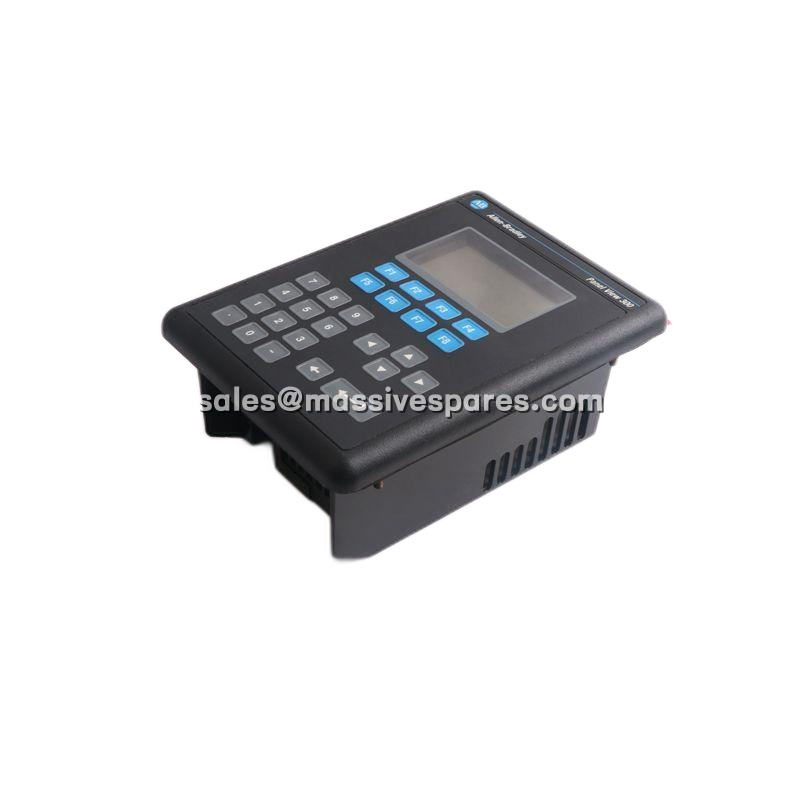
Application Scenarios:
A packaging machinery OEM had shipped several hundred machines over a decade, each with a 2711P-T6M20D mounted on the operator pendant — recipe selection, jog controls, alarm banner, and a small trend for seal-bar temperature. The machines were mechanically sound, but the HMI was the weak link: panels were reaching the point of backlight dimming, and the OEM’s service team was fielding calls for replacement units that were increasingly hard to source.
The pain point was not performance — a grayscale QVGA panel is entirely adequate for a recipe selector and an alarm list. It was continuity. Because the 2711P-T6M20D mounts in a standard panel cutout with a compression gasket and uses the same FactoryTalk View ME runtime as the rest of the PanelView Plus family, a service technician could swap a unit, restore the .mer runtime file from a USB drive, and have the machine back in production without touching the PLC program or the panel cutout. The alternative — a modern widescreen HMI — would have required re-cutting the pendant, re-laying out every display, and re-validating the machine.
In a second setting, a water booster station used the 2711P-T6M20D as a local interface to a MicroLogix controller, with the RS-232 port carrying DF1 to the PLC and the Ethernet port left available for a later SCADA connection. When the SCADA link was added two years later, no hardware change was needed — the port was already there.
Parameter:
| Main Parameters | Value/Description |
|---|---|
| Product Model | 2711P-T6M20D (PanelView Plus 600; suffix-8 variant: 2711P-T6M20D8) |
| Manufacturer | Allen-Bradley / Rockwell Automation |
| Product Category | Graphic operator terminal — machine-level HMI (touch input) |
| Operator Input | Touch only (T); analog resistive touch screen, 4-wire, 1 million press actuations, 10–110 g operating force |
| Display | 5.5 in. grayscale passive-matrix FSTN LCD; display area approx. 112 × 84 mm; QVGA 320 × 240 resolution |
| Backlight | Not replaceable; brightness approx. 300 cd/m² on the original PanelView Plus (440 cd/m² on the Plus 6 variant); long service life at rated temperature |
| Input Power | 24 V DC nominal, 18–30 V DC range (18–32 V DC per Rockwell installation data); reverse-polarity protected; use a Class 2 / SELV isolated supply |
| Communication Ports | 1 × Ethernet 10/100 Mbps (EtherNet/IP), 1 × RS-232 (DF1 and third-party serial), USB host and USB device ports |
| Memory | 64 MB RAM, 64 MB nonvolatile flash (original PanelView Plus); 256 MB RAM / 512 MB nonvolatile on the Plus 6 suffix-8 variant — confirm which build you hold, as it determines firmware and application size limits |
| Software | FactoryTalk View Machine Edition runtime; applications built in FactoryTalk View Studio for Machine Edition |
| Modular Communication | Optional communication module slot for additional network interfaces (600 series supports the modular expansion design; DH-485/DH+ and ControlNet modules are 700–1500 series only) |
| Front Panel Rating | NEMA 4X / IP65-class front panel when mounted with the supplied gasket; IP20 rear — indoor enclosure mounting |
| Environmental | Operating temperature 0 to +55 °C; storage −25 to +70 °C; 5–95% relative humidity, non-condensing |
| Mounting | Panel cutout with supplied mounting levers (400 and 600 terminals) or clips (700–1500); gasket forms a compression seal; clip screws torqued to 0.90–1.1 N·m (8–10 in-lb) |
| Certifications | UL, CSA, CE, RoHS, marine and hazardous-location approvals depending on catalog suffix |
| Lifecycle Status | Superseded; PanelView Plus 6 variants reached end of life in 2021 — plan spares or migration |
Note on the “8” suffix: catalog numbers ending in 8 (2711P-T6M20D8) denote the PanelView Plus 6 generation with Windows CE 6.0, FactoryTalk View ME 6.10 or later, and substantially more memory. Ending in 9 adds extended features and file viewers. Both share the 600-series form factor and cutout.
Technical Principles and Innovative Values:
Innovation Point 1 — Modular architecture separates display, logic and communication:
The 2711P-T6M20D was built on a modular design in which the display module, logic module and communication module are distinct field-replaceable assemblies. A failed display does not force replacement of the computing and communication hardware, and a network change does not require a new terminal. In practice this means a maintenance department can stock fewer complete units and more targeted subassemblies, and it is the reason these terminals remained serviceable in the field for well over a decade.
Innovation Point 2 — Native EtherNet/IP on the NetLinx architecture:
The 2711P-T6M20D speaks CIP over EtherNet/IP natively, optimized for the Logix control architecture while retaining support for PLC and SLC-based systems through its serial port. There is no OPC server, no gateway and no driver translation layer between the terminal and a ControlLogix or CompactLogix controller — tags are addressed directly. For machine builders this collapses commissioning to configuring a path in RSLinx and downloading the runtime.
Innovation Point 3 — Dual communication paths for brownfield and greenfield in one unit:
The 2711P-T6M20D carries both Ethernet and RS-232. The serial port handles DF1 to SLC 500, MicroLogix and third-party drives and instruments, while the Ethernet port handles the modern Logix link and future SCADA or MES connectivity. Machines designed around serial could be upgraded to networked monitoring without changing the HMI — a genuine future-proofing that saved a generation of retrofit projects.
Innovation Point 4 — Industrial sealing with a compression gasket, not adhesives:
Front-panel sealing on the 2711P-T6M20D is achieved by a compression gasket tightened to a specified torque sequence, not by sealant. The terminal achieves a NEMA 4X-class front face suitable for washdown and coolant exposure, while the rear remains IP20 for enclosure mounting. Rockwell is explicit that sealant compounds must not be used and that the mounting screws must be tightened alternately in sequence — a design that rewards correct installation with years of panel integrity.
Innovation Point 5 — Software continuity across the whole PanelView Plus family:
Applications for the 2711P-T6M20D are authored in the same FactoryTalk View Studio for Machine Edition used across PanelView Plus, PanelView Plus 6 and the Compact series, and the terminal supports application upload and reverse-compilation. This is the single most valuable long-term attribute: the engineering asset — the .med project and the .mer runtime — outlives the hardware, and migrating to a newer terminal is a conversion exercise rather than a rewrite.