Description
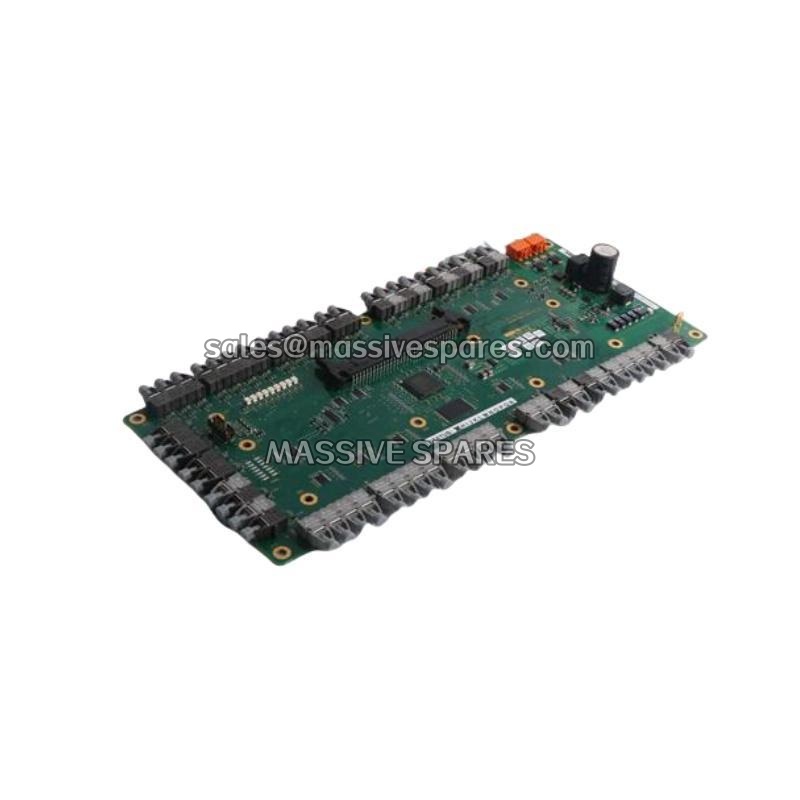
Technical Specifications
| Parameter Name | Parameter Value |
|---|---|
| Product Model | 3BHE024855R0103 |
| Manufacturer | ABB (Hitachi Energy) |
| Product Type | Analog Input Module, Basic Tier |
| Series / Platform | UAD Series, Symphony Plus / INFI 90 DCS |
| Number of Channels | 8 (independent, software-configurable) |
| Input Signal Ranges | 4–20 mA, 0–20 mA, 0–10 V |
| A/D Resolution | 16-bit per channel |
| Measurement Accuracy | ±0.1 % of full scale (25 °C reference) |
| Current Input Impedance | 250 Ω precision shunt |
| Voltage Input Impedance | >1 MΩ |
| Channel Isolation | ≥ 500 V DC (channel-to-channel and channel-to-backplane) |
| Diagnostics | Open-wire / broken-transmitter detection (current mode) |
| Configuration Method | Software-defined via Symphony engineering tool (no jumpers) |
| Mounting | Plugs into UAD baseplate (e.g., UAD140A type) |
| Operating Temperature | 0 °C to +60 °C |
| Storage Temperature | -40 °C to +85 °C |
| Relative Humidity | 5 %–95 % RH, non-condensing |
| Protection Rating | IP20 (indoor control cabinet installation) |
| Typical Dimensions | Approx. 160 × 100 × 30 mm (UAD rack module) |
| Weight | Approx. 0.25–0.40 kg |
Main Features and Advantages
Software-configurable per channel:
Each of the eight channels on the ABB 3BHE024855R0103 can be independently set to 4–20 mA, 0–20 mA or 0–10 V through the Symphony engineering tool. There are no DIP switches, jumper blocks or range cards to handle at the rack, which removes a long-standing source of field wiring errors. A single card can therefore mix a 4–20 mA flow transmitter on channel 1, a 0–10 V position feedback on channel 2 and a 0–20 mA chemical-dose signal on channel 3. Commissioning teams can re-range a point after startup without opening the cabinet or disturbing terminations, and spare holding is cut in half because one part number covers both current-loop and voltage-feedback applications.
Precision acquisition with 16-bit resolution:
The ABB 3BHE024855R0103 converts each input through a 16-bit A/D converter, delivering ±0.1 % of full-scale accuracy at the 25 °C reference and low temperature drift across the 0 °C to +60 °C operating band. The 250 Ω precision shunt establishes the 4–20 mA range with tight tolerance, while the high-impedance voltage input avoids loading the source. The result is measurement headroom that supports tight regulatory loops—analyzer trends, level control in separators, reactor temperature profiles—without the quantization noise that plagues lower-resolution input cards.
Galvanic isolation and transient immunity:
Isolation of at least 500 V DC between channels and between channels and the backplane is a defining advantage of the ABB 3BHE024855R0103. In a power plant or refinery, transmitter loops are long, grounded at arbitrary points and exposed to switching transients from motor starters and thyristor drives. The isolation barrier stops ground-loop currents from corrupting the measurement and prevents a field-side fault from propagating into the UAD rack. Combined with the IP20 industrial enclosure and a conformal-coated PCB, the module is built to survive the humidity, dust and electromagnetic interference of a continuously operating control room.
Built-in open-wire detection:
In current mode, the ABB 3BHE024855R0103 continuously monitors for an open circuit on the transmitter loop and reports it as a diagnostic to the controller. This turns a slowly developing failure—a corroded terminal, a broken lead, a transmitter with a dying power supply—into an alarm that appears while the loop is still readable, rather than a silent 3.6 mA “normal” value that convinces the operator the process is stable while the tank is actually overflowing. It is a small feature with outsized value in hazardous-area and remote-skid applications where a site walk is expensive.
Retrofit sanity and lifecycle economics:
The ABB 3BHE024855R0103 preserves the UAD mechanical footprint, backplane and function-code block mapping of the original INFI 90 installation. Plants running 1990s-vintage control logic can extend service life without rewriting control strategies, retraining operators or re-terminating the I/O cabinet. As the volume AI spare, it is also the most readily available replacement in the secondary market, which matters during a forced outage when a 2 a.m. failure cannot wait for a factory lead time.