Description
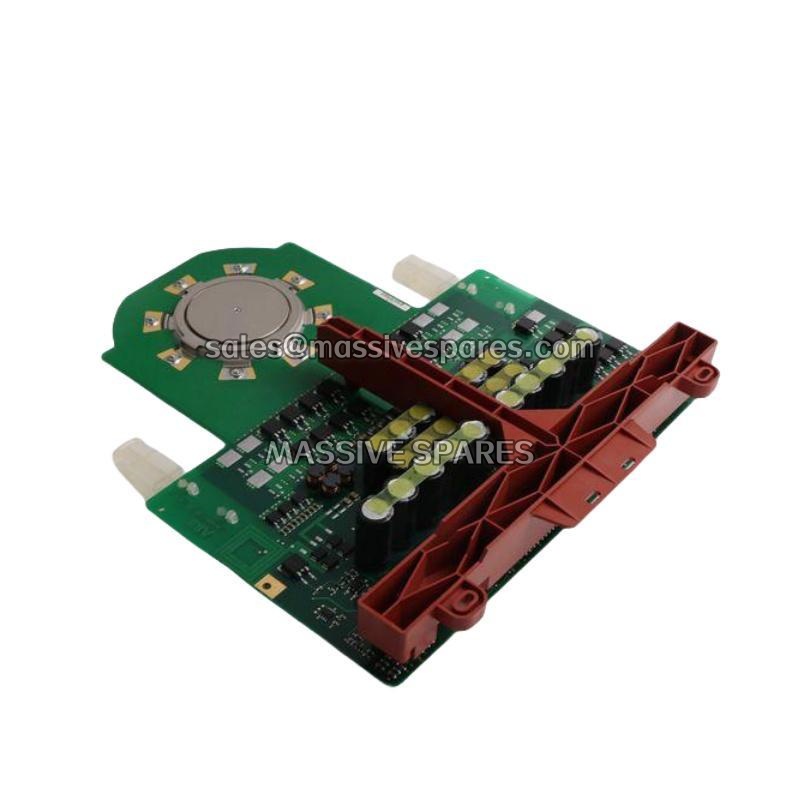
Technical Specifications
| Parameter Name | Parameter Value |
|---|---|
| Product Model | 5SHX 1060H0003 (order / type code 3BHB020538R0001) |
| Manufacturer | ABB Switzerland Ltd., Semiconductors (Lenzburg, Switzerland) |
| Product Type | HiPak IGBT Power Module, 6-cell, press-pack housing |
| Chip Technology | SPT+ (Soft Punch Through), trench-gate, field-stop IGBT |
| Repetitive Peak Collector-Emitter Voltage (VCES) | 1700 V |
| Collector-Emitter Saturation Voltage (VCE(sat)) | approx. 2.1 V at IC = 400 A, Tj = 25 °C (typ. 1.9 V, max. 2.5 V) |
| Continuous Collector Current (IC) | 400 A at Tcase ≤ 85 °C; 560 A at Tcase = 25 °C |
| Pulsed Collector Current (IC, puls) | 1200 A (tp ≤ 1 ms) |
| Forward Current of Inverse Diode (IF) | 400 A continuous; 1200 A pulsed |
| Forward Voltage of Inverse Diode (VF) | approx. 1.75 V at IF = 400 A |
| Total Switching Energy (Ets) | approx. 55 mJ at IC = 400 A, VGE = ±15 V, RG = 2.2 Ω, Tj = 125 °C |
| Gate-Emitter Threshold Voltage (VGE(th)) | 5.0 … 6.5 V |
| Gate-Emitter Voltage (VGE) | ±20 V (absolute maximum); +15 V / −15 V recommended drive |
| Input Capacitance (Cies) | approx. 38 nF |
| Turn-on / Turn-off Delay Time | approx. 0.10 μs / 0.35 μs |
| Rise / Fall Time | approx. 0.10 μs / 0.15 μs |
| Short-Circuit Withstand Time | 10 μs at VCE = 1000 V, VGE = 15 V, Tj = 125 °C |
| Insulation Voltage (VISOL) | 6000 V RMS, 1 minute, between terminals and baseplate |
| Thermal Resistance, Junction-to-Case (Rth(j-c)) | 0.35 K/W per IGBT; 0.70 K/W per diode |
| Maximum Junction Temperature (Tj, max) | +125 °C (IGBT and diode) |
| Operating Case / Baseplate Temperature | −40 °C … +85 °C (module operational); −40 °C … +125 °C storage |
| Temperature Sensing | 6 × NTC thermistors, one per cell, NTC B-value 3930 K |
| Mounting Torque | 9 … 11 N·m (M6 stainless steel screws, lubricated) |
| Dimensions (L × W × H) | 236 mm × 120 mm × 48 mm |
| Weight | approx. 1.6 kg |
| Moisture Sensitivity Level | MSL 1, unlimited floor life at ≤ 30 °C / 60 % RH |
Main Features and Advantages
SPT+ chip, the decisive advantage: The ABB 5SHX 1060H0003 3BHB020538R0001 gains its character from the SPT+ die. A conventional punch-through IGBT reduces VCE(sat) by thinning the drift region, but the thinner region then stores charge that must be removed at turn-off, producing a long, lossy tail current. The soft-punch-through construction controls that stored charge, so the tail collapses in roughly 0.35 μs. The practical consequence is visible on the heatsink and the electricity bill: at a 2 kHz switching frequency the module runs cooler than a same-voltage generation-old part, which permits a smaller heatsink, a lower airflow requirement, and fewer devices in parallel. For a drive manufacturer, that is direct bill-of-materials savings; for a plant, it is fewer fans to maintain and a quieter converter room.
Low VCE(sat) at full current: A saturation voltage near 2.1 V at 400 A means about 840 W of conduction loss per device in a hard-switched bridge, and that figure stays relatively flat across the current range because the SPT+ chip exhibits a soft, non-snapback forward characteristic. The significance is not the wattage but the predictability: conduction loss can be calculated and cooled; switching loss can only be estimated until the layout is built. The ABB 5SHX 1060H0003 3BHB020538R0001 therefore shifts the thermal problem toward the calculable side, which is why it is favored in converter designs where the DC link voltage and the load spectrum are known but the ambient temperature is not.
Six NTCs, one per cell: Most power modules give you one thermistor for the whole block, which tells you the average of an increasingly uneven situation. The ABB 5SHX 1060H0003 3BHB020538R0001 places an NTC next to each of the six cells, so the gate-drive or the converter controller can detect a cracked thermal interface, a clogged cold-plate channel, or a mis-clamped heatsink before the hottest cell fails. In a three-level NPC or ANPC topology, where the neutral-point devices see a different loss profile from the outer devices, this per-cell visibility is genuinely useful rather than merely thorough.
Dielectric robustness and press-pack mechanics: The 6 kV RMS isolation rating lets the module be mounted on a grounded aluminum cold plate, which is the standard arrangement in 690 V class drives and in the water-cooled racks of medium-voltage converters. The flat baseplate and the four M6 mounting holes distribute clamping force evenly, avoiding the localized stress that cracks ceramic in poorly mounted modules. When the torque is respected, the thermal interface is repeatable; when it is not, the failure is intermittent and expensive. ABB’s stated 9–11 N·m window exists for that reason.
Short-circuit ruggedness: A 10 μs short-circuit withstand time at 1000 V and 125 °C junction temperature gives the desaturation-detection and the hardware trip enough time to act. The ABB 5SHX 1060H0003 3BHB020538R0001 does not invite a short circuit, but it will survive the one that occurs during commissioning of a mis-labeled motor cable.