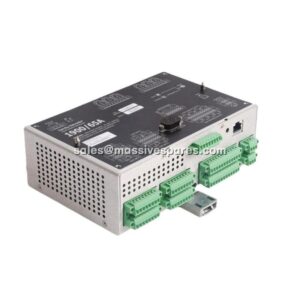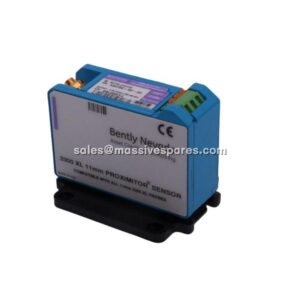

Description
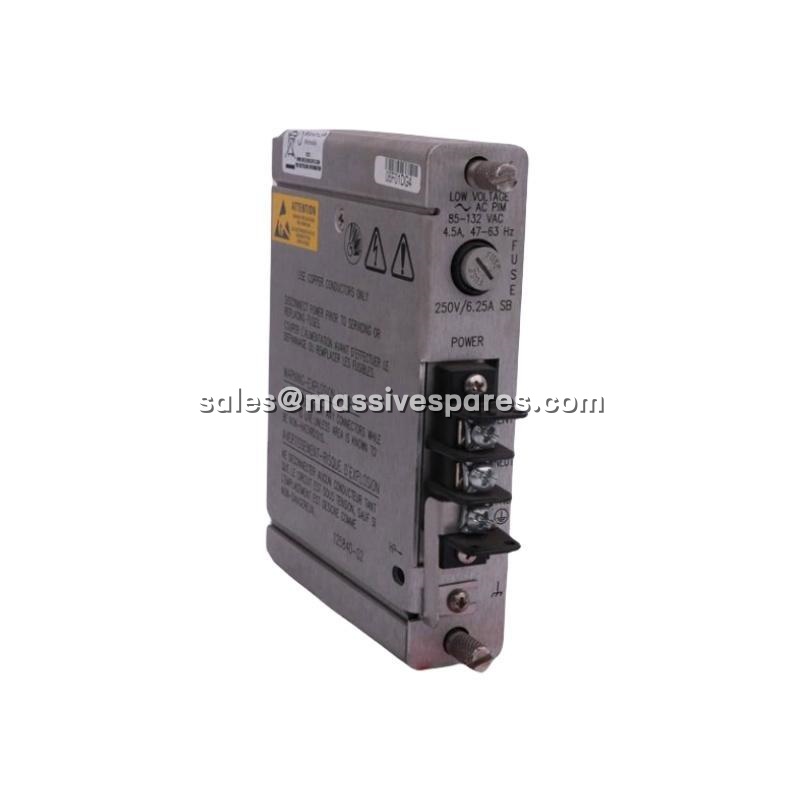
Technical Specifications
| Parameter Name | Parameter Value |
|---|---|
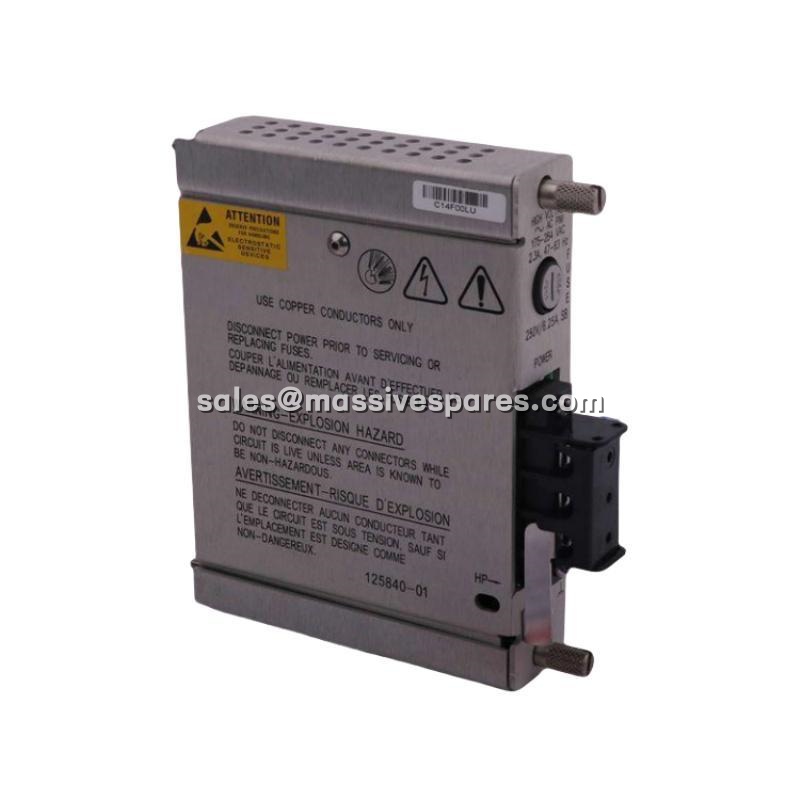
| Product Model | 135489-01 |
| Manufacturer | Bently Nevada (Baker Hughes) |
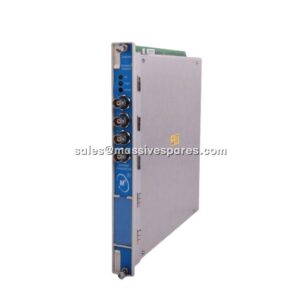
| Product Type | 4-Channel Proximitor/Seismic I/O Module |
| Series / Platform | 3500 Machinery Protection System (3500/42M) |
| Channel Count | 4 independent channels (configurable as pairs 1&2, 3&4) |
| Supported Inputs | Proximity probes (Prox), Accelerometers (Accel); Velomitor/velocity on variant-dependent channels |
| Termination Type | Internal terminations (Euro-style screw terminals, no external block) |
| Intrinsic Safety | Internal galvanic isolation barriers (ATEX / IECEx / Class I Zone 2) |
| Bandwidth | 30 kHz (Proximity & Acceleration) |
| Accuracy | ±0.33% full-scale typical, ±1% maximum |
| Recorder Output | 4–20 mA per channel (load 0–600 Ω) |
| Buffered Output Impedance | 550 Ω |
| Transducer Power | -24 V DC (supplied by module) |
| Power Consumption | 7.7 W typical |
| Operating Temperature | 0 °C to +65 °C (internal-barrier version) |
| Storage Temperature | -40 °C to +85 °C |
| Humidity | 0–95% RH, non-condensing |
| Mounting | Rear full-height slot of 3500/05 rack, behind 3500/42M main card |
| Dimensions (H×W×D) | 241.3 × 24.4 × 163.1 mm (9.50 × 0.96 × 6.42 in) |
| Weight | 0.46 kg (1.01 lb) |
| Compliance | API 670, EMC (EN 61000-6-2 / -6-4), RoHS |
Main Features and Advantages
The core value of the Bently Nevada 135489-01 is that it places both signal conditioning and intrinsic-safety isolation directly on the I/O card. A single module therefore replaces a conventional arrangement of external safety barriers, separate termination hardware, and additional cabinet wiring—cutting installed cost, freeing panel space, and removing a common source of wiring errors.
Built-in intrinsic safety barriers:
The galvanically isolated barriers limit voltage, current, and stored energy to levels that cannot ignite a hazardous atmosphere, allowing the Bently Nevada 135489-01 to connect directly to IS-rated proximity probes and seismic sensors in Zone 2 / Division 2 locations. Because the barriers are internal, cabinet layout is simplified and the signal path is shorter, reducing both noise pickup and commissioning time. The safety certification remains valid only when approved field devices and documented intrinsic-safety installation practices are used, so the Bently Nevada 135489-01 should always be installed in accordance with the relevant 3500/04 internal-barrier documentation.
Flexible mixed-sensor channel architecture:
Each of the four channels is independently programmed through 3500 Configuration Software, so a single Bently Nevada 135489-01 can mix Prox displacement channels with Accel seismic channels to suit the asset. A channel may be dedicated to radial vibration, axial (thrust) position, eccentricity, differential expansion, shaft absolute velocity, or acceleration—covering the measurement set needed for API 612 and API 617 critical machinery. This per-channel configurability means one spare part covers many machine configurations, an important advantage for plant stores and turnaround planning.
High-integrity measurement performance:
With a 30 kHz bandwidth and ±0.33% typical full-scale accuracy, the Bently Nevada 135489-01 preserves the fidelity of high-frequency dynamic signals used for vibration trending, orbit plots, and rolling-element bearing analysis. Buffered transducer outputs (550 Ω, coaxial) give technicians direct access to raw waveforms at the rack for diagnostic troubleshooting without breaking the protection loop. Integrated sensor-health diagnostics continuously monitor transducer DC bias and signal continuity, flagging open or shorted probes before they compromise protection coverage.
Seamless 3500 system integration and maintainability:
The Bently Nevada 135489-01 communicates with the 3500/42M front card over the standard 3500 backplane, inheriting alarm and trip logic, communication via the 3500/22M TDI, and Modbus/TCP access through modules such as the 3500/15. In redundant or properly bypassed installations it supports online (hot) replacement, allowing a failed channel interface to be changed without taking the protected machine out of service—provided the replacement barrier configuration and channel type match the original.