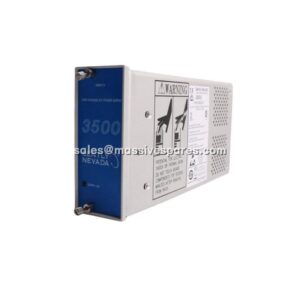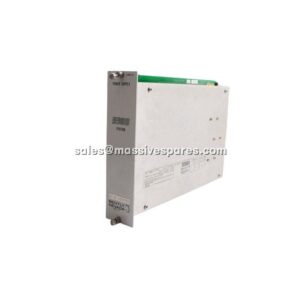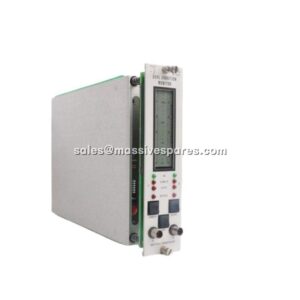

Description
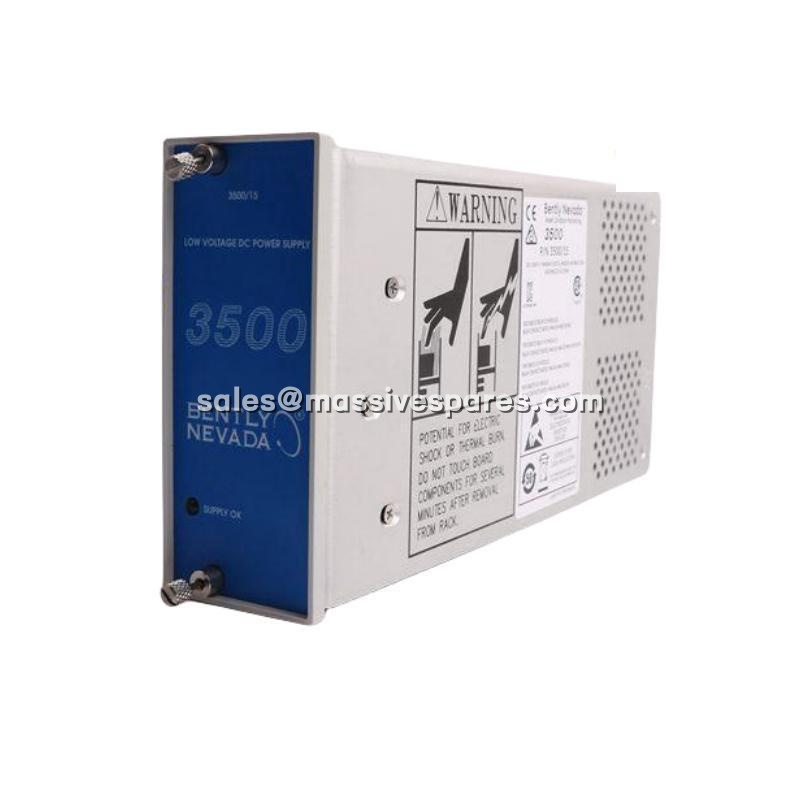
Technical Specifications
| Parameter | Value |
|---|---|
| Product Model | 128015-08 |
| Manufacturer | Bently Nevada (Baker Hughes) |
| Also Identified As | 3500/70M Recip Impulse / Velocity Monitor |
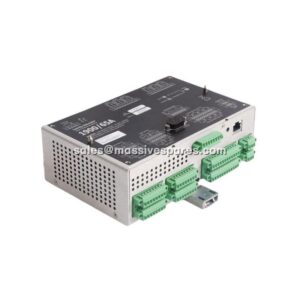
| Product Type | Reciprocating Machinery Monitor (I/O Module) |
| Number of Channels | 4 (paired; Ch1–2, Ch3–4) |
| Input Signal Type | Seismic velocity (case velocity / acceleration-derived) |
| Signal Processing | Digital Signal Processing (DSP); pulse & reciprocating-velocity algorithms |
| Derived Variables | Pulse Acceleration, Reciprocating Velocity |
| Measurement Range | 0 to 20 in/s (0 to 500 mm/s) per channel, programmable |
| Accuracy | ± 2 % of reading |
| Frequency / Order Range | Programmable; covers reciprocating impulse spectrum |
| Setpoints | Per-channel Alert + Danger; user-programmable |
| Sensor Power | -24 V DC (rack-supplied) |
| Typical Power Consumption | 8.0 W |
| Outputs | Static value / proportional output per channel; relay drive via 3500 relay module |
| Status Indicators | Channel OK, Alert, Danger, Module OK LEDs |
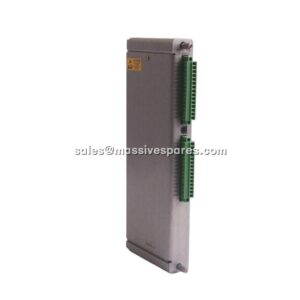
| Mounting | Standard 3500 single-slot rack module; rear I/O via 128015-series termination |
| Operating Temperature | 0 °C to +65 °C (system/rack dependent) |
| Compliance | API 670 (machinery protection); API 618 (reciprocating compressors) |
Note: Range, supply, and environmental values follow published 3500 system conventions; confirm against the 3500/70M manual for the installed firmware revision.
Main Features and Advantages
Optimized specifically for reciprocating dynamics
The decisive advantage of the Bently Nevada 128015-08 is that it was designed for the physics of reciprocating motion rather than adapted from a rotary-monitor platform. Reciprocating machines produce impulsive, crank-angle-dependent energy rather than smooth sinusoidal vibration; a conventional overall-RMS reading simply averages that energy away. The Bently Nevada 128015-08 instead detects the impulse at the moment it occurs and reports it as a position-resolved diagnostic value, giving maintenance teams a direct indicator of the offending cylinder or valve event.
Pulse Acceleration and Reciprocating Velocity diagnostics
By calculating Pulse Acceleration and Reciprocating Velocity from the seismic input, the Bently Nevada 128015-08 separates the two failure mechanisms that matter most: short, high-energy impact events (valve action, piston slap, crosshead knock) and sustained reciprocating motion that reveals rider-band and guide wear. This dual-parameter approach makes fault identification far more specific than a single velocity number could ever be.
Angle-synchronous measurement with Keyphasor reference
Referenced to crankshaft speed, the Bently Nevada 128015-08 associates every impulse with a crank angle. A rising Pulse Acceleration trend can therefore be traced to “cylinder 3, compression stroke” rather than merely to “the compressor.” This turns an alarm into an actionable work order and substantially reduces diagnostic time during planned outages.
Full 3500 alarm, trip, and integration architecture
Each channel of the Bently Nevada 128015-08 supports independent Alert and Danger setpoints, with Danger logic routed through the 3500 relay module to the unit’s ESD/trip system. At the same time, measured values are available to System 1 condition monitoring and can be exported over the rack communication gateway to the plant DCS. Protection and diagnostics therefore share one sensor installation — no separate data-acquisition system required.
Robustness and serviceability
Like all 3500 M-series monitors, the Bently Nevada 128015-08 is a single-slot, hot-swappable module with front-panel OK / Alert / Danger LEDs for immediate field diagnosis. Its rear I/O connects through a dedicated 128015 termination block, keeping field wiring outside the rack and allowing module replacement without disturbing sensor cables — a significant advantage during an unplanned trip.