Description
Application Scenarios
In a plastics injection molding facility, a 12-zone barrel heating system requires precise temperature monitoring to maintain consistent melt quality across each zone. The existing universal analog input cards, configured for 4–20 mA signals, force each zone to use a separate temperature transmitter—adding 12 transmitters, 12 calibration points, and roughly double the panel wiring.
The retrofit installs three 3AT350.6 modules directly in the System 2005 rack, wiring the PT100 sensors in 3-wire configuration straight to the field terminals. The 3AT350.6 measures resistance differentially, with its internal firmware mathematically canceling the lead resistance that would otherwise introduce ~10°C error on a 50-meter cable run to the barrel heater . The CPU reads all 12 temperature values over the parallel backplane bus in a single scan, feeding the PID loops without the lag introduced by transmitter conversion and 4–20 mA A/D stages. Post-installation, the machine builder eliminated 12 transmitters, freed roughly 40% of the panel’s DIN rail area, and reduced the temperature loop’s response time by half.
Parameter
| Parameter | Value/Description |
|---|---|
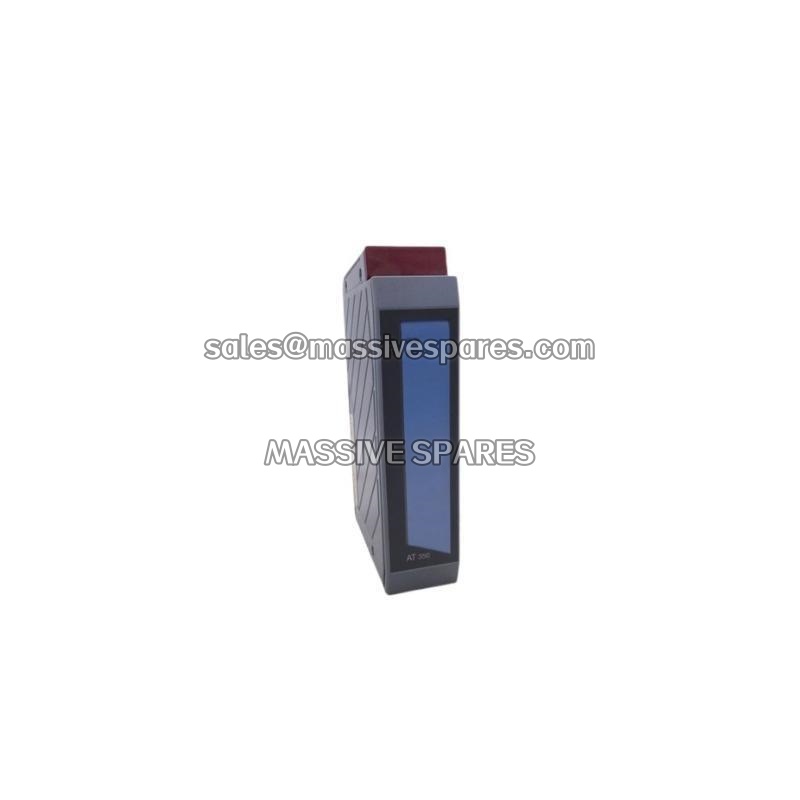
| Product Model | 3AT350.6 |
| Manufacturer | B&R (Bernecker + Rainer, ABB Group) |
| Product Category | Analog Temperature Input Module (RTD/PT100) |
| Platform | B&R System 2005 |
| Number of Channels | 4 independent resistance measurement inputs |
| Sensor Type | PT100 (IEC/EN 60751) |
| Connection | 3-wire (lead compensation active) |
| Measurement Range | –50 to +450 °C |
| Resolution | Internal 13,500 steps |
| Measurement Accuracy | ±0.1% basic at 20°C; ±0.2% at 0–60°C |
| Conversion Time | ~20 ms or 16.67 ms per channel (selectable) |
| Input Filter | 2nd-order Bessel low-pass, 8 Hz cutoff |
| Supply / Power Consumption | 5 V + 24 V via backplane; max 4 W total |
| Mounting | System 2005 single-width slot; terminal block TB170 ordered separately |
| Operating Temperature | 0°C to +60°C |
Technical Principles and Innovative Values
- Innovation Point 1: 3-Wire Lead Compensation Without External Transmitters. The 3AT350.6 excites each PT100 with a constant 2.5 mA current and measures the voltage differentially across the sense leads. The firmware then mathematically subtracts the lead resistance contribution at the A/D level . On a typical 50-meter home run to a heater manifold, the 2Ω per lead error that would translate to ~10°C in 2-wire mode is reduced to under 0.2°C—without requiring a 4-wire cable run or a local 4–20 mA transmitter. This makes the 3AT350.6 economical for distributed temperature acquisition where sensor-to-cabinet distances are significant but laboratory-grade accuracy is not mandatory.
- Innovation Point 2: High Channel Density in a Single-Width Footprint. At System 2005 single-width (~37.5 mm), the 3AT350.6 delivers four PT100 channels where a universal AI module typically provides two to four channels only with external 250Ω resistors and transmitters. On a compact machine panel with limited DIN rail, this density directly impacts enclosure size and cost. The module’s front terminal block (TB170, ordered separately) accepts screw or push-in wiring, keeping field terminations organized .
- Innovation Point 3: Selectable 50/60 Hz Noise Rejection. The 3AT350.6 offers a selectable measurement time of 20 ms (for 50 Hz mains filtering) or 16.67 ms (for 60 Hz mains filtering), indicated by a front-panel “60Hz” LED . This is a practical differentiator in global machine building: a single module part number can be deployed in both European and North American installations without changing hardware, simply by selecting the appropriate measurement time in the application software.