
Description
Application Scenarios
A combined-cycle plant running a Frame 7FA gas turbine on a Mark VI TMR control system began to see intermittent “missing I/O” reports during hot afternoons, with no clear pattern and no repeatable fault. Each event meant the control room had to hold the unit back from loading while maintenance tested cables, terminal boards and I/O cards one at a time. The real problem was a degraded communications path: the existing VCMI board was still passing most traffic, but its diagnostic state and the quality of its IONet segments were no longer trustworthy enough for a TMR environment.
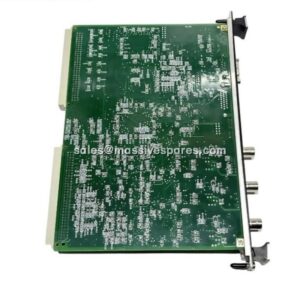
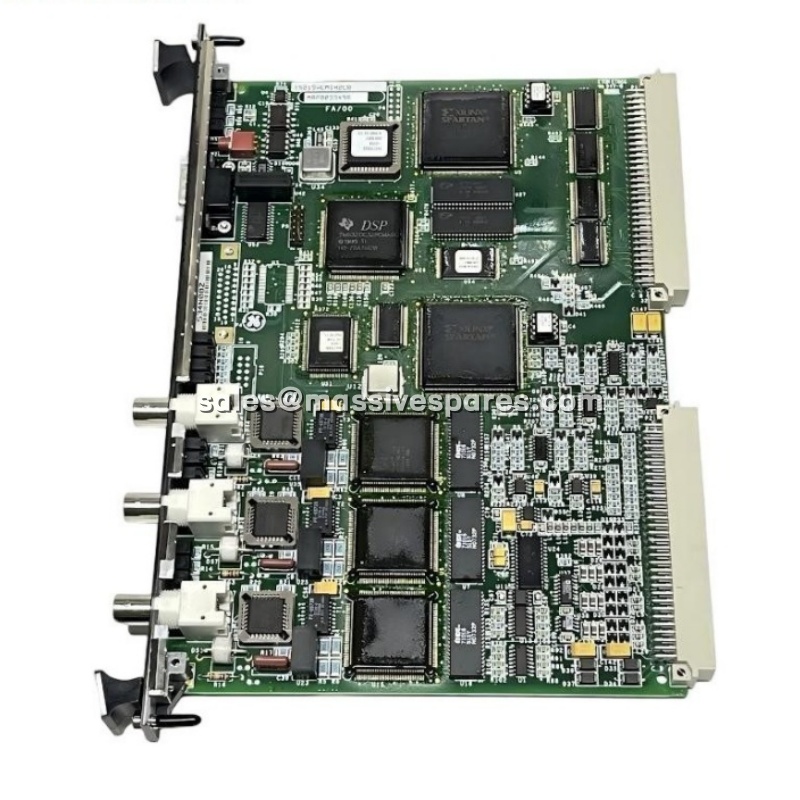
The plant replaced the suspect card with a tested GE IS215VCMIH2CB. Because the VCMI is the device that assigns identity to every board and associated terminal board in the rack, the replacement immediately re-established clean addressing and deterministic IONet communication between the controller and the distributed I/O racks. The three 10Base2 IONet ports allowed each TMR channel to retain its own dedicated communications path, so a cable or transceiver issue on one segment could no longer propagate into the others. The on-board Run, Fail, Status and per-port TX/RX/CD indicators then gave the maintenance team a local, first-pass diagnostic that had previously been missing.
For a turbine operator, that distinction matters: a VCMI fault does not simply mean “one card is down.” It means control commands and field data can lose synchronization, TMR voting can be compromised, and a unit that should ride through a transient can instead shed load or trip. The IS215VCMIH2CB exists to keep that communications layer deterministic, observable and replaceable.
Parameter
| Main Parameters | Value / Description |
|---|---|
| Product Model | IS215VCMIH2CB |
| Manufacturer | GE (General Electric), Mark VI / Speedtronic product family |
| Product Category | VME Communications Interface (VCMI) / VME bus master controller |
| Board Form Factor | 6U VME board, 0.787 in (20 mm) wide, single-slot VME card |
| Processor | Texas Instruments TMS320C32 32-bit digital signal processor |
| Memory | Dual-port SRAM with Flash memory for buffering and program/data storage |
| IONet Ports | 3 × 10Base2 Ethernet ports (BNC), dedicated communication segments |
| Serial Port | 1 × RS-232C diagnostic/configuration port (D-sub connector) |
| Backplane Interface | VMEbus; acts as VME bus master in control and I/O racks |
| Redundancy Architecture | Simplex and Triple Modular Redundant (TMR) Mark VI configurations |
| Frame Rate | 20 ms frame rate at 50 Hz typical control execution |
| Power Supply Monitoring | Monitors +5 V, ±12 V, ±15 V and +28 V backplane supply rails |
| Diagnostic Functions | Power supply monitoring, ground-fault detection, external circuit monitoring |
| Indicators | Status, Fail, Run, binary-coded indicators and TX/RX/CD per IONet port |
| Reset | Manual push-button reset |
| Installation | Mounts in GE Mark VI control or I/O VME rack |
| Operating Temperature | 0 to 60 °C typical, depending on panel and system configuration |
| Typical System | GE Speedtronic Mark VI gas turbine, steam turbine and related control systems |
Note: memory size, exact current draw and coating revision vary with the individual board revision and manufacturing run. Always verify the installed firmware revision and the GEH-6421C compatibility notes before swapping a board in a running TMR system.
Technical Principles and Innovative Values
- Innovation Point 1 — VME bus master and I/O identity manager in one card. The IS215VCMIH2CB is not a passive communications card. When installed in a Mark VI control or I/O rack it acts as the VME bus master, governing data flow on the backplane and assigning identification to every board and its associated terminal board. That makes rack addressing a managed, repeatable process rather than something left to cabling and physical position alone.
- Innovation Point 2 — Three dedicated IONet ports instead of one shared segment. The board provides three 10Base2 IONet ports. In a TMR system this supports separate communication paths for the redundant channels, so the failure or degradation of one IONet segment does not automatically become a common-mode event for the other two.
- Innovation Point 3 — TMR state exchange and voting handled at the communications layer. In a TMR Mark VI system, input data is accumulated, placed in a pre-vote table and transmitted to the other control modules over IONet. The IS215VCMIH2CB participates directly in this state exchange and voting process, offloading deterministic communications work from the application controller and keeping controller variables synchronized across channels.
- Innovation Point 4 — Built-in power supply intelligence. The board continuously monitors the +5 V, ±12 V, ±15 V and +28 V supplies and supports ground-fault and external-circuit monitoring. The practical value is early warning: voltage degradation can be identified before it produces an uncontrolled module lockup or a spurious trip.
- Innovation Point 5 — Deterministic 20 ms, 50 Hz frame performance. The board operates at a 20 ms frame rate in typical Mark VI applications. In turbine control, that predictability is more important than raw bandwidth — it keeps sensor inputs, protection logic and output commands aligned from frame to frame.
- Innovation Point 6 — Diagnostics visible at the rack without a laptop-first approach. Run, Fail, Status and binary-coded LEDs, combined with per-port TX/RX/CD indication, give field staff a meaningful first look at the board’s state. RS-232 provides a diagnostic path for deeper fault isolation when required.