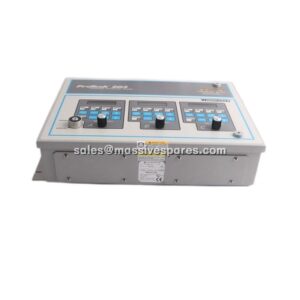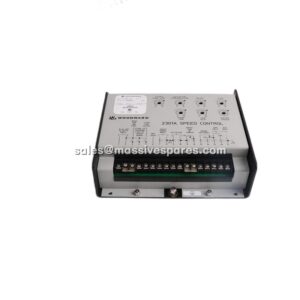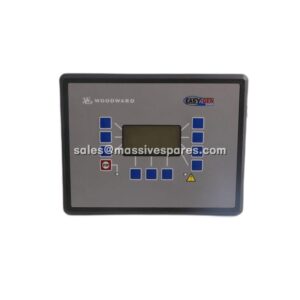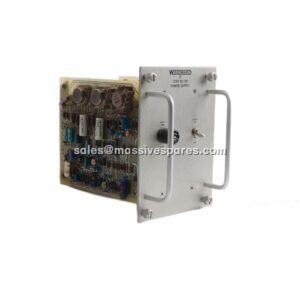

Description
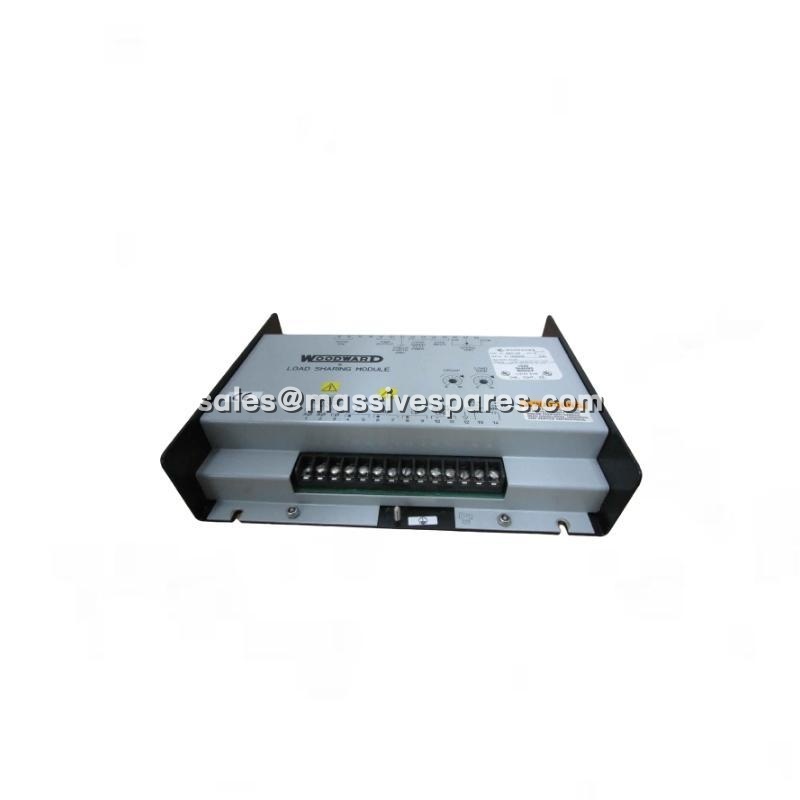
Technical Specifications
| Parameter Name | Parameter Value |
|---|---|
| Product Model | Woodward 9907-252 (Load Sharing Module, 0.5–4.5 Vdc Output) |
| Manufacturer | Woodward Inc. |
| Product Type | Analog Generator Load Sharing Module / Speed-Bias Control Module |
| Power Supply | 18–32 Vdc, 24 Vdc nominal, approx. 5 W consumption |
| Supply Protection | Undervoltage and overvoltage protection to +80 Vdc, reverse-voltage protection to -32 Vdc |
| 3-Phase PT Inputs | 95–130 Vac line-to-line nominal; module rated 100–240 Vac, 50–400 Hz |
| PT Input Burden | 1.6 W per phase at 240 Vac; 0.4 W per phase at 120 Vac |
| 3-Phase CT Inputs | 3–7 A RMS at full load; 0.1 VA burden per phase |
| Load Sharing Input | 0–3 Vdc into 25 kΩ in isochronous mode |
| Analog Output | +0.5 Vdc minimum to +4.5 Vdc maximum to engine speed control (terminals 19, 20) |
| Zero-Error Output | +2.50 ± 0.05 Vdc; output impedance 2 kΩ |
| Speed Trim | ±7.5% with external 10 kΩ, 10-turn potentiometer (terminals 26, 27, 28) |
| Droop Adjustment | 0–11% speed reduction, front-panel adjustable |
| Synchronizer Input | Compatible with optional Woodward SPM-A synchronizer (terminals 24 positive, 25 negative) |
| Operating Modes | Isochronous load sharing; droop load control; external 5 Vdc reference option on terminal 21 |
| Operating Temperature | -40°C to +70°C (-40°F to +158°F) |
| Humidity | Tested at 95% relative humidity, non-condensing |
| Vibration and Shock | 4 G vibration; 40 G shock at 11 ms sawtooth pulse |
| Dimensions (L × W × H) | 273.6 mm × 214.1 mm × 59.2 mm (10.77 × 8.43 × 2.33 in) |
| Weight | Approximately 1.4 kg (3.08 lb) |
| Agency Compliance | UL Listed industrial control equipment, CE compliant, CSA certified |
| Reference Manual | Woodward manual 02035, Load Sharing Module Installation and Operation Manual |
Main Features and Advantages
True proportional kW sharing through real power sensing: The Woodward 9907-252 does not infer load from actuator position or fuel rack; it measures it. Three-phase PT voltage and CT current are multiplied inside the module’s power sensor to produce a signal proportional to actual generator kilowatts, and that signal is then compared against the load-sharing line common to all paralleled machines. Because the comparison is made on real power rather than on a proxy, mismatched machine ratings, unequal cable impedances and differing governor gains do not prevent correct sharing, and circulating reactive current does not corrupt the control action.
Isochronous and droop flexibility in one module: A single Woodward 9907-252 covers both operating cases that a paralleling system has to handle. On an isolated bus, closing the droop and breaker auxiliary contacts puts the module into isochronous load sharing, holding frequency constant while it actively equalizes kW. Opening either contact transfers the machine to droop operation at a selected 0–11% setting, which is the correct behavior when the set is tied to a utility bus or run alongside non-compatible governors. Switching between the two requires no reconfiguration software, only a contact, which simplifies both commissioning and operator procedures.
Field-adjustable without software: Droop and Load Gain are set from front-panel potentiometers, and a remote 10 kΩ ten-turn potentiometer on the speed trim input gives operators ±7.5% manual bias for synchronizing by hand or for trimming load demand in droop operation. The Woodward 9907-252 therefore suits plants with no laptop-based tooling: a technician can balance a paralleled bus with a multimeter and a screwdriver. An optional external 5 Vdc reference can be brought in on terminal 21 when the host speed control requires a stabilized reference.
Broad governor compatibility and rugged construction: Because the interface to the prime mover is a simple 0.5–4.5 Vdc speed-setting signal, the Woodward 9907-252 works with Woodward governors and with many non-Woodward electronic speed controls, which makes it a practical retrofit for mixed fleets. The 18–32 Vdc supply tolerance tolerates battery sag during cranking, the -40°C to +70°C range covers arctic skids and engine-room heat, and the 40 G shock and 4 G vibration ratings allow installation in mobile, marine and offshore equipment where lighter controls fail.