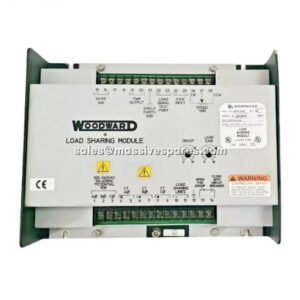

Description
Application Scenarios
A pipeline operator ran a remote gas compressor station where the only local visibility into the turbine control system was a laptop tethered to the MicroNet CPU through a service cable. That arrangement worked when an engineer was on site, but it failed during the moments that mattered most: an unplanned overnight trip, a start sequence that stalled partway, or an alarm that needed acknowledging before the machine could be restarted. Operators were forced to choose between waiting hours for a specialist to arrive and restarting a machine they could not fully see. The deeper problem was that the control system was fine; only its face was missing.
Installing the Woodward 5453-203 on the control cabinet door closed that gap. The 5453-203 gave the station a permanent local face: the two-line display showed speed, load and alarm text directly, and the keypad allowed alarm acknowledgement, setpoint adjustment and start sequence control without any external tool. Because the Woodward 5453-203 is designed for harsh installation conditions, it could be mounted on the skid itself rather than in a climate-controlled room, which is exactly where the operator needed it.
The value delivered is compressed diagnostic time and restored operator independence. When a trip occurs at two in the morning, the person standing in front of the machine can read why it tripped and act on it. That is the practical role of the 5453-203: it converts a control system that can only be interrogated into one that can be operated.
Parameter
| Main Parameters | Value / Description |
|---|---|
| Product Model | 5453-203 |
| Manufacturer | Woodward, Inc. (United States) |
| Product Category | MicroNet 2-line display operator interface panel, local HMI |
| Display Type | Two-line alphanumeric display, high-contrast VFD or backlit LCD character format |
| Input Method | Integrated tactile keypad for menu navigation, command entry and setpoint adjustment |
| Communication Ports | RS-232 for local service connection, RS-422 for longer panel-to-controller runs |
| Connector Type | DB9 serial connector with dedicated Woodward HMI cable assembly |
| Power Supply | 12 VDC nominal, 650 mA current draw, approximately 7.8 W |
| Supported Platforms | Woodward MicroNet, MicroNet Plus and NetCon digital control systems |
| Typical Monitored Data | Speed, load, temperature, pressure, actuator position, lubrication pressure, alarm and fault text |
| Operating Temperature | -40 °C to +70 °C (-40 °F to +158 °F) |
| Humidity Range | 5% to 95% non-condensing |
| Dimensions | 305 mm high x 356 mm wide x 152 mm deep |
| Weight | Approximately 1.82 kg (4.0 lb) |
| Mounting | Panel or enclosure door mounting with gasket seal for cabinet integrity |
| Compliance | CE and industrial EMC compliance; marine and hazardous-area suitability dependent on host system certification |
Technical Principles and Innovative Values
Innovation Point 1: Dual serial architecture that separates service access from control traffic. The Woodward 5453-203 carries both an RS-232 port and an RS-422 port, and that is a deliberate design choice rather than redundancy for its own sake. RS-232 serves the short local service connection, while the differential RS-422 link handles the longer cable run back to the MicroNet controller, where noise immunity and distance matter. In practice this lets a commissioning engineer connect a service laptop through one port while the 5453-203 continues its normal exchange with the controller through the other, so diagnostics can be performed without interrupting the panel’s own operation.
Innovation Point 2: Plain-language alarm presentation instead of coded fault dumps. The 5453-203 uses its alphanumeric display to present alarm and status messages in readable text rather than as numeric exception codes requiring a lookup table. Under upset conditions, when an operator has seconds to understand what happened, readable fault text directly reduces the chance of a wrong action. This is a human-factors decision built into the firmware, and it materially lowers the training burden for rotating shift crews.
Innovation Point 3: Serial communication with the controller rather than hard-wired signal mirroring. The Woodward 5453-203 does not require individual analog or discrete signals to be wired to the panel for every value displayed. It exchanges data with the MicroNet controller over a serial link, which means the panel can present any variable the controller knows about, including internally calculated values, without additional field wiring. Adding a displayed parameter becomes a configuration change rather than a cabling project.
Innovation Point 4: Environmental design matched to the machine, not the control room. With a -40 °C to +70 °C operating window and a sealed panel-mount enclosure, the 5453-203 is specified for the same environment as the turbine or engine it serves. Arctic pipelines, desert power plants and vibrating compressor skids all fall inside its envelope, which removes the need for a climate-controlled enclosure and lets the interface be placed exactly where operators work.
Innovation Point 5: Two-line format as a deliberate constraint. A two-line display looks modest compared with a modern graphical HMI, and that is the point. The Woodward 5453-203 surfaces only the parameters that matter for local operation, which keeps the operator’s attention on speed, load and alarms instead of navigating screens. The compact format also keeps the panel’s resource footprint small and its firmware stable, which is precisely why these panels remain in service on machines commissioned decades ago.
Application Cases and Industry Value
Case 1: Gas turbine start-up and troubleshooting on a combined heat and power site. A CHP plant running a MicroNet-controlled gas turbine had a recurring problem with start sequences that aborted before reaching firing speed. Each abort required a service engineer to travel to site, connect a laptop and read the event log, and the round trip often consumed half a shift. After the Woodward 5453-203 was mounted on the turbine control cabinet, local operators could read the reason for the abort directly from the panel and, in most cases, clear the condition and restart without external support. Over the first year the plant recorded a substantial reduction in engineer call-outs for start aborts, and maintenance staff reported that the panel’s alarm text made it far easier to distinguish a genuine fuel or ignition fault from a permissive that had simply been missed in the sequence.
Case 2: Compressor station automation upgrade without a full HMI migration. An oil and gas operator was adding anti-surge monitoring and discharge pressure visibility to an ageing MicroNet-based compressor control system. The control logic itself was sound, but the existing operator console had no local display and the alternative quoted was a complete HMI platform replacement, which would have triggered re-validation of the operator interface layer and a lengthy outage. Deploying the 5453-203 allowed the new values to be presented on a permanent local panel at a fraction of the cost and with no change to the validated control application. The measurable outcomes were avoidance of a full HMI migration project, no additional outage window, and a permanent improvement in local situational awareness for station operators who previously had no face on their own control system.