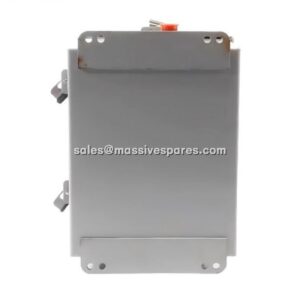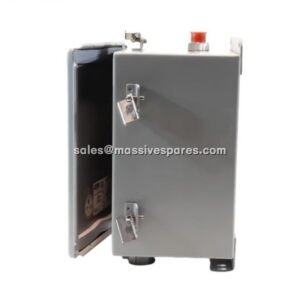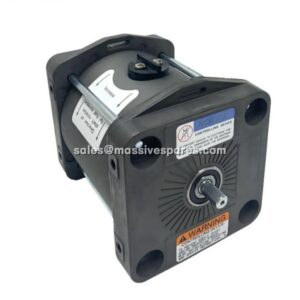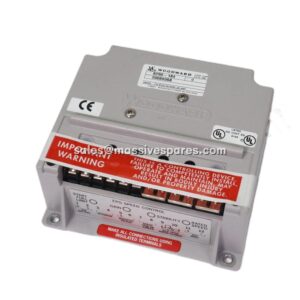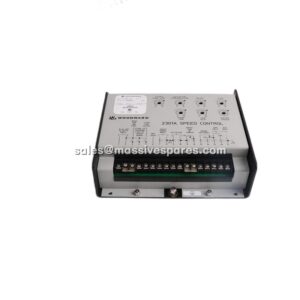

Description
Application Scenarios
A regional data centre operating four 1.5 MW diesel gensets for utility failure response experienced chronic load imbalance during weekly no-break transfer tests. One unit routinely carried nearly 40% of the block load while another idled near 20%, creating hot engine temperatures on the overloaded set and carbon build-up on the under-loaded one. After installing the 8408-005 in the master load-control position and configuring proportional percentage loading across all four units, the site achieved balanced kW distribution within the module’s rated ±1% accuracy band. The result was a measurable reduction in specific fuel consumption, cooler and more even exhaust temperatures across the fleet, and no further load-swing events during 10-second pickup tests.
The practical role of the 8408-005 in this kind of system is to prevent generators from “fighting” each other for frequency control. When paralleled sets are left in isochronous mode without proper coordination, or when droop settings do not match, the bus oscillates between overload and underload conditions. The module continuously monitors generator output and re-distributes load through controlled ramp rates, maintaining stable frequency and avoiding cascade trips during sudden demand steps.
Parameter
| Parameter | Value / Description |
|---|---|
| Product Model | 8408-005 |
| Manufacturer | Woodward |
| Product Category | LCD Generator Loading Control / Interface Module |
| Supply Voltage | 18–32 Vdc (24 Vdc nominal, SELV) — runs from standard 24 Vdc control-bus supplies |
| Load Distribution Accuracy | ±1% — keeps each unit proportionally loaded, avoiding overload on one machine |
| Frequency Range | 50 Hz / 60 Hz auto-compatible — suitable for global and marine installations |
| Control Modes | Droop control and isochronous load sharing — covers utility-parallel and islanded bus operation |
| Inputs | 3-phase PT (95–260 Vac L-L), 3-phase CT (3–7 Arms full load), load-share bus 0–3 Vdc |
| CT Burden | 0.1 VA per phase at full load — minimises metering impact on protection-class CTs |
| PT Burden | 1.6 W/phase at 240 Vac; 0.4 W/phase at 120 Vac |
| Communication | Analog load-share bus; digital interface compatible with Woodward control networks |
| Display | Integrated LCD — local readout of load, status, alarms and configuration values |
| Mounting | Panel or rack mount within generator control cabinet |
| Cooling | Natural convection — no forced-air requirement |
| Operating Temperature | –40 °C to +70 °C — rated for unheated substations and tropical engine rooms |
| Storage Temperature | –40 °C to +85 °C |
| Dimensions | 273.6 × 214.1 × 59.2 mm (approx. 270 × 180 × 60 mm per some listings) |
| Weight | Approx. 1.3–1.5 kg depending on revision |
| Protection Functions | Overload monitoring, under-frequency detection, voltage-stability support |
| Isolation | Galvanic isolation on critical signal paths for noise immunity |
Technical Principles and Innovative Values
Innovation Point 1 — Dual-mode load control in one module. The 8408-005 supports both electronic droop and isochronous load sharing, selected and tuned to suit the operating regime. Droop mode allows autonomous load division on a shared analog bus without a master controller, while isochronous mode holds bus frequency steady and divides kW proportionally across units. This removes the need for separate load-control hardware when a site migrates between islanded and utility-parallel modes.
Innovation Point 2 — True-RMS-based load calculation. The module derives real power from simultaneously sampled PT and CT inputs rather than relying on a single current signal. This gives it accurate load readings even on busbars with high SCR content and distorted voltage waveforms, a condition that causes conventional zero-crossing detectors to miscount cycles and drives unstable load sharing.
Innovation Point 3 — Local LCD diagnostics eliminate the laptop dependency. The integrated LCD provides immediate readout of load percentage, system status and alarm conditions at the cabinet front. During black-start or emergency response, an operator can read loading and verify synchronisation without connecting a PC, which materially shortens mean time to restoration.
Innovation Point 4 — Ramped, bumpless mode transitions. Load reference changes are applied through user-selected ramp rates when moving into or out of load-control modes. The transfer is bumpless, so a paralleling or unparallelling event does not produce a step change in fuel demand or a visible frequency transient on the bus.
Innovation Point 5 — Built-in protective supervision. Continuous monitoring for overload, under-frequency and voltage instability lets the module initiate corrective load adjustment or protective action before downstream electrical equipment is exposed to damaging conditions.