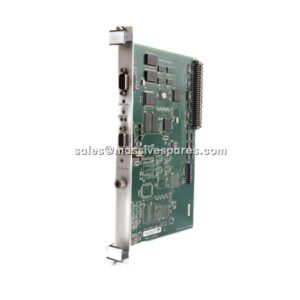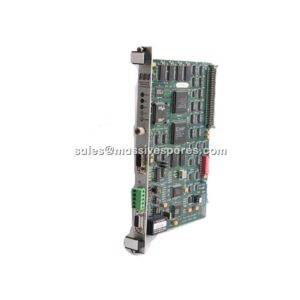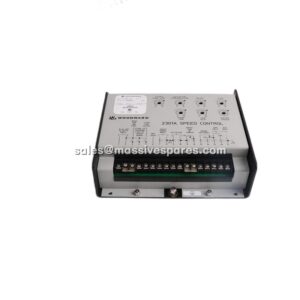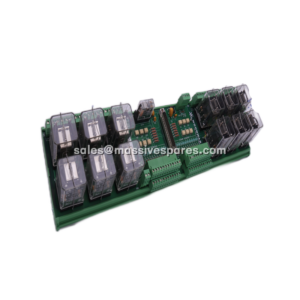

Description
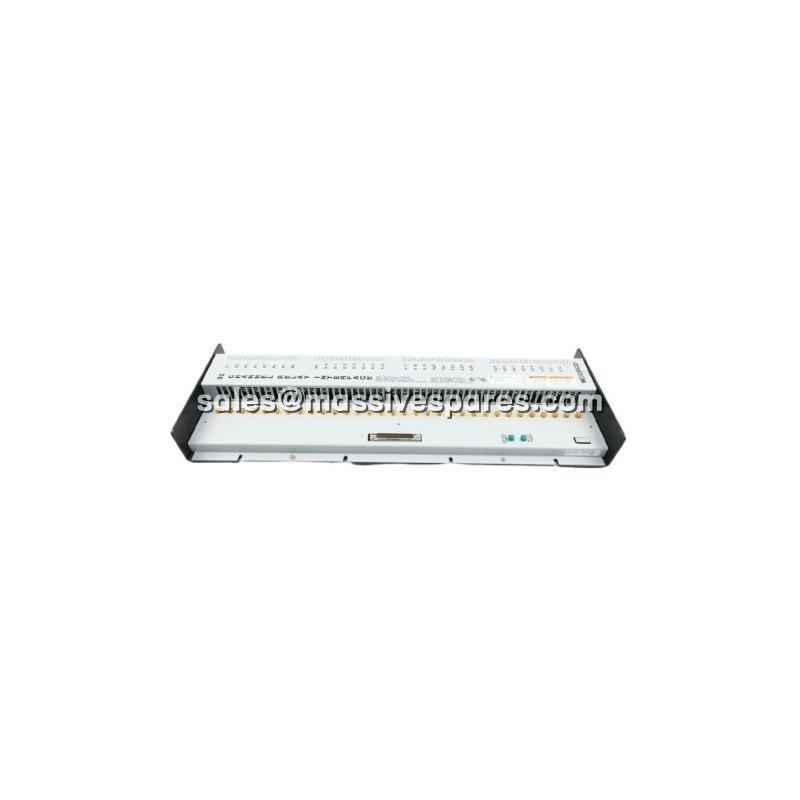
Technical Specifications
| Parameter Name | Parameter Value |
|---|---|
| Product Model | Woodward 5441-413 |
| Manufacturer | Woodward, Inc. |
| Product Type | Amp Relay Interface Module, discrete relay output interface |
| System Platform | Woodward MicroNet, MicroNet Plus and MicroNet TMR control chassis |
| Number of Channels | 32 independent relay channels |
| Relay Type | Electromechanical relay, SPDT (single-pole double-throw) contact configuration |
| Contact Rating | Up to 10 A per channel; 250 V AC / 30 V DC maximum switching voltage per series rating |
| Isolation Voltage | 1500 V AC minimum galvanic isolation between control logic and field circuits (input to output typically greater than 1500 V DC) |
| Coil / Logic Supply | 24 V DC nominal, wide-range input typically 18 V DC to 32 V DC |
| Input Interface | Digital control signals from the controller via the chassis backplane bus |
| Bus Standard | VERSAmodule Eurocard (VME) bus for connector specification and data transfer |
| Response Time | Less than 5 ms typical relay actuation after command |
| Contact Resistance | Less than 100 mΩ |
| Status Indication | Individual LED indicator per channel |
| Field Connection | Cables from the front of the board to field termination modules (FTMs) in the cabinet |
| Operating Temperature | -20°C to +60°C (-4°F to +140°F); extended ratings to +70°C on some system configurations |
| Storage Temperature | -40°C to +85°C (-40°F to +185°F) |
| Relative Humidity | 5% to 95%, non-condensing |
| Protection Rating | IP20, for installation inside a control cabinet or enclosure |
| Mounting | Chassis or rack mount within the Woodward control assembly; field terminal variants support panel or DIN-rail mounting |
| Protection Features | Over-voltage and short-circuit protection on the logic side, surge suppression across relay contacts |
| Certifications | CE and UL; system-level compliance with CSA and RoHS where applicable |
| Approximate Weight | 0.63 kg to 0.9 kg depending on assembly revision |
Main Features and Advantages
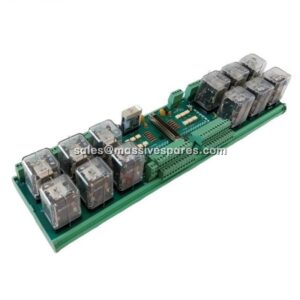
High-density output that shrinks the cabinet: Thirty-two independent relays in one module replace a panel full of interposing relays, terminal blocks and wiring. For a turbine control cabinet where every discrete output needs its own isolation and its own status lamp, the Woodward 5441-413 compresses that function into a single chassis slot, which reduces wiring labour, cabinet space and the number of terminations that can fail.
Amplification and isolation in one stage: The controller side of the Woodward 5441-413 sees only a low-current logic command, while the field side receives a dry contact rated up to 10 A. Because the contacts are voltage-agnostic, the same module can switch 24 V DC interlocks, 120 V AC annunciator circuits and 250 V AC solenoid or contactor coils, and the 1500 V isolation barrier keeps any fault on those circuits from reaching the control electronics. This dual role is what makes the module an amplifier in the practical sense: a small control signal governs a much larger load safely.
Deterministic switching for protection logic: Relays on the Woodward 5441-413 respond in under 5 ms, and because the switching element is electromechanical rather than a semiconductor, the behaviour under fault conditions is predictable and easy to verify during proof testing. In trip and emergency shutdown service, that predictability matters more than raw speed, and it is why relay interface modules remain the preferred output stage for turbine protection even in modern digital control systems.
Diagnostics built for the field: An LED on every channel gives immediate, unambiguous indication of which outputs are energised, so a technician investigating a failed start sequence or a spurious trip can trace the logic path without a laptop. Combined with the controller’s own diagnostics, this shortens fault-finding from hours to minutes and reduces the risk of unnecessary module replacement.
Designed for the Woodward ecosystem and for long service life: The Woodward 5441-413 plugs into the same VME-based architecture as the rest of the 5441 family, drawing logic power and commands from the chassis backplane and routing field wiring to field termination modules. Industrial-grade contacts are rated for high cycle counts under load, and the module is built to withstand the vibration, temperature cycling and electrical noise found in turbine halls, compressor stations and engine rooms.