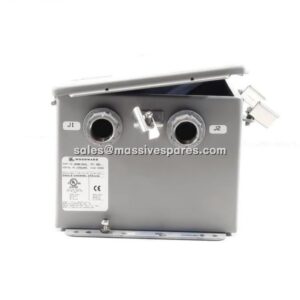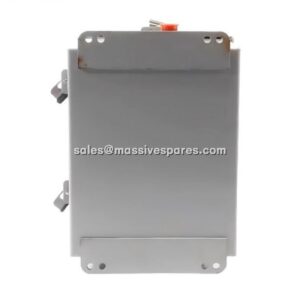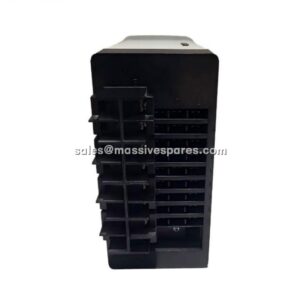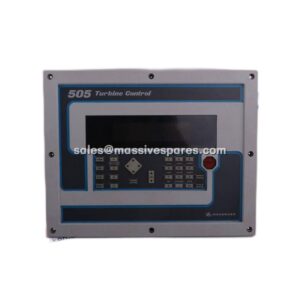

Description
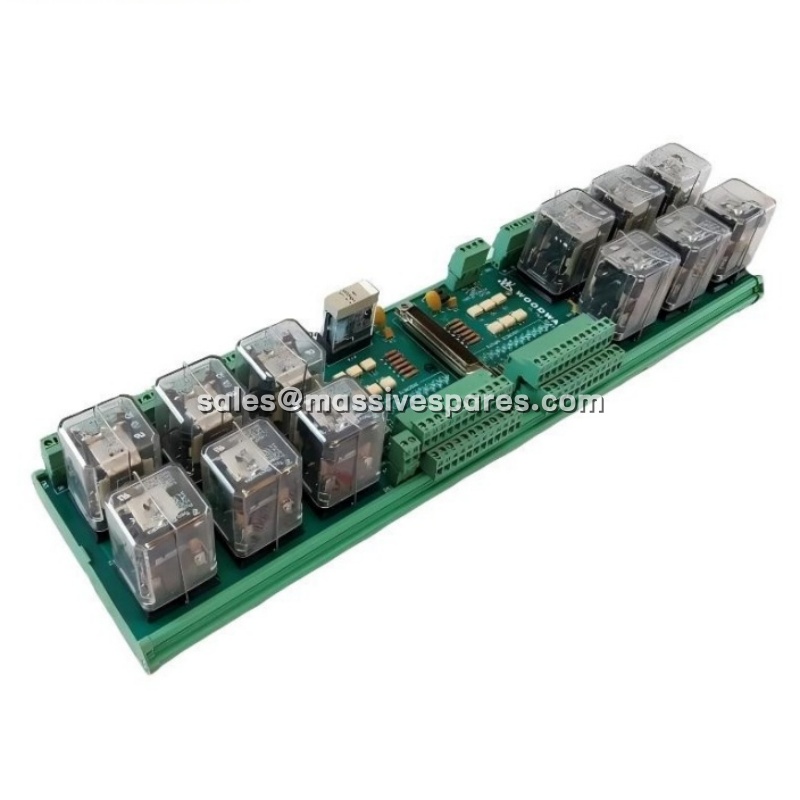
Technical Specifications
| Parameter Name | Parameter Value |
|---|---|
| Product Model | 5441-691 |
| Manufacturer | Woodward |
| Product Type | Relay Field Terminal Module (FTM) |
| Relay Count | 16 channels |
| Contact Form | DPDT (Double-Pole, Double-Throw) |
| Relay Installation | Socket-mounted, plug-in type |
| Coil Voltage | 24 VDC |
| Coil Current | Approximately 80 mA per relay |
| Isolation | 1000 Vrms between control and field circuits |
| Response Time | 15 ms |
| Operating Temperature | -40°C to +85°C |
| Dimensions | 150 mm × 110 mm × 40 mm |
| Weight | 0.45 kg |
| Compatible Systems | MicroNet Simplex, MicroNet Plus, 505, 505E |
| Mounting | DIN-rail or panel-mount |
| Product Origin | USA |
Main Features and Advantages
The WOODWARD 5441-691 delivers a combination of high-density relay integration, robust electrical isolation, and simplified field wiring that addresses the practical demands of turbine and engine control systems.
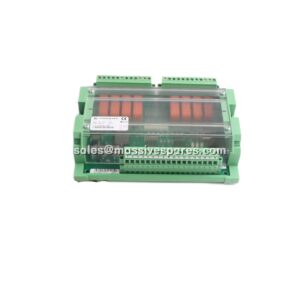
High-Density Relay Architecture: With 16 DPDT relay channels in a compact form factor, the WOODWARD 5441-691 maximizes I/O capacity within limited cabinet space. Each relay is socket-mounted for easy replacement, reducing maintenance downtime when individual contacts reach their operational life limit. The DPDT configuration provides both normally open and normally closed contact options for each channel, offering maximum flexibility in control logic design.
Enhanced Signal Isolation and Protection: The WOODWARD 5441-691 provides 1000 Vrms galvanic isolation between control logic and field circuits. This isolation barrier protects sensitive processor electronics from voltage transients, electrical noise, and fault currents that may originate in field wiring. The module’s magnetic blow-out arc suppression design further extends relay contact life when switching inductive loads such as solenoids and contactors.
Integrated Safety Features: The WOODWARD 5441-691 incorporates an I/O lockout relay that enables system-level interlock and emergency shutdown logic without requiring additional external hardware. This integrated safety layer simplifies protection scheme implementation while maintaining compliance with functional safety requirements in critical turbine and generator applications.
Real-Time Status Monitoring: The module provides comprehensive diagnostic capabilities through integrated LED indicators. Yellow LEDs indicate relay energized status, while green LEDs confirm relay power and control power presence. This visual feedback enables technicians to quickly verify channel operation and diagnose faults during commissioning and maintenance activities.
Application Field
The WOODWARD 5441-691 is deployed wherever Woodward control systems require reliable, high-density relay interfacing for critical industrial processes.
In power generation facilities, the WOODWARD 5441-691 serves turbine and generator control panels, managing discrete outputs for valve actuation, breaker control, alarm annunciation, and permissive logic. Steam turbine and gas turbine governing systems rely on the module’s relay outputs to interface with hydraulic actuators, trip solenoids, and auxiliary equipment controls. The integrated I/O lockout relay is particularly valuable in overspeed protection and emergency shutdown circuits.
Oil and gas applications deploy the WOODWARD 5441-691 in compressor stations, pipeline control systems, and offshore platforms. The module’s robust electrical isolation protects control electronics from the harsh electrical environments common in these facilities, while its wide operating temperature range ensures reliable performance in extreme climates. The 16-channel configuration suits medium-scale discrete control requirements including valve sequencing, status monitoring, and safety interlock implementation.
Industrial energy systems including reciprocating engine management, combined heat and power plants, and marine propulsion controls also utilize the WOODWARD 5441-691 for relay output termination. For facilities maintaining existing MicroNet Simplex or MicroNet Plus installations, the module remains an essential component for system maintenance and expansion projects despite changes in original manufacturing availability.