
Description
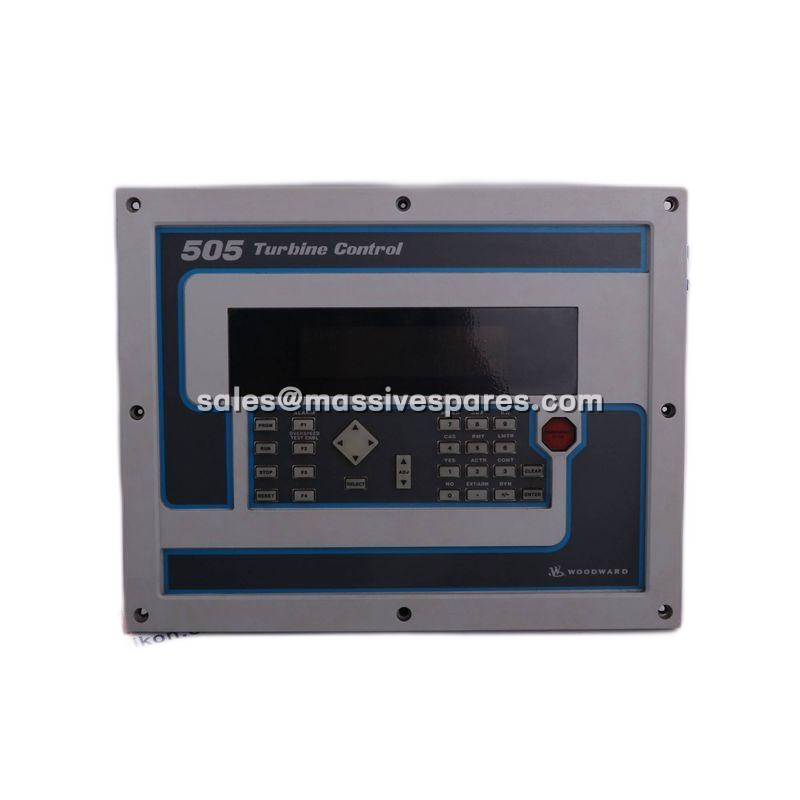
Technical Specifications
| Parameter Name | Parameter Value |
|---|---|
| Product Model | 9907-164 |
| Manufacturer | Woodward |
| Product Type | Digital governor control unit / microprocessor turbine controller |
| Series / Platform | Woodward 505 / 505E digital governor (second generation) |
| Input Voltage | +24 Vdc, 1 A typical |
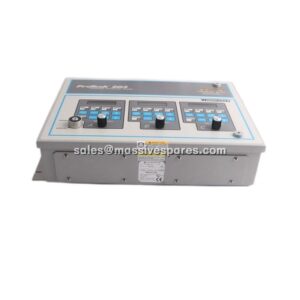
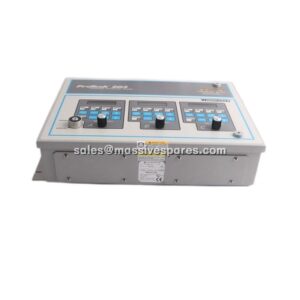
| Operator Interface | 30-key multifunction keypad with integrated overspeed test key |
| Display | Two lines × 24 characters, alphanumeric text display |
| Discrete Inputs | 16 contact inputs (4 dedicated, 12 programmable) |
| Analog Inputs | 6 programmable current inputs, 4–20 mA |
| Analog Outputs | 6 programmable outputs, including actuator drive signals (0–10 Vdc class) |
| Discrete Outputs | 8 programmable discrete outputs |
| Actuator Outputs | 2 actuator drive channels (configuration dependent) |
| Communication Interface | RS-232 / RS-422 serial ports, Modbus protocol support |
| Control Functions | Speed PID, auxiliary PID, cascade PID, critical speed avoidance, valve limiter, auto start sequence, overspeed test |
| Operating Temperature | −20 °C to +60 °C (−4 °F to +140 °F) |
| Storage Temperature | −40 °C to +85 °C (−40 °F to +185 °F) |
| Humidity Rating | 95% RH at 20 °C and 55 °C for 48 hours, non-condensing |
| Front Panel Protection | IP56 per IEC 60529 (NEMA 4X class, front panel) |
| Mounting | Panel / cabinet front mounting |
| Dimensions (W × H × D) | Approx. 356 mm × 279 mm × 102 mm (14 × 11 × 4 in) |
| Weight | Approx. 4.13 kg (9.11 lb) |
| Configuration Software | 505View or OpView service software |
Main Features and Advantages
Turbine-specific control algorithms, not generic PID: The Woodward 9907-164 carries the accumulated turbine control engineering of its platform as resident firmware. Three independent PID blocks — speed, auxiliary, and cascade — can be arranged so that steam inlet pressure, exhaust pressure, or compressor suction pressure becomes the controlling variable, with turbine speed serving as the inner loop. Critical speed avoidance automatically accelerates the machine through resonance bands instead of allowing the operator to dwell there, while the valve limiter constrains actuator travel to a safe mechanical envelope during start-up and warming.
Automated start-up reduces operator-dependent risk: Manual turbine run-ups place the burden of warm-up rates, soak times, and critical-band transit on a human being, and that is where most start-up damage originates. The Woodward 9907-164 executes a programmed automatic start sequence that walks the machine from turning gear through warm-up, acceleration, critical speed transit, and onto rated speed or synchronisation, holding each ramp and dwell to configured values. The result is a repeatable start that does not vary with shift, fatigue, or experience level.
Field-programmable without a laptop: Commissioning engineers and maintenance technicians can reach every configuration layer of the Woodward 9907-164 through the front-panel keypad and menu structure. Parameters such as rated speed, warm-up setpoints, idle speed, droop and isochronous settings, and trip levels can be reviewed and adjusted on the turbine deck, which matters enormously during an outage when the alternative is carrying a service computer through a permit-controlled area. The 505View service software provides the same access from a workstation when remote or archived configuration work is preferred.
Open serial communications for plant integration: With RS-232 and RS-422 ports running Modbus, the Woodward 9907-164 reports speed, load, valve position, alarm and trip status to a DCS, SCADA, or balance-of-plant Historian without a proprietary gateway. Operators in the control room see the same values the local panel shows, and plant-wide sequence-of-events recording can capture governor alarms alongside the rest of the unit’s trips.
Industrial hardware for a long service life: The front panel meets IP56 ingress protection and the unit is rated for continuous operation from −20 °C to +60 °C with 95% non-condensing humidity, so it tolerates the heat, dust, and humidity of a turbine hall or a compressor shelter. Relay and contact inputs accept dry plant contacts directly, and the separate analog input channels accept standard 4–20 mA transmitter loops without additional signal conditioning.