
Description
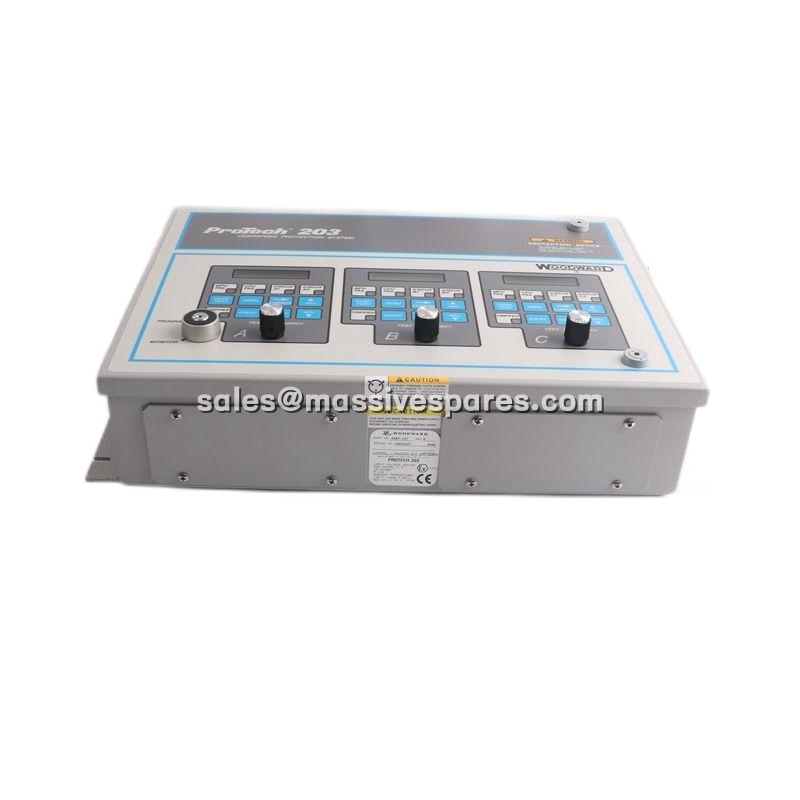
Application Scenarios:
Consider a captive cogeneration plant at a pulp and paper mill. Two steam turbine-driven generators, 6 MW each, feed an isolated plant bus that also has a weak utility tie. The original mechanical ballhead governors still sit on the governor stands as a backup, and each turbine now carries a Woodward PGPL electrohydraulic actuator. The plant’s pain is familiar: when a rolling mill motor starts, the two units “fight” — one takes the step load, the other backs off, circulating current climbs, and the bus frequency dips far enough to trip sensitive drives.
Installing 9905-021 on each turbine solves that in an afternoon of commissioning. Each control reads its own magnetic pickup, compares frequency to the rated-speed reference, and drives its actuator through the 0–200 mA loop. Because the actuator is reverse-acting, a loss of control signal drives the actuator to full fuel rather than to shutdown — the mechanical ballhead governor simply picks up the turbine and the unit stays online instead of tripping the mill. Once the units are synchronized and the generator breakers close, the 0–6 Vdc load sharing lines tie the two controls together, and both units carry load in proportion to their rating. The frequency dip on motor starting collapses, and operators stop babysitting the throttle.
The same pattern repeats wherever low-voltage DC is the only control power available: remote gas-engine gensets on 24 Vdc battery banks, offshore and marine generator switchboards, pipeline compressor stations that parallel to a utility bus in droop mode, and standby plants that must start cold in Arctic or desert ambient conditions.
Parameter:
| Parameter | Value / Description |
|---|---|
| Product Model | 9905-021 |
| Manufacturer | Woodward |
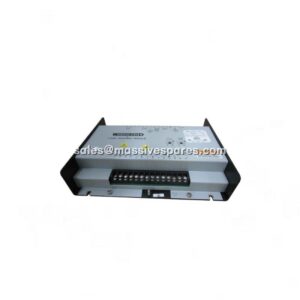
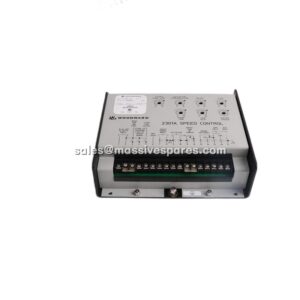
| Product Category | Analog electronic load sharing and speed control (governor module) |
| Series / Family | 2301A LSSC, 9905 series — the low-voltage model group (20–40 Vdc) |
| Power Supply | 20–40 Vdc, 24 Vdc nominal, ≤ 15 W; must be fed from a SELV-classified source — runs directly off the station battery bank with no inverter |
| Actuator Output | 0–200 mA DC into a single actuator, 7.5 Vdc maximum — the mA value is the fuel/rack command, not a voltage command |
| Control Action | Reverse acting: decreasing actuator current calls for more fuel, so total signal loss fails safe to full fuel and lets a mechanical backup governor take over |
| Speed Sensing | Magnetic pickup (MPU) input, 1.0–30 Vac, 100–300 Ω impedance; switch-selectable bands of 500–1500 / 1000–3000 / 2000–6000 / 4000–12000 Hz to match gear teeth × RPM ÷ 60 |
| Load Sensing & Sharing | 3-phase 90–240 Vac PT and CT input, 45–66 Hz; analog 0–6 Vdc load sharing lines, share accuracy ±5% of rated load with matched speed setting |
| Control Modes | Isochronous (constant speed) with the droop pot fully counter-clockwise, or 0–10% droop for infinite-bus and paralleled operation |
| Interfaces | 29-point screw terminal strip; ±5 Vdc input for a Woodward SPM-A synchronizer; 0–100 Ω external speed trim (0–10%); acceleration ramp 0–10 s idle-to-rated; no deceleration ramp on this variant |
| Environmental & Mechanical | –40 to +85 °C operating; 4 G vibration 5–500 Hz; 60 G shock; sheet-metal chassis, approx. 387 × 181 × 64 mm, approx. 1.8 kg; panel or chassis mount inside a closed control cabinet; UL Listed for ordinary locations (E97763) |
Technical Principles and Innovative Values:
- Innovation Point 1: Fail-safe reverse action. 9905-021 outputs maximum current at rest and drives the actuator toward full fuel if the control signal or supply collapses. Where a forward-acting or direct-acting control would shut the prime mover down, this topology hands control back to a mechanical ballhead governor. For steam turbines and critical base-load engines, that is the difference between a controlled excursion and a plant trip.
- Innovation Point 2: Latency-free analog load sharing. Paralleled units exchange a 0–6 Vdc signal over dedicated sharing lines derived from the CT/PT load sensor. There is no polling cycle, no baud rate, no gateway — proportional kW sharing is continuous and deterministic, which is why analog 2301A systems remain stable where some digital retrofits oscillate under fast load steps.
- Innovation Point 3: One card, four prime mover classes. The internal range switch lets the same 9905-021 be matched to diesel engines, gas engines, steam turbines or gas turbines simply by selecting 500–1500, 1000–3000, 2000–6000 or 4000–12000 Hz. A single spare part number can therefore cover an entire mixed fleet, cutting spares inventory dramatically.
- Innovation Point 4: Zero-software commissioning. Rated speed, gain, reset, actuator compensation, load gain and droop are all front-panel potentiometers. In remote sites, secure facilities and brownfield outages where laptops are restricted or unavailable, a technician can commission 9905-021 with a screwdriver and a multimeter — typically in a single shift.
- Innovation Point 5: Drop-in continuity for an installed base. External wiring on reverse-acting controls is identical to direct-acting controls, so 9905-021 replaces like-for-like in existing 2301A panels without redesigning the terminal strip, PT/CT circuits or sharing lines. Against a full digital migration, that removes rewiring cost, revalidation and production downtime from the business case.
Application Cases and Industry Value:
Case 1 — Mill cogeneration retrofit (two steam turbine generators on an isolated bus). The plant replaced aging hydraulic governors with PGPL electrohydraulic actuators driven by 9905-021 controls, keeping the mechanical ballheads in place as backup. Commissioning sequence: set droop at 4%, null the actuator at 0 mA, bump speed until the synchroscope stopped drifting, close the breaker, then raise load gain until both units tracked within ±5% of rated load. Result: bus frequency excursion on mill motor starts dropped from roughly 1.5 Hz to under 0.3 Hz, circulating current between the machines essentially disappeared, and the plant removed two unplanned outages per year attributed to load fighting. Maintenance reported the biggest gain as predictability — tuning is now a documented potentiometer setting, not a mechanical linkage adjustment that drifts.
Case 2 — Remote gas-engine genset island with 24 Vdc battery power. A three-unit landfill-gas genset station had no reliable AC control power and was limited to a 24 V battery bank. 9905-021, being the low-voltage 20–40 Vdc variant, was installed directly on the battery bus with no inverter and no additional power supply. All three units parallel in isochronous mode over the 0–6 Vdc sharing lines under 9905-021 control. The station now runs unattended for weeks, starts reliably at –25 °C, and the operator keeps one 9905-021 on the shelf as a common spare for all three machines — a spare-parts strategy that a mixed digital fleet could not support.
In both cases the industry value is the same: higher automation level without a DCS migration, lower maintenance cost through a single standardized analog platform, and improved production safety through a control topology that fails toward continued operation rather than toward a trip.
Related Product Combination Solutions:
- 9905-020: the forward-acting twin of 9905-021 — identical 20–40 Vdc supply, 0–200 mA, single actuator, no decel ramp — selected when increasing actuator current must mean increasing speed.
- 9905-023: reverse-acting, low-voltage, 0–400 mA output, for larger actuators and higher-torque fuel valves that need more drive current than 9905-021 delivers.
- 9905-029: reverse-acting 0–200 mA variant with the optional deceleration ramp (approximately 20 seconds rated-to-idle), chosen where a turbine or engine requires a controlled coastdown instead of the instant return 9905-021 provides.
- 9905-025: reverse-acting tandem-actuator version for machines with split fuel and gas valves or dual-stage racks that a single-channel 9905-021 cannot drive.
- 9905-031: the high-voltage equivalent (88–132 Vac or 90–150 Vdc, 0–200 mA, reverse acting, single actuator), used where a 125 Vdc station battery exists and 24 Vdc distribution is not available.
- 9905-002: Woodward SPM-A synchronizer, feeding the ±5 Vdc speed/phase matching signal into 9905-021 so that breaker closure happens automatically once voltage, frequency and phase align.
- PGPL Actuator/Driver: the electrohydraulic actuator designed for 0–200 mA Woodward controls including the 2301A series; paired with 9905-021 it converts the current command into fuel-valve or rack position with self-contained oil supply and optional integral magnetic pickup.
- 2301D / 2301D-EC (8273-501 / 8273-505): the digital upgrade path for sites that later need Modbus communications, soft load transfer and PC-based configuration; it interoperates with analog load sharing lines, so it can be phased in alongside existing 9905-021 units rather than replacing the whole system at once.