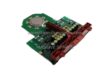
Application Scenarios
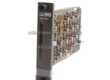
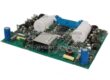
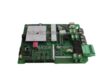
At a 330 MW coastal thermal power plant, following a scheduled maintenance outage, the unit exhibited terminal voltage drift during steady-state P-Q dispatch, with fluctuations reaching ±1.8%. The “EXC FAULT” indicator on the UNITROL 6000 front panel flickered amber every twenty to forty minutes. Electrical personnel retrieved the event log and found recurring alarms for “AVR loop instability—feedback noise threshold exceeded.” Troubleshooting ultimately pointed to the UNS2880B-P (3BHE014967R0001) in Slot 2 of the DSR rack—a reference buffer in one of the 16-bit ADC channels had drifted, contaminating the rotor current feedback entering the PI loop and causing continuous hunting in the firing angle output. Fortunately, the plant had a UNS2880B-P V1 spare on the shelf purchased three years prior. Following the shutdown, power-down, board extraction, board replacement, power-up, and self-test sequence, voltage stability returned to ±0.2% within one synchronization cycle. A follow-up eighteen months later showed zero recurrence. The plant’s electrical supervisor put it directly: “The UNS2880B-P is the kind of spare where ‘if it drifts, the whole unit’s P-Q is compromised.’ We now keep two per UNITROL 6000 cubicle—one online, one cold standby”.
Parameter
| Main Parameters | Value/Description |
|---|---|
| Product Model | UNS2880B-P V1 |
| Order Code | 3BHE014967R0001 |
| Manufacturer | ABB Switzerland, Baden |
| Product Category | COB PCB Assembly / Excitation Control Main Board |
| Compatible Systems | UNITROL 5000 / 6000 / 6800 static excitation; ACS 5000 / 6000 compatible |
| Processor | 32-bit RISC / Freescale PowerQUICC class |
| Onboard Storage | NVRAM (excitation parameters, calibration data, event records) |
| Control Loop Update Rate | 10 kHz (AVR PI algorithm) |
| Analog Input Resolution | 16-bit ADC (PT/CT feedback) |
| Downstream Interface | Fiber optic to GDI/GDI2 gate units (up to 6 pulses/cycle) |
| External Communication | RS485 (Modbus RTU), CAN bus, backplane bus |
| Isolation Withstand | Control side ↔ power side ≥2.5 kV AC |
| Protection Functions | OEL, UEL, V/Hz limit, Loss-of-Field (LOM) detection |
| Operating Temperature | 0°C to +60°C (cabinet internal) |
| Mounting | Rack slot / backplane insertion |
Technical Principles and Innovative Values
- Innovation Point 1: 10 kHz AVR Loop with 16-bit Feedback Path. The UNS2880B-P V1 runs the UNITROL AVR PI algorithm at a 10 kHz update rate—roughly five times faster than traditional excitation control boards, which typically stop at 2 kHz. Rotor voltage, current, and PT-secondary terminal voltage are sampled through 16-bit ADCs, with quantization noise below 0.02%. This means that even during P-Q transients (such as line reactor switching or 30% sudden load rejection), the firing angle output to the thyristor bridge remains smooth. For grid-connected units requiring steady-state voltage regulation better than 1%, this combination is non-negotiable.
- Innovation Point 2: Six-Pulse Firing with Onboard Limiter Stack. The 3BHE014967R0001 does not merely calculate firing angles—it distributes 6 opto-isolated firing pulses per 50 Hz cycle to the three-phase full-controlled bridge, while onboard firmware runs Over-Excitation Limit (OEL), Under-Excitation Limit (UEL), V/Hz over-flux limit, and Loss-of-Field impedance relay (LOM). These protection functions execute locally at the excitation control layer, independent of upper-level DCS or plant monitoring systems, forming the first line of rapid defense.
- Innovation Point 3: Fiber Optic Isolation and GDI Coordination Architecture. In the hierarchical architecture of UNITROL 5000, the UNS2880B-P sits between the CIN control interface board and the GDI/GDI2 gate units, sending firing commands downstream to the power bridge via fiber optics and reading back status. The fiber optic link achieves potential isolation at the multi-kV