Product Overview
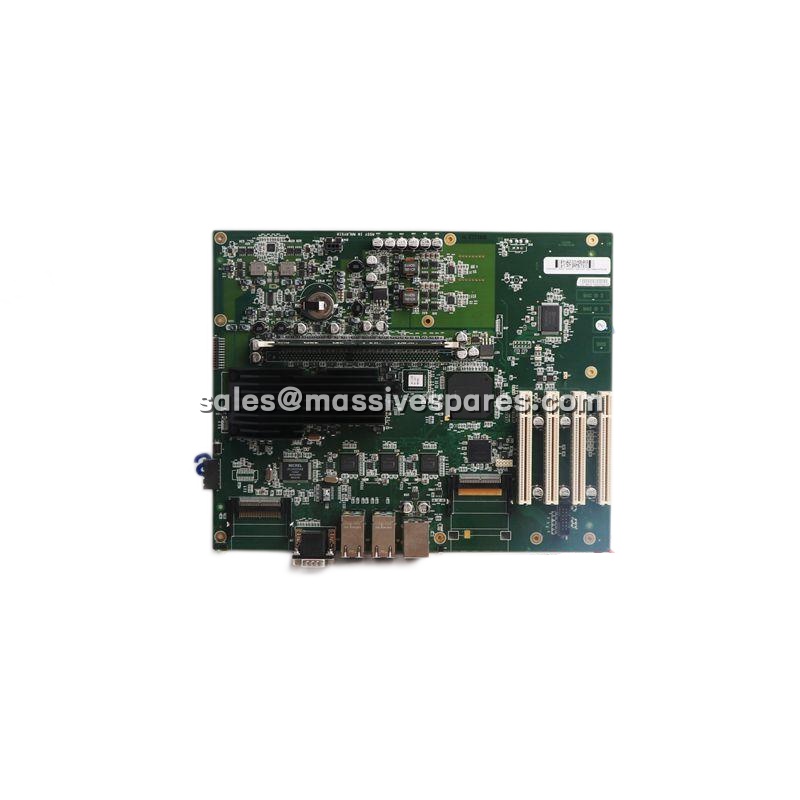
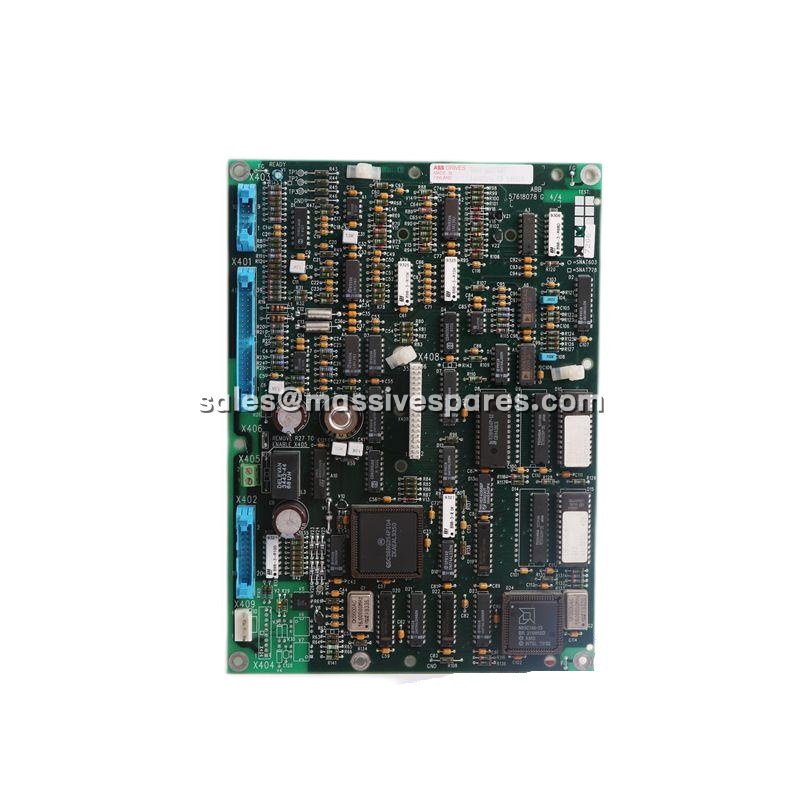
The ABB 6204BZ10100 is the central processing unit of the ABB SC 6200 controller family used within the Advant MOD 300 distributed control system, the platform that grew out of the Taylor MOD 300 line and was extended in 1988 with the SC controller, Taylor Ladder Logic and TRIO I/O. In a MOD 300 architecture the controller module performs the primary functions of data acquisition and control, including I/O processing, continuous control, interlocking and sequential control as well as communications, and the ABB 6204BZ10100 is the board that carries that responsibility for its subsystem. It is also catalogued with the variant designation ABB 6204BZ10100F, and in older documentation and surplus channels the two numbers are treated as the same functional CPU, with additional revision suffixes such as B, C, D and G appearing across the installed base.
What makes the ABB 6204BZ10100 distinctive is that it is not a bare processor card but a controller with its own operator interface. The module carries a menu-based control panel with an eight-line by forty-character illuminated display, twelve status LEDs for plant and alarm conditions, and configuration held in non-volatile memory so that a control strategy survives a power cycle without reloading. In the applications where this CPU is most often encountered, that local panel is not a convenience but an operational requirement: technicians configure, test and restart plant equipment directly at the controller faceplate, without a workstation connected.
Functionally, the ABB 6204BZ10100 supervises demanding auxiliary plant systems. Published feature sets describe monitoring of plant shunts, monitoring and control of up to sixty-four rectifiers, automatic rectifier restart, multiple rectifier fail alarms, float and boost mode control, reserve engine transfer, alarm cut-off and alarm test, plus a traditional office alarm interface with sixteen relays and a hardwired backup high-voltage shutdown circuit. The ABB 6204BZ10100 therefore sits at the intersection of DCS control and protective shutdown logic, which is why it remains a critical spare on sites that still run MOD 300 and why ABB continues to offer refurbished hardware and an evolution path for owners of this platform.
Technical Specifications
| Parameter Name | Parameter Value |
|---|---|
| Product Model | 6204BZ10100 (also supplied as 6204BZ10100F) |
| Manufacturer | ABB (ABB Industrial Systems / Taylor heritage) |
| Product Type | SC Controller CPU Module / Central Processing Unit |
| Product Platform | ABB SC 6200 controller family for Advant MOD 300 DCS |
| Processor Architecture | 32-bit industrial control processor (80-bit floating-point capability in some documentation) |
| Processor Speed | 15 MHz (revision dependent) |
| Memory | 32 KB RAM with 16 KB EEPROM; up to 1 MB ROM on later configurations; configuration stored in non-volatile memory |
| Input Voltage | 24 V DC nominal (extended 12–48 V DC tolerance in some variants) |
| Power Consumption | Typically under 2.5 W to approximately 10 W depending on configuration |
| Digital I/O Capability | 16 digital inputs and 16 digital outputs (backplane and configuration dependent) |
| Operator Interface | Menu-based control panel with 8-line x 40-character illuminated display |
| Status Indication | 12 LEDs for plant and alarm status |
| Alarm Interface | Traditional office alarm interface with 16 relays |
| Shutdown Function | Hardwired backup High-Voltage Shutdown (HVSD) circuit |
| Control Functions | Monitoring and control of up to 64 rectifiers, automatic rectifier restart, multiple rectifier fail alarm, float/boost mode control, reserve engine transfer, plant shunt monitoring, alarm cut-off and alarm test |
| Communication Interfaces | MOD 300 controller subsystem bus, DCN control network; serial RS-485, Modbus RTU/TCP, CANopen and Ethernet on revision-dependent configurations |
| I/O Expansion | Local I/O via termination board with 16 analogue inputs, 8 analogue outputs and up to 48 digital channels, plus Taylor Remote I/O (TRIO) option |
| Operating Temperature | -25 °C to +60 °C |
| Storage Temperature | -40 °C to +85 °C |
| Humidity | 5% to 95% RH, non-condensing |
| Protection Class | IP20, for installation inside a control cabinet |
| Dimensions (W x H x D) | Approximately 86 x 100 x 32 mm (board); up to 356 x 51 x 483 mm in full assembly listings |
| Weight | Approximately 0.2 kg (board) to 1.8 kg (full assembly, listing dependent) |
| Country of Origin | Sweden |
| Lifecycle Status | Obsolete / legacy – new surplus, refurbished and tested units only |
| Alternate Part Numbers | 6204BZ10100B, 6204BZ10100C, 6204BZ10100D, 6204BZ10100G, AA P194016 |
Main Features and Advantages
Controller-level intelligence with a built-in operator panel:
The ABB 6204BZ10100 gives maintenance personnel a full menu-driven interface directly on the module, with an eight-line illuminated display and twelve status LEDs that report plant and alarm conditions at a glance. On a plant where the engineering workstation may be a shared resource or where a fault must be diagnosed in the field at night, this local interface turns a controller cabinet into a usable control point, and it removes the dependency on a connected operator console during commissioning and restart.
Non-volatile configuration with protective shutdown independence:
Configuration for the ABB 6204BZ10100 is held in non-volatile memory, so a power interruption does not wipe the control strategy and the controller returns to service with its settings intact. More importantly, the board carries a hardwired backup high-voltage shutdown circuit that operates independently of the processor and its software. That separation matters in protective applications: even if the CPU or its application is compromised, the hardware shutdown path remains available, which is exactly the philosophy safety-conscious plants expect from a controller of this generation.
Purpose-built supervision of rectifier and auxiliary plant systems:
Few general-purpose CPUs offer native support for monitoring and controlling up to sixty-four rectifiers, and the ABB 6204BZ10100 combines that capability with automatic rectifier restart, multiple rectifier fail alarms, float and boost mode control, plant shunt monitoring and reserve engine transfer. For installations where rectifiers, chargers and DC distribution are the heart of the auxiliary system, these functions are already engineered into the controller rather than being built from scratch in application logic, which reduces both engineering effort and the risk of an untested strategy.
Straightforward integration within the MOD 300 ecosystem:
Because the ABB 6204BZ10100 is a genuine member of the SC 6200 controller family, it works with the MOD 300 controller subsystem, the local termination board I/O set of 16 analogue inputs, 8 analogue outputs and up to 48 digital channels, and the Taylor Remote I/O option, and it can participate in the redundancy schemes the platform provides. Sites that standardise on the original module avoid the re-engineering, re-wiring and re-commissioning that any substitute would demand, and they preserve the evolution path ABB offers toward Advant and System 800xA architectures.