Application Scenarios
Consider a chemical blending skid where four metering pumps must receive precise 4–20 mA speed commands from the ControlLogix controller. The pumps regulate the flow of four different additives into a main process line, and even a small deviation in the analog output can throw off the blend ratio—resulting in off-spec product or, worse, a rejected batch.
The 1756-OF4/A handles this by providing four independent 16-bit analog outputs, each configurable for 0–20 mA operation. The 16-bit resolution translates to approximately 65,000 discrete steps across the 4–20 mA range, giving the controller fine control over pump speed. More importantly, the module’s per-channel diagnostics monitor for open circuits, underrange, and overrange conditions, immediately flagging a failed pump or broken loop wire before the blend ratio drifts out of tolerance. For the plant, this means fewer off-spec batches, less wasted product, and confidence that the analog control loop is actually delivering what the program intends.
Parameter
| Parameter | Value / Description |
|---|---|
| Product Model | Allen-Bradley 1756-OF4/A (Series A) |
| Manufacturer | Rockwell Automation / Allen-Bradley (USA) |
| Product Category | ControlLogix Analog Output Module |
| Number of Outputs | 4 single-ended, independently configurable |
| Output Types | Voltage or current (per channel) |
| Voltage Ranges | ±10 V, 0–10 V, ±5 V |
| Current Ranges | 0–20 mA, ±20 mA (4–20 mA standard) |
| Resolution | 16-bit |
| Conversion Time | 2 ms per channel |
| Diagnostic Points | 8 per channel |
| Isolation Voltage | 750 V continuous |
| Module Power | 24 V DC (from chassis backplane or external) |
| Enclosure / Protection | None (open-style), IP20 when installed in cabinet |
| Mounting | DIN rail or panel mount |
| Operating Temperature | 0 °C to +60 °C |
| Storage Temperature | −40 °C to +85 °C |
| Dimensions / Weight | 132 × 35 × 120 mm; 0.26 kg (0.56 lb) |
Technical Principles and Innovative Values
Innovation Point 1 – Independently Configurable Channels: Each of the four outputs on the 1756-OF4/A can be set to a different range and type—one channel driving a 4–20 mA control valve, another feeding a ±10 V speed reference to a drive, and a third sending a 0–10 V signal to a proportional pressure regulator. This flexibility eliminates the need for range-changing jumpers or external signal converters, which are common on older analog modules.
Innovation Point 2 – 16-Bit Resolution With 2 ms Conversion: The 16-bit digital-to-analog conversion provides 65,536 discrete output levels, while the 2 ms per-channel conversion time keeps the module responsive enough for closed-loop control. In a pressure control loop, for example, the difference between 12-bit and 16-bit resolution is the difference between a noticeable step in valve position and a smooth, continuous adjustment that the process never sees.
Innovation Point 3 – Per-Channel Diagnostic Coverage: The module provides 8 diagnostic points for each output channel, covering conditions such as open circuit, underrange, overrange, and output status. Rather than discovering a failed loop wire during the next maintenance round, the controller knows immediately and can alarm the operator, shut down the affected part of the process, or switch to a backup loop.
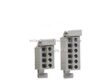
Innovation Point 4 – Removable Terminal Block Design: The 1756-OF4/A uses a removable terminal block (compatible with 1756-TBCH and 1756-TBNH blocks), allowing the wiring to remain intact when the module is replaced. In a live plant, this is a material advantage: a faulty module can be swapped in under a minute without touching a single field wire, dramatically reducing both the outage window and the chance of a wiring error during reassembly.
Innovation Point 5 – 750 V Isolation and 24 V DC Operation: The 750 V continuous isolation between the field side and the backplane protects the control system from ground loops, induced transients, and the kind of electrical noise that is routine in motor-heavy environments. Combined with 24 V DC powering, the module integrates cleanly into standard control cabinet designs without requiring a separate isolated supply for the analog circuitry.
Application Cases and Industry Value
In a pharmaceutical fermentation plant, the 1756-OF4/A was used to control four 4–20 mA signals feeding into mass flow controllers that meter sterile air, nitrogen, and two feed streams into a bioreactor. The application demanded stable, drift-free analog outputs because even a 0.5 % deviation in the air-to-nitrogen ratio could stress the culture and reduce yield.
After commissioning, the plant reported that the 16-bit resolution and per-channel diagnostics gave them confidence in the loop integrity that they had not had with the previous 12-bit modules. When one mass flow controller developed an internal fault and began drawing the loop out of range, the 1756-OF4/A flagged the condition within one scan, allowing the operator to isolate the device before the batch was compromised. The plant estimated that the early detection saved a single batch worth approximately $45,000 in raw materials and lost production time.
In a steel mill in Eastern Europe, the 1756-OF4/A controls the speed references for four DC drive systems on a hot strip mill cooling line. The environment is electrically hostile—arc furnaces, large motor starters, and welding activity generate substantial noise on every cable run in the area.
The 750 V isolation and robust grounding design of the 1756-OF4/A proved essential. Prior to installation, the mill had experienced sporadic drive speed fluctuations that traced back to ground loop-induced offsets on the analog command signal. After installing the 1756-OF4/A with properly shielded and grounded analog cables, the speed fluctuations disappeared entirely. The maintenance team also appreciated the removable terminal block: when a module required replacement during a scheduled outage, the swap took less than two minutes and the wiring was verified correct on reassembly with no retesting required.