Application Scenarios
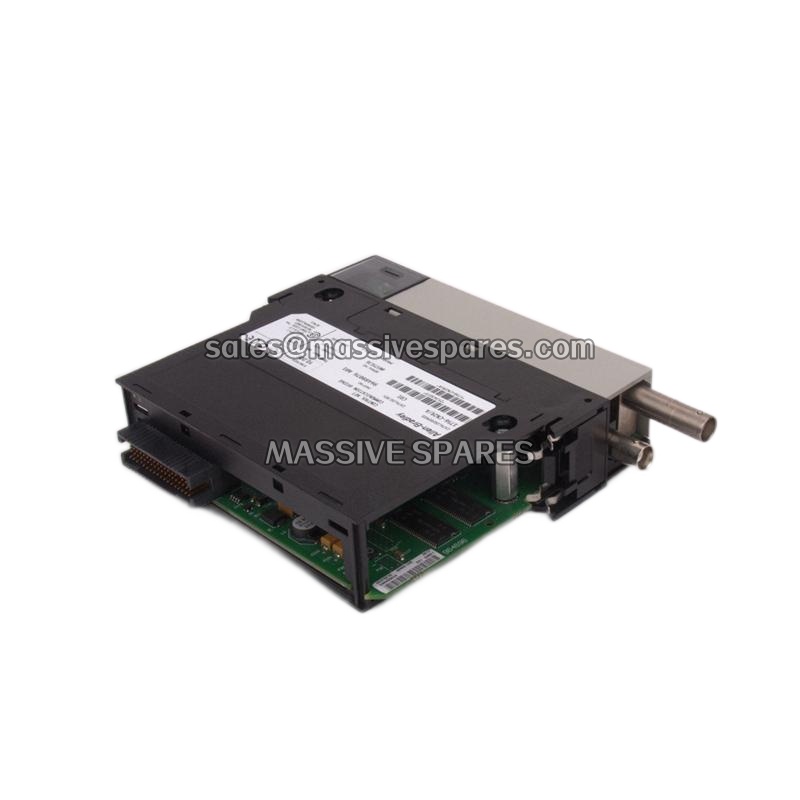
An automotive components welding line needed six servo-driven robots to perform synchronized positioning and welding, with position commands across all axes required to stay aligned within millisecond cycles—any drift would scrap an entire batch at the weld seam. The project team selected the 1756-M16SE as the motion backbone, linking the ControlLogix controller to Kinetix 6000 multi-axis drives at 8 Mbps with a 2 ms ring cycle. The fiber ring is inherently immune to the severe electromagnetic interference of a welding shop, and a single fiber replaced up to 18 digital cables per axis, freeing nearly forty percent of cabinet space. When one drive tripped on overload, the module’s ring status LED shifted from solid green to flashing red, letting maintenance locate the fault node without probing axis by axis—a direct example of how the 1756-M16SE converts communication reliability into line availability in high-speed multi-axis coordination.
Parameter
| Main Parameters | Value/Description |
|---|---|
| Product Model | 1756-M16SE (Series A) |
| Manufacturer | Allen-Bradley (Rockwell Automation) |
| Product Category | SERCOS Interface Module / Motion Control |
| Axes per Module | 16 (maximum) |
| Axes per Controller | 32 (maximum) |
| SERCOS Data Rate | 4 or 8 Mbps |
| Cycle Time (8 Mbps) | 0.5 ms (≤4 axes) / 1 ms (≤8 axes) / 2 ms (≤16 axes) |
| Communication Medium | Single fiber-optic ring (plastic or glass) |
| Backplane Current | 760 mA @ 5.1 V DC; 2.5 mA @ 24 V DC |
| Power Dissipation | 6.2 W (21.2 BTU/hr thermal) |
| Isolation Voltage | 50 V continuous |
| Compatible Drives | Kinetix 2000/6000/7000, Ultra3000 SERCOS |
| Weight | Approximately 0.60 kg |
The axis-to-cycle-time relationship is the key constraint at selection: if all 16 axes must participate in interpolated motion, the ring cycle must be set to 2 ms; if four axes or fewer demand the tightest response, it can drop to 0.5 ms. That trade-off needs careful weighing in high-speed packaging or flying-shear applications, where a shorter cycle means smaller position following error but comes at the cost of axis count.
Technical Principles and Innovative Values
Innovation Point 1: A fiber ring that severs the EMI coupling path. The 1756-M16SE uses a single fiber to form the SERCOS ring topology, with data traveling as light pulses bidirectionally between the module and each drive. In welding, stamping, or drive-dense environments, pulse commands over copper are easily buried by induced noise, while a fiber link cuts the electromagnetic coupling channel at its root. Field experience shows one fiber from this module can replace up to 18 digital cables per axis, cutting wiring cost and eliminating the intermittent communication dropouts caused by cable aging and loose terminals.
Innovation Point 2: Determinism born of a fixed telegram structure. Unlike some programmable SERCOS masters, the 1756-M16SE fixes the structure of its MDT (master data telegram) and AT (acknowledge telegram) in firmware; the only user-adjustable element is the number of probe inputs. That design may look inflexible, but it guarantees strict cycle determinism—every ring scan delivers position feedback and command issuance for all 16 axes in fixed sequence, with no jitter introduced by telegram restructuring. For multi-axis interpolation on machining centers or printing presses, that determinism is worth more than programmability.
Innovation Point 3: A clearly drawn drive-compatibility boundary. The module supports only SERCOS drives within the Allen-Bradley family (Kinetix 2000/6000/7000, Ultra3000, 8720SM, 1394 series), and firmware rejects drives outside the AB IDN subset. Attempting to drive third-party SERCOS devices such as Indramat ECO directly from the 1756-M16SE will not work. That limit must be settled at selection: if a project must retain existing third-party drives, move to the 1756-M08SEG (generic profile support) or an analog control approach. Stating the boundary plainly prevents far more rework than a vague compatibility promise.