Application Scenarios
A food-and-beverage plant was running a 1756-L71S on a high-speed bottling line and hitting two limits at once: the safety program had grown to the point where the standard task and the safety task were competing for scan time, and the line’s new vision system needed far more tag traffic than the 10/100 port could carry without eating into the I/O budget. Rewriting the program to fit was not an option — the validation paperwork alone would have taken months. The plant installed the 1756-L85E, kept the existing 1756 chassis and I/O, and gained 8 MB of user memory plus a 1 Gb EtherNet/IP port in the same physical slot.
The safety task now runs on its own execution time, so a guard-door event no longer has to wait behind a long standard-task scan. The 1 Gb port carries the vision-system tags and the HMI traffic without throttling the I/O, and the dual-IP configuration lets the IT department put the enterprise traffic on a separate address range from the control traffic. The project went through validation with the original logic intact; the only change the operators noticed was that the alarm list refreshed faster.
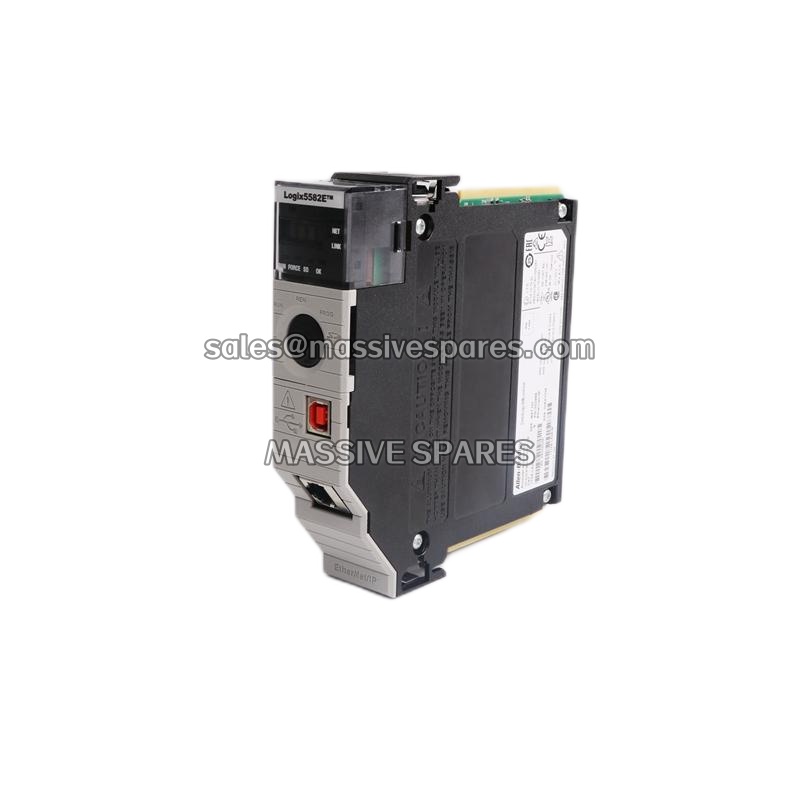
Parameter
| Main Parameters | Value / Description |
|---|---|
| Product Model | 1756-L85E |
| Manufacturer | Allen-Bradley / Rockwell Automation |
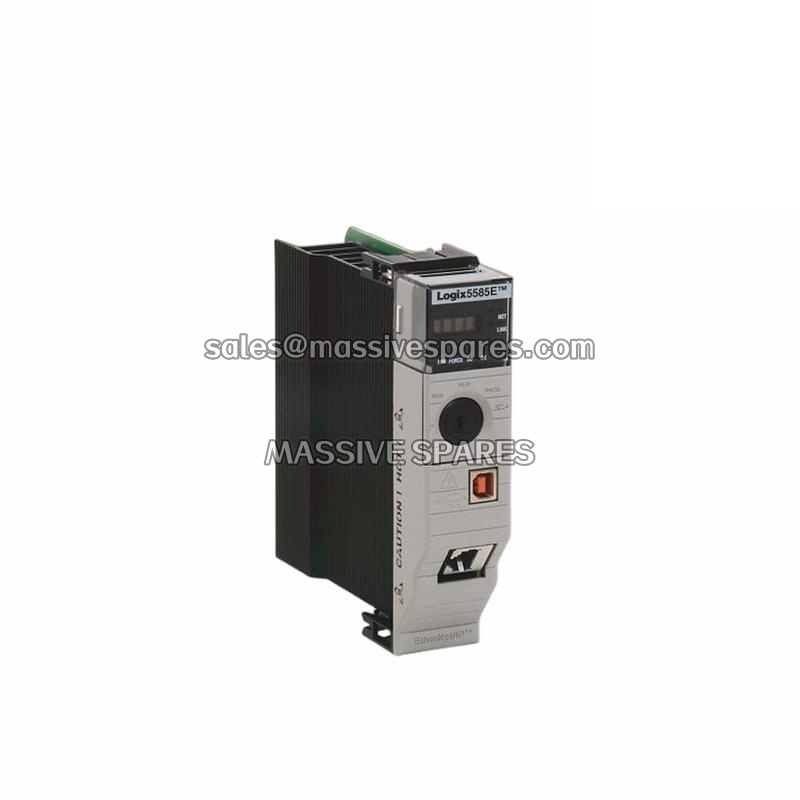
| Product Category | ControlLogix 5580 programmable automation controller (PAC) |
| Controller Family | 1756-L8x (5580 platform) |
| User Memory | 8 MB |
| Safety Memory | 4 MB maximum (1.98 MB available for safety code) |
| Task Capacity | 31 tasks: 1 continuous, 30 periodic |
| Program Capacity | 1000 programs maximum |
| SFC Capacity | 1500 SFC steps |
| Motion Axes | 16 Logix Motion axes (1 year control) |
| Motion Groups | 4 motion groups |
| Motion Instruction Capacity | 300 motion instructions |
| Event Tasks | 16 |
| Data Logging | 4 data logs, 6 MB total (2 MB per log) |
| EtherNet/IP Nodes | 256 standard + 128 redundant |
| EtherNet/IP Connections | 1024 standard + 256 redundant; 512 multicast capable |
| Onboard Ethernet | 1 × 10/100/1000Base-T, full-duplex, auto-negotiating, auto-crossover (1 Gb); RJ45 |
| Second Ethernet Port | None onboard — add a 1756-EN2T / 1756-EN2TR or 1756-EN3T for a second network |
| USB Port | 1 × USB 2.0 (12 Mbit/s), 5 V DC at 200 mA |
| SD Card Slot | 1 × Secure Digital card (FAT32, 2 … 32 GB); 0.75 W (5 V at 150 mA) |
| Power Dissipation | 5 W (17.1 BTU/hr) |
| Chassis Power Draw | 2.5 A @ 5.1 V DC (12.75 W); typical 1.2 A @ 5.1 V DC (6.1 W) |
| Heat Dissipation | 42 BTU/hr |
| Dimensions (H × W × D) | 139 × 31 × 138 mm (5.47 × 1.22 × 5.43 in) |
| Weight | 0.24 kg (0.53 lb) |
| Scan Time | 0.98 ms per 1K words of standard task logic |
| I/O Bus Scan Time | 2 ms for 30 modules |
| Backplane Current Draw (1756 Backplane) | 2.55 A @ 5.1 V DC |
| EtherNet/IP Port Current Draw | 0.24 A @ 5.1 V DC |
| Controller Current Draw (Chassis) | 3.1 A @ 1.2 V DC |
| Operating Temperature | 0 … 60 °C (32 … 140 °F) |
| Storage Temperature | -40 … 85 °C (-40 … 185 °F) |
| Relative Humidity | 5 … 95 % non-condensing |
| Shock / Vibration | 30 g operating, 50 g non-operating; 2 g at 10 … 500 Hz |
| Enclosure / Environment | Open-style module, IP20 per IEC 60529; pollution degree 2; overvoltage category II |
| Certifications | UL, cUL, CE, C-Tick, ATEX, FM, KC, IECEx, ABS marine |
| Keying | Electronic keying, software-configurable |
| Firmware | 1756-L85E / A; shipped with Studio 5000 Logix Designer version 31.00 or later |
| Replacement / Variant | 1756-L85EP (available in some regional and safety-oriented catalogs; confirm availability with the current Rockwell price list) |
| Compatible Chassis | 1756-A7, A10, A13, A17, A4, BERRY (consult the 1756 system wiring and selection guide for slot and power-supply constraints) |
| Compatible I/O | 1756 local I/O on the same chassis; 1756 remote I/O via EtherNet/IP or ControlNet (ControlNet requires the 1756-CN2 module and RSNetWorx for ControlNet) |
| Compatible HMI / Drive | PanelView 5000 terminals; PowerFlex 525, 755 and 755T drives; Kinetix 5500 and 5700 servo drives |
| Software | Studio 5000 Logix Designer (version 31.00 or later) |
| Communication Protocols | EtherNet/IP (CIP, CIP Motion, CIP Safety, CIP Sync, CIP Security, Time Synchronization) |
| Communication Services | Explicit messaging, produced/consumed tags, implicit messaging |
| Safety Functions | Emergency stop, two-hand control, safety gates, dual-channel emergency stop with the safety task |
| Languages | English and other European and Asian languages via the software and HMI |
| Battery | No battery required |
| Status Indicators | 4-character alphanumeric display plus standard controller status LEDs |
| Country of Origin | United States / Singapore (as marked on the product) |
| Lifecycle | Active, but verify lead time and stock level with the current price list before specifying |
A note on the figures in circulation: several reseller pages attach specs to the 1756-L85E that belong to other members of the 5580 family or to earlier ControlLogix generations — 16 MB or 32 MB of user memory, a second onboard Ethernet port, 16 GB of memory, 300–1000 motion axes, 4 GB SD card support, an integral 24 V DC input, or a “4 character status display” listed as a separate feature. The authoritative Rockwell publication 1756-TD002 and the current 1756 ControlLogix selection guide are consistent with the table above: 8 MB user memory, one 1 Gb port, no second port, 16 motion axes, and SD cards of 2–32 GB formatted FAT32. The 1756-L8x family members are distinguished by memory size, so matching the catalog number to the memory figure is the single most reliable check.
Technical Principles and Innovative Values
- Innovation Point 1 — Memory size, not architecture, separates the family. The L85E, L86E and L87E share the 5580 core; the 1756-L85E has 8 MB of user memory, the L86E 16 MB, the L87E 32 MB. This lets the plant size the controller to the program rather than to the cabinet. The program, the task structure and the safety project move between them unchanged, so a line that outgrows 8 MB upgrades by swapping the processor rather than rewriting the application.
- Innovation Point 2 — The safety task runs on its own time. Earlier ControlLogix generations mixed safety logic into the standard task and relied on the scan to be short. The 1756-L85E gives the safety task a separate execution time and a separate 4 MB safety memory area, with 1.98 MB available for safety code. A guard-door evaluation is therefore not delayed by a long data-logging or recipe routine, which is why the module appears so often on machines where safety response time is a calculated value rather than a hope.
- Innovation Point 3 — One Gigabit port changes the traffic model. At 1 Gb, the onboard EtherNet/IP port can carry 256 standard nodes and 128 redundant nodes, 1024 standard plus 256 redundant connections, and 512 of those connections can be multicast. The practical effect is that HMI traffic, drive traffic and I/O traffic no longer have to be rationed against each other — a common source of “why did the drive fault” calls on 10/100 controllers.
- Innovation Point 4 — 31 tasks and 1000 programs make large programs readable. A 30,000-rung single-file program is a maintenance liability. With 30 periodic tasks plus the continuous task, and up to 1000 programs, the 1756-L85E lets the program mirror the machine: one program per station, one periodic task per process loop, each with its own watchdog. The scan time of 0.98 ms per 1K words of standard task logic means the structure can be broken up without losing scan performance.
- Innovation Point 5 — CIP Security and time synchronization are built in. CIP Security lets the controller enforce authenticated and encrypted EtherNet/IP communication, so engineering workstations and HMIs are identified rather than merely addressed. Time synchronization then gives every event a consistent timestamp across the line — the prerequisite for any serious alarm analysis or batch record.
- Innovation Point 6 — No battery, and configuration changes without a download. The non-volatile memory model removes the battery-replacement round that used to dominate preventive-maintenance schedules. Combined with online edits and the ability to change I/O configuration while online, the 1756-L85E turns a configuration correction from a planned shutdown into a ten-minute job.
Application Cases and Industry Value
Case 1 — High-speed bottling line, memory and safety scan relief. A plant running a 1756-L71S was hitting the memory ceiling while the safety program continued to grow. Installing the 1756-L85E provided 8 MB of user memory and a dedicated safety task, so the standard task no longer had to share scan time with the safety logic. The line gained a 1 Gb EtherNet/IP port that carried the vision system’s tag traffic without throttling the I/O, and the project went through validation with the original logic untouched. The operators’ only visible change was a faster-refreshing alarm list; the maintenance team’s gain was a controller that no longer needed a battery.
Case 2 — Material handling with dual-IP segmentation. A distribution-center sorter needed to keep corporate network traffic separate from the control network for both security policy and troubleshooting. The 1756-L85E was configured with two IP addresses on the onboard 1 Gb port — one for the control VLAN, one for the enterprise VLAN — and the 256-node EtherNet/IP capacity was used to put the drive network and the I/O network on the same physical link without contention. The IT department retained its addressing scheme, the control engineer kept a predictable I/O scan, and the sorter’s throughput was no longer a victim of a file-transfer burst on the corporate side.