Technical Specifications
| Parameter Name | Parameter Value |
|---|---|
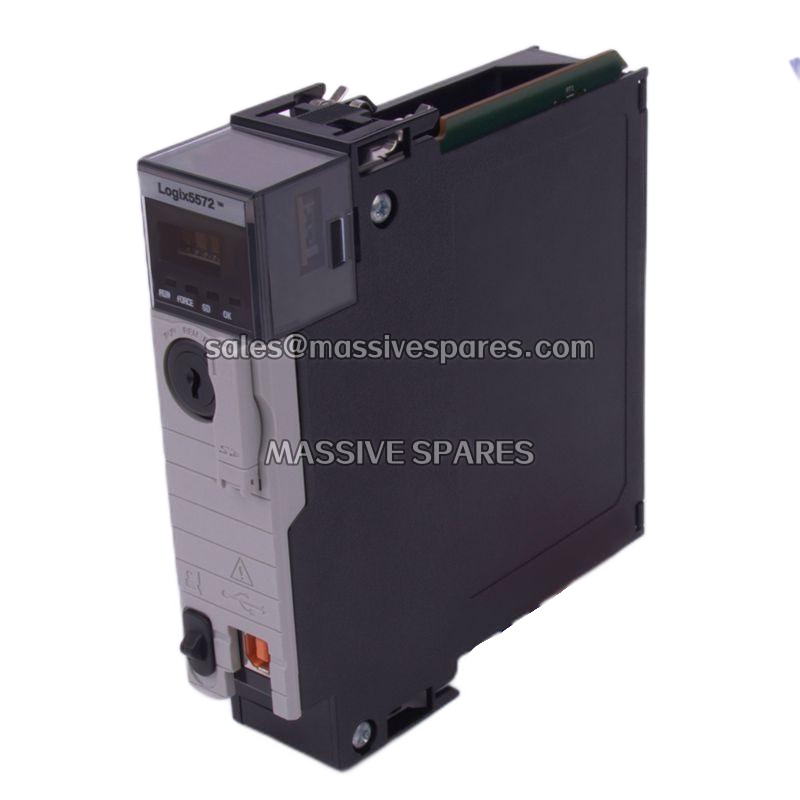
| Product Model | 1756-L72 |
| Manufacturer | Rockwell Automation / Allen-Bradley |
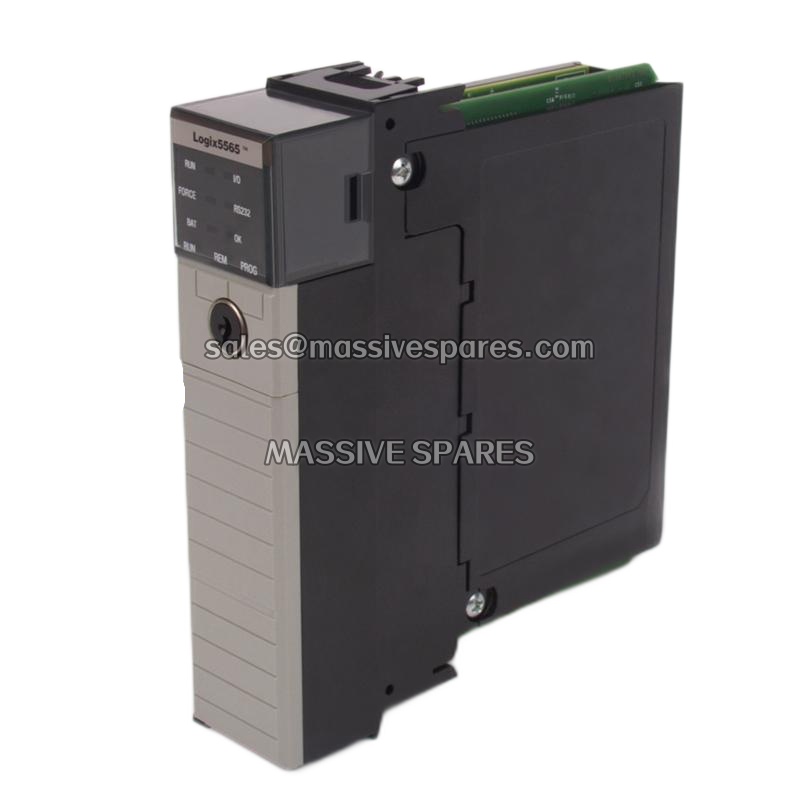
| Product Type | ControlLogix Programmable Automation Controller (Processor) |
| Product Family / Platform | Bulletin 1756 ControlLogix 5570 (1756-L7x series) |
| User Memory | 4 MB |
| Execution Rate | Up to 0.92 million instructions per second (MIPS) |
| Bit Execution Time | 0.49 µs |
| Scan Time (1,000 instructions) | 1.16 ms typical |
| I/O Capacity | 128,000 digital or 4,000 analog I/O points |
| CIP Connections | 1,000 |
| I/O Messaging Memory | 31.5 KB |
| Program / Task Capacity | 4,000 programs; 32 tasks; 100 programs per task |
| Program Support | Sequential function chart (SFC) |
| Ethernet Port | 1, 1784-BNC connector (10/100 Mbps, DLR capable) |
| Serial Port | 1, 9-pin RS-232 |
| Backplane Interface | Built-in 1756 ControlLogix backplane |
| USB Port | None |
| Real-Time Clock | None |
| Current Draw @ 5.1 V DC | 5 mA |
| Current Draw @ 24 V DC | 1.5 A |
| Power Dissipation | 9 W (max) |
| Thermal Dissipation | 31 BTU/hr |
| Enclosure Type Rating | None (open-style) |
| Dimensions | 5.71 x 1.65 x 6.80 in (14.5 x 4.19 x 17.27 cm) |
| Weight | 1.07 lb (0.49 kg) |
| Operating Temperature | 0 to 60 °C (32 to 140 °F) |
| Storage Temperature | -40 to 85 °C (-40 to 185 °F) |
| Relative Humidity | 5 to 95%, non-condensing |
| Certifications | CE, CSA, C-UL, FM, ATEX, IECEx, RCM, CCC, EAC, KC, UL |
| Lifecycle Status | Discontinued effective December 31, 2024; engineering replacement |
Main Features and Advantages
A balanced memory tier in the L7x family:
The 1756-L72 occupies the middle of the 5570 memory ladder — 4 MB, twice the 1756-L71 and half the 1756-L73 — which is where most mid-size machine and skid applications actually land. That sizing matters in practice: it is large enough to hold meaningful historical trend data, device configuration, and a safety or motion coordination layer without forcing the memory-reduction exercises that a 2 MB controller demands, yet it does not pay for capacity that the application will never use.
The unified Logix control engine:
The 1756-L72 runs the same control engine across discrete, process, drive, and safety programming, so one project file covers the whole machine. Its 32-task, 4,000-program structure lets engineers separate sequencing, safety interlocks, motion coordination, and communications into distinct program contexts rather than burying everything in one continuous routine. SFC support is particularly valuable for batch and state-based equipment, where the 1756-L72 makes the operating states visible and auditable instead of implicit in ladder logic.
High-density I/O and connection handling:
With capacity for 128,000 digital or 4,000 analog I/O points and 1,000 CIP connections, the 1756-L72 is not limited to a single panel. It can coordinate multiple remote I/O racks, PowerFlex drives, and HMI stations across EtherNet/IP and DeviceNet, while the 31.5 KB of I/O messaging memory accommodates the explicit messaging traffic that integration projects generate. For brownfield plants this means the 1756-L72 can sit at the center of a mixed-generation architecture without becoming the bottleneck.
Three independent communication paths:
The 1756-L72 carries an Ethernet port, an RS-232 serial port, and the 1756 backplane interface on the same module. The Ethernet port supports Device Level Ring (DLR) for redundant-ring topologies, which removes the single point of failure in a linear backbone. The RS-232 port handles legacy serial devices, ASCII strings, and direct-connect terminals without consuming a communication module slot. The backplane interface services the local I/O chassis at full backplane speed.
Deterministic performance and certified safety pairing:
At 0.92 MIPS and 1.16 ms for a 1,000-instruction scan, the 1756-L72 is predictable enough for high-speed packaging, converting, and material handling, and its performance scales linearly enough that scan budgeting remains straightforward. Paired with a GuardLogix controller in a safety application, the 1756-L72 can also serve in the safety-rated 1756-L72S form, extending the same architecture into SIL-rated machinery.
A managed end-of-life, not an abrupt dead end:
Rockwell’s published migration path from the 1756-L72 to the 1756-L85E/1756-L86E is detailed and supported by conversion tools, so the module’s discontinued status does not leave users stranded. The trade-off — new chassis, Studio 5000 v31+, and communication-module review — is precisely why a reliable supply of tested 1756-L72 units extends the useful life of an existing investment.