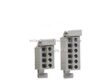
Description
The 1756-OW16I is an isolated relay output module manufactured by Rockwell Automation under the Allen-Bradley brand for the ControlLogix 1756 platform. It provides sixteen independently isolated, normally open relay contacts that connect field loads to external power sources under control of the ControlLogix processor.
Each output point on the 1756-OW16I behaves like a dry-contact switch rather than a fixed-voltage semiconductor output. This design allows one module to control a broad range of AC and DC loads without requiring the outputs to share a common electrical reference.
Application Scenarios
A packaging line needed to operate 24V DC solenoid valves, 120V AC motor starters, and 230V AC indicator circuits from the same control cabinet. Using ordinary transistor or triac outputs would have created voltage, current, and reference-compatibility problems. The engineering team installed the 1756-OW16I because each of its sixteen contacts is electrically isolated and can switch the appropriate externally supplied load voltage.
During commissioning, the maintenance team connected the common terminal of each load group to the required external supply and verified the contact rating for the application. The relay outputs simplified integration with mixed AC and DC equipment, while the module’s fused terminals added a measurable layer of fault protection. The project reduced the number of specialized output cards and made panel wiring easier to understand during troubleshooting.
This scenario demonstrates the practical value of the 1756-OW16I: it is not chosen only for its sixteen points, but for the electrical flexibility created by independent isolation, normally open contacts, and compatibility with multiple load voltages.
Parameter
| Main Parameters | Value/Description |
|---|---|
| Product Model | 1756-OW16I |
| Manufacturer | Rockwell Automation |
| Brand | Allen-Bradley |
| Product Category | ControlLogix isolated relay output module |
| Number of Outputs | 16 points |
| Contact Type | Normally open isolated relay contact |
| Rated Current per Point | 0.5 A at 125V AC |
| Rated Current per Point | 1.0 A at 30V DC |
| Maximum Voltage | 125V AC or 30V DC |
| Minimum Load Current | 10 mA |
| Maximum Inrush Current | 5 A |
| Leakage Current | 0 mA |
| On-State Voltage Drop | 0.5V at 0.5 A |
| Off-State Leakage | 0 mA |
| Module Filtering Time | 9 ms |
| Maximum Thermal Dissipation | 5.1 W |
| Terminal Protection | Fused terminals |
| Chassis Position | Must be installed in slots 0–30 of a 1756 chassis |
The 0.5V on-state voltage drop represents the voltage lost across the closed contact at rated current. The 9 ms filtering time helps stabilize the module’s internal operation but should be considered when calculating total system response time. Because the contacts provide isolation rather than a built-in load supply, the connected load must have its own properly rated AC or DC power source.
Technical Principles and Innovative Values
- Innovation Point 1: Electromechanical isolation between logic and load circuits. The 1756-OW16I uses relay contacts to separate the control backplane from field wiring. This reduces the risk of a shared electrical fault propagating through multiple outputs and allows each point to interface with a different load voltage.
- Innovation Point 2: Sixteen normally open dry contacts in one module. Every output operates as a normally open contact pair. The controller closes the selected contact to complete the external circuit, making the module suitable for applications that require straightforward switch contacts rather than polarity-sensitive semiconductor outputs.
- Innovation Point 3: Flexible mixed-voltage switching. Each contact can switch an external source of up to 125V AC or 30V DC, depending on the load and application conditions. The 1756-OW16I is therefore well suited to panels containing mixed 24V DC, 120V AC, and other compatible control voltages.
- Innovation Point 4: Zero leakage in the open-contact state. With off-state leakage listed as 0 mA, the relay contacts provide a physical open circuit when de-energized. This characteristic is valuable when the application requires a clean break rather than the small leakage current associated with some solid-state outputs.
- Innovation Point 5: Integrated terminal protection. The module uses fused terminals to help protect against wiring and load faults. Although this does not eliminate the need for correctly sized external overcurrent protection, it adds an important layer of protection within the module termination arrangement.