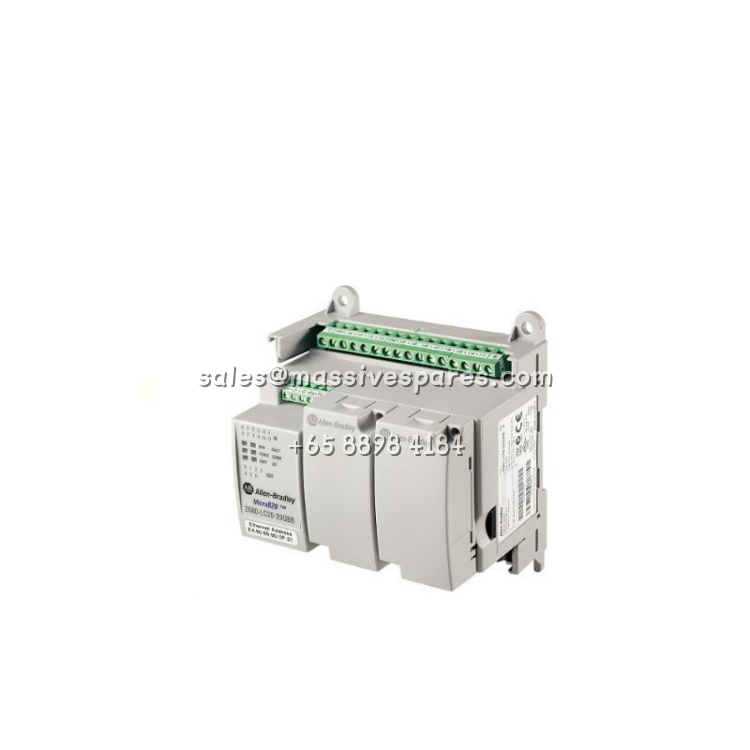
Application Scenarios:
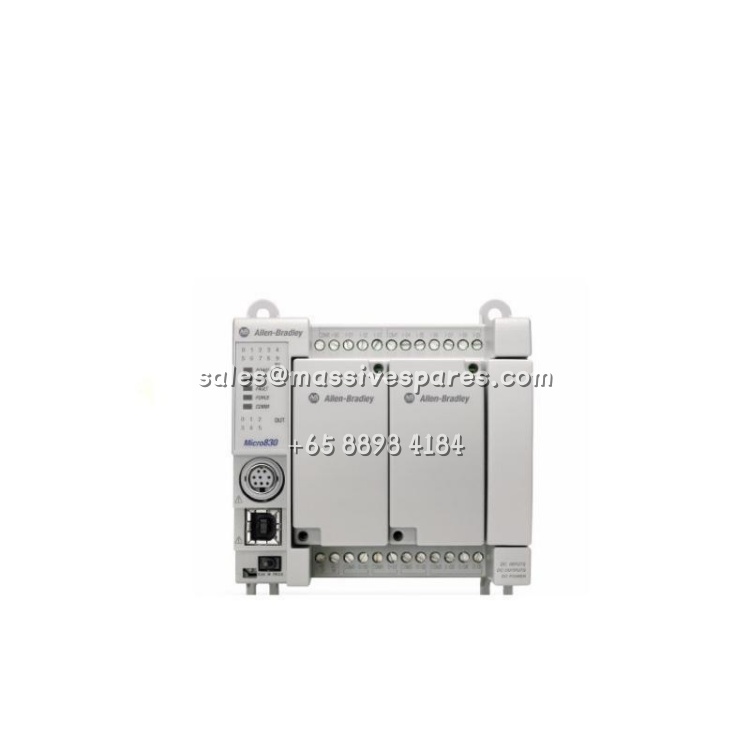
Consider a small packaged reverse-osmosis skid in a bottling plant — the builder has been wiring up relays, timers, and a touchscreen by hand for every unit shipped, and every customer-specific tweak means returning to the panel with a screwdriver. Swapping that hardwired panel for a 2080-LC30-10QWB closes the loop: the six embedded inputs read pressure switches, float switches, and a flow pulse signal on one of the high-speed channels, while the four relay outputs drive the inlet solenoid, concentrate dosing pump, flush valve, and fault lamp. Program changes ship over the USB port from Connected Components Workbench in seconds, and Modbus RTU over the serial port lets the same controller hand production data to a customer’s SCADA layer without additional hardware. Pain points such as hardwired-logic rigidity, missing high-speed pulse capture on a tight budget, and the cost of a full Logix platform on small machines are all addressed by a single controller — which is why the 2080-LC30-10QWB is a go-to brick PLC for OEM skid builders, water treatment, packaging, conveyors, and small material-handling applications where full-size PLCs are over-engineered and basic relays are under-engineered.
Parameter:
| Main Parameters | Value / Description |
|---|---|
| Product Model | 2080-LC30-10QWB (Micro830 10-point controller) |
| Manufacturer | Allen-Bradley / Rockwell Automation |
| Product Category | Micro830 Brick-Style Programmable Logic Controller |
| Embedded I/O | 10 total — 6 × 24 V DC sink/source inputs, 4 × relay outputs (N.O.) |
| High-Speed Inputs | 4 inputs (I-00…I-03) rated to 100 kHz — supports 6 HSC modes |
| Relay Output Rating | 2 A per point @ 240 V AC / 125 V DC; 1 A per point @ 30 °C, 0.3 A per point @ 65 °C |
| Serial Communication | 1 × non-isolated RS232/485 combo port — CIP Serial, Modbus RTU, ASCII |
| Programming Port | USB 2.0 Type B (temporary local programming, ≤ 3 m cable) |
| Program Memory | 4 K steps user program, 8 KB data memory |
| Expansion Capacity | Up to 2 plug-in modules on controller + up to 4 expansion I/O modules (max 88 I/O total) |
| Power Supply | 20.4 – 26.4 V DC Class 2 / LVLC source; 5 W total consumption |
| Dimensions / Weight | 90 × 100 × 80 mm (3.54 × 3.94 × 3.15 in); ~0.302 kg (0.666 lb) |
| Mounting | 35 × 7.5 mm DIN rail (EN 50022) or panel mount with four M4 screws |
| Environment / Enclosure | IP20 open-style; 0 – 65 °C operating; North American Temp Code T4; Class I Div 2 Groups A–D |
Specifications compiled from the Allen-Bradley 10-point Micro830 installation instructions 2080-IN002 and Rockwell Micro830/Micro850 user manual 2080-UM002.
Technical Principles and Innovative Values:
- Innovation Point 1 — True brick-style simplicity with embedded I/O. The 2080-LC30-10QWB carries all ten I/O points directly on the controller housing — no separate chassis, no I/O modules to order, no backplane budget to calculate. A machine builder can pull one part number off the shelf and have the entire control layer in hand, which is precisely where lower-cost competitors with brick PLCs (Mitsubishi FX, Siemens LOGO!) force users to buy a base unit and snap-on expansion just to reach the same ten points.
- Innovation Point 2 — High-speed input capability at the entry level. Four of the six embedded inputs on the 2080-LC30-10QWB accept signals up to 100 kHz and support six high-speed counter operating modes, giving users genuine flow-meter, encoder, and pulse-sensor acquisition on a controller that costs a fraction of a full Logix platform — a capability that traditional micro-PLC offerings in this class often reserve for a higher tier or an external HSC module.
- Innovation Point 3 — Modbus RTU and CIP Serial on the standard serial port. Rather than locking users into a proprietary fieldbus, the 2080-LC30-10QWB speaks Modbus RTU natively over its RS232/485 combo port, opening direct connectivity to drives, meters, and SCADA gateways from any vendor, while CIP Serial keeps the controller native to Rockwell ecosystems when both worlds must coexist.
- Innovation Point 4 — Tiered expansion path to 88 I/O. The controller accepts two plug-in modules directly on its top connector and cascades up to four additional expansion I/O modules along the Micro800 rail, meaning a 2080- purchased for a 10-point machine can scale into a mid-range application without a controller swap — protecting OEM machine-design investment across product families.
- Innovation Point 5 — Class I Division 2 hazardous-location approval as standard. The 2080- carries North American Class I, Division 2, Groups A–D approval with a T4 temperature code, letting OEMs deploy the same controller on skids destined for petroleum, chemical, and solvent-handling environments without sourcing a separate certified variant.
- Innovation Point 6 — Free Connected Components Workbench software. Programming, configuration, and commissioning run on CCW — Rockwell’s free Microsoft-Windows IDE supporting ladder logic, function block, and structured text — eliminating the recurring software-licence cost that typically follows entry-level PLCs from other manufacturers.
Application Cases and Industry Value:
Case 1 — Small Municipal Lift Station, North America.
A municipal contractor packaging sewage lift stations for towns of under 5,000 residents needed a controller that could sit inside a small outdoor NEMA 4X panel, drive two submersible pumps on lead/lag alternation, read float switches and a pressure transmitter, and report status to a county SCADA system over serial. Standardising on the 2080- allowed the contractor to ship a pre-programmed controller with every skid: the six embedded inputs handled four float switches and two pump-seal fault signals, while the four relay outputs drove the two pump contactors, a high-level alarm beacon, and a building-access light. Modbus RTU over the serial port passed pump run-hours and alarm states to the SCADA master without a gateway. Post-deployment, the contractor reported a measurable drop in field-commissioning time — panels now arrive pre-tested, and startup is reduced to verifying field wiring and downloading the project over USB — a workflow change that cut per-station commissioning labour from roughly a full day to under two hours.
Case 2 — Bakery Tray Packaging Machine, Europe.
An OEM building small tray-wrapping machines had been using a mid-range Logix controller on every unit and found that customers buying single machines were paying a premium for capability they never used. Redesigning the machine around a 2080- brought the bill of materials down significantly while preserving the features that mattered: the high-speed inputs captured a photo-eye pulse train for product counting, the four relay outputs drove the seal bar, cutter, tray ejection solenoid, and stacker light tower, and the 4K program capacity was more than sufficient for the wrap/count/fault-handling sequence. The OEM reported the controller swap made the entry-level machine price-competitive against non-Rockwell packaging lines while keeping spares and programming software identical to the rest of the fleet — a supply-chain consolidation that recovered the redesign effort within the first production quarter.