Application Scenarios
A commercial bakery operates a batch dough mixing line where a single mixer must sequence flour delivery, water metering, and kneading cycle timing without the cost and complexity of a full PLC rack. The existing control panel uses discrete timers and contactors, and when a contactor coil fails, the entire sequence drifts out of specification. The 2080-LC10-12DWD replaces the timer relay stack: its 12V DC inputs interface directly with the existing selector switches and level sensors, while the four relay outputs drive the flour auger, water valve, and mixer motor starter. Because the controller supports 0–10V analog inputs on channels 4–7, the baker can also monitor a load cell for dough consistency without adding a separate analog module. The compact footprint allows the upgrade to fit inside the existing enclosure, and the relay outputs handle the inductive load switching that the original contactor logic performed, with the added benefit of programmable timing that eliminates drift and sequence errors.
Parameter
| Main Parameters | Value / Description |
|---|---|
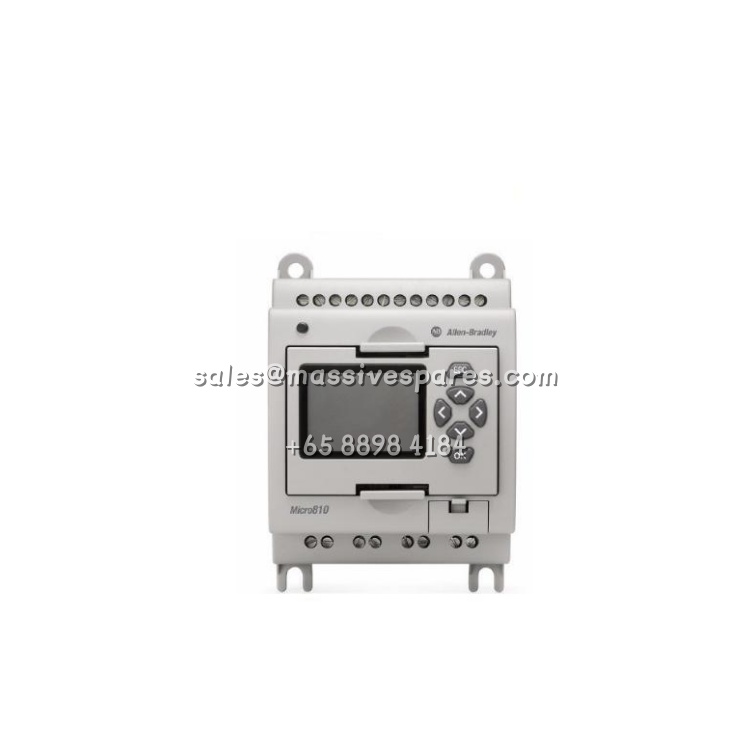
| Product Model | 2080-LC10-12DWD |
| Manufacturer | Allen-Bradley / Rockwell Automation |
| Product Category | Micro810 Smart Relay Controller |
| Digital Inputs | 8 total: 4 isolated (0–3), 4 non-isolated shared with analog (4–7) |
| Digital Input Voltage | 12/24V DC sink/source (on-state min 9.8V DC, max 28.8V DC) |
| Analog Inputs | 4 channels (inputs 4–7), 0–10V DC, 10-bit resolution |
| Relay Outputs | 4 total: Relay 00 & 01 rated 8A @ 240V AC / 5A @ 24V DC; Relay 02 & 03 rated 4A @ 240V AC / 2A @ 24V DC |
| User Memory | 4 KB |
| Power Dissipation | 3W at full load 100% |
| Operating Temperature | 0°C to 55°C |
| Input Filter Options | DC 8ms / 16ms / 32ms; AC 8ms / 16ms / 28ms (configurable per input group) |
| Hazardous Location Rating | Class I, Division 2, Groups A, B, C, D |
| Country of Origin | Singapore |
Technical Principles and Innovative Values
- Hybrid Digital-Analog Input Architecture: The 2080-LC10-12DWD dedicates inputs 0–3 as fully isolated digital channels and inputs 4–7 as non-isolated channels that can function as either digital or analog voltage inputs. This dual-purpose design eliminates the need for a separate analog expansion module in applications that need just a few analog signals—such as a pressure transducer, load cell, or potentiometer—alongside discrete sensors. For small machines and skids, this consolidation reduces component count, wiring, and panel space.
- Relay Outputs with Tiered Current Ratings for Mixed Loads: The four relay outputs on the 2080-LC10-12DWD are not uniformly rated: relays 00 and 01 handle 8A at 240V AC, while relays 02 and 03 are rated 4A. This tiered design acknowledges a practical reality in small control panels—some outputs drive heavy inductive loads like motor starters or solenoid valves, while others handle pilot lights or small relays. Engineers can assign the high-current loads to the first two outputs and use the lower-rated relays for lighter duties, optimizing the controller’s internal thermal performance without external interposing relays for moderate loads.
- Configurable Input Filtering for Electrical Noise Immunity: Each input group on the 2080-LC10-12DWD supports selectable filter times, from 8ms DC response for fast sensor signals to 28ms AC filtering for noisy environments. In installations where the controller shares an enclosure with variable-frequency drives or contactor coils, the longer filter setting suppresses false input transitions caused by electrical noise, preventing spurious sequence steps without requiring external filtering hardware. This configurability lets the same controller model serve both high-speed packaging sensors and noise-prone motor control panels.