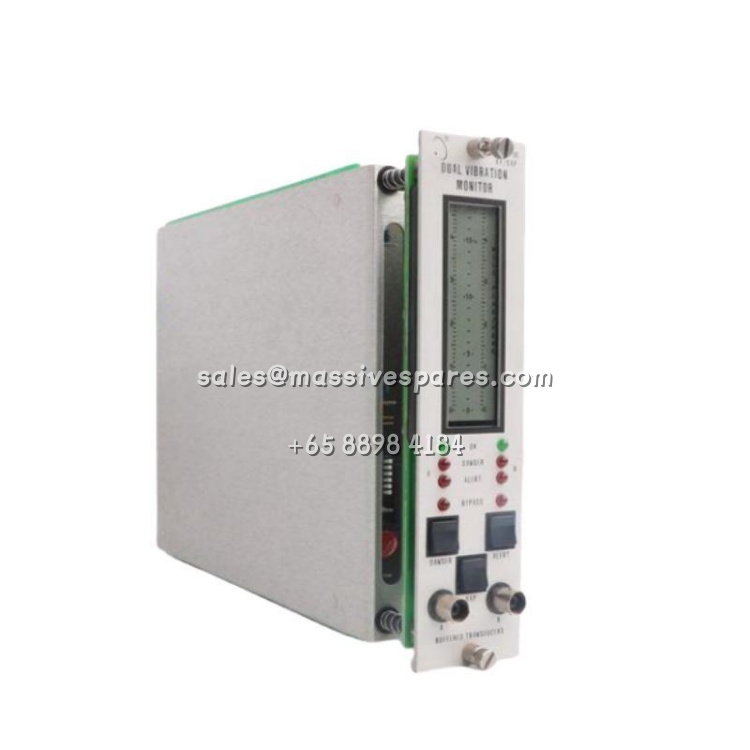
Product Overview
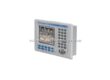
The 1900/27-02-00 is a single-channel, stand-alone vibration monitor from Bently Nevada, designed for local mounting on or near critical rotating machinery. As a member of the 1900 series of machinery protection instruments, the 1900/27-02-00 provides continuous monitoring of vibration levels and generates alarm signals when preconfigured thresholds are exceeded, enabling operators to protect equipment from damage and schedule maintenance before catastrophic failure occurs. The monitor accepts input from Bently Nevada 200150 and 190520 accelerometers with 100 mV/g sensitivity, making it compatible with the most common industrial vibration transducers used in condition monitoring applications .
Unlike rack-based monitoring systems that require a central cabinet and multiple card slots, the 1900/27-02-00 is a self-contained unit intended for local installation in the field, close to the machine being monitored. This architecture reduces wiring runs from the transducer to the monitor and allows the vibration signal to be processed before transmission over longer distances, preserving signal integrity. The monitor is now discontinued by the manufacturer, but remains widely available through surplus and refurbished channels for facilities maintaining existing Bently Nevada installations .
The 1900/27-02-00 employs a true peak-to-peak detection method rather than RMS conversion, a distinction that matters in machinery protection because vibration waveforms are rarely pure sinusoids. The monitor’s proprietary Timed OK/Monitor Defeat circuit reduces the likelihood of false alarms caused by faulty transducers, wiring issues, or power supply disturbances, while power-up inhibit prevents alarms during transient power interruptions . These features reflect the monitor’s design intent: reliable, unattended protection of pumps, motors, fans, and other rotating equipment in industrial environments where maintenance resources are limited and unplanned downtime is costly.
Technical Specifications
| Parameter Name | Parameter Value |
|---|---|
| Product Model | 1900/27-02-00 |
| Manufacturer | Bently Nevada (GE) |
| Product Type | Single-Channel Vibration Monitor |
| Input Sensitivity | 100 mV/g |
| Compatible Transducers | Bently Nevada 200150 and 190520 accelerometers |
| Maximum Acceleration | 20 g peak |
| Maximum Differential Input Voltage | 4 volts peak to peak |
| Monitor Full-Scale Signal Conditioning | <614 Hz |
| Output Signals | 4-20 mA (peak velocity); buffered velocity signal via coaxial connector |
| Alarm Relays | Two single-pole, double-throw (Type 2 FORM C) |
| Relay Bypass | Front-panel switch with red BYPASS LED |
| Operating Temperature | Not consistently documented across sources; typical industrial range assumed |
| Country of Origin | USA |
| Lifecycle Status | Discontinued by manufacturer |
Note on specifications: Search results from third-party resellers conflict significantly on parameters such as input channel count, communication interface, and operating temperature range. Several sources describe the 1900/27-02-00 as having four input channels and RS485 Modbus communication , but these descriptions appear to conflate the model with other products or represent inaccurate reseller listings. The authoritative manual-derived information indicates a single-channel architecture with relay outputs and a 4-20 mA interface . The table above prioritizes manual-sourced and consistent technical data. Buyers should verify specifications against the original Bently Nevada manual for their specific unit revision.
Main Features and Advantages
True Peak Measurement for Accurate Protection: The 1900/27-02-00 uses an analog peak-to-peak detector to determine vibration amplitude, rather than measuring RMS and applying a sinusoidal correction factor. Because real machinery vibration is rarely a pure sine wave, the RMS-conversion approach can under- or over-estimate peak levels, leading to either missed alarms or nuisance trips. The true peak method employed by the 1900/27-02-00 provides a more faithful representation of the actual mechanical stress experienced by the machine, making alarm thresholds more meaningful and protection decisions more reliable .
Integrated Diagnostics and False-Alarm Suppression: The monitor includes a Timed OK/Monitor Defeat circuit that distinguishes between a genuine high-vibration condition and a fault caused by a failed transducer, broken wiring, or power supply problem. When the circuit detects an abnormal transducer signal, it temporarily inhibits alarms to avoid unnecessary shutdowns while the condition is investigated. Power-up inhibit performs a similar function during power restoration, preventing transient surges from triggering alarms . These features are particularly valuable in remote or unattended installations where a false alarm might trigger an unnecessary site visit or production stoppage.
Local Diagnostic Access via Buffered Output: The front-panel coaxial connector provides a buffered velocity signal (500 mV/in/s or 20 mV/mm/s) that allows maintenance technicians to connect a portable data collector or oscilloscope directly to the 1900/27-02-00 without disturbing the machine’s protection circuits. This capability supports detailed vibration analysis for root-cause diagnostics while the monitor continues to perform its protection function in parallel. The 4-20 mA interface provides a secondary path for transmitting peak velocity data to a PLC or DCS for trend monitoring and historian recording .