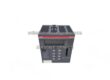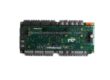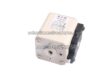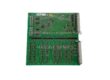
Application Scenarios
An offshore gas production platform was mid-way through a brownfield expansion, adding skid-mounted equipment that required analog control signals. The existing control architecture was a PAC8000 remote I/O network running on Railbus, but the new skids needed a dozen additional 4-20 mA outputs for valve positioners on a separator train and speed references on two variable speed drives. The project team’s first estimate assumed an external marshalling cabinet with intrinsic safety barriers, additional cable routes through a classified area, and a shutdown window to tie everything in. That estimate was large enough to threaten the project’s economics.
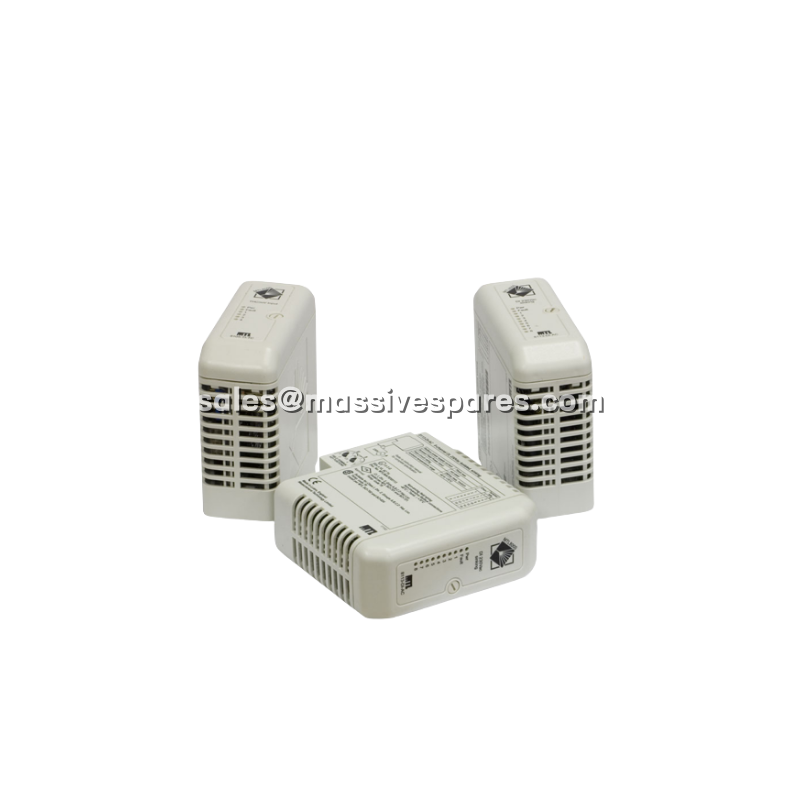
The GE 8104-AO-IP-03 changed the arithmetic. Because the module carries non-incendive field circuit approvals, the new outputs could be driven directly from PAC8000 modules mounted in the Zone 2 area without a barrier cabinet in between. Because the 8104-AO-IP-03 sits on the same Railbus backplane as the rest of the node, no new communication infrastructure was needed. And because PAC8000 I/O is hot-swappable, the modules could be added and commissioned without taking the existing node offline.
The pain point this addresses is the hidden cost of adding I/O late in a plant’s life. Every new analog output normally drags along cabinet space, barrier hardware, cable, drawings and outage time. The GE 8104-AO-IP-03 collapses most of that into two 42 mm modules on an existing carrier. Equally important, the module’s per-channel open and short circuit detection meant the platform’s technicians could see a broken loop from the control room rather than sending someone to the skid, which on an offshore installation is worth more than the hardware itself.
Parameter
| Main Parameters | Value / Description |
|---|---|
| Product Model | 8104-AO-IP-03 (base part number 8104-AO-IP, -03 hardware/firmware revision) |
| Manufacturer | GE Intelligent Platforms / GE Fanuc, now Emerson (MTL PAC8000 family) |
| Product Category | 8-channel analog output module for PAC8000 remote I/O |
| Output Channels | 8 single-ended analog outputs, 4-20 mA nominal |
| Signal Range | 4-20 mA nominal, 1-23 mA full range |
| Resolution | 12-bit digital-to-analog conversion |
| Accuracy | ±0.25% of span |
| Response Time | 25 ms or less from Railbus command to output; 0.75 s when HART is used |
| Output Compliance | 20 mA at 21.6 VDC into a maximum 700 ohm load |
| Open Circuit Detection | Per-channel fault triggered at approximately 0.7 ± 0.25 mA |
| Isolation | 100 VAC galvanic isolation between channels and Railbus logic |
| Diagnostics | Per-channel open-circuit and short-circuit detection, channel status reporting |
| Fail-Safe Behaviour | Configurable drive-on-fail-safe to a predefined value or hold last value; configurable initialization state |
| Field Power | 24 VDC ±10% bussed field power; 300 mA maximum field power, 150 mA maximum system power |
| Communication | PAC8000 Railbus backplane via Bus Interface Module; up to 32 modules per BIM |
| Environmental | Operating -40 °C to +70 °C, storage -40 °C to +85 °C, 5% to 95% humidity non-condensing |
| Mechanical and Compliance | 42 mm module width for carrier mounting, approximately 0.5 kg; IP20 module, IP40 with terminal cover; FM non-incendive parameters 28.7 V, 33 mA, 0.17 μF, 11.0 mH; ATEX, IECEx, UL, CE |
Technical Principles and Innovative Values
Innovation Point 1: Non-incendive field circuits that remove the barrier cabinet. The GE 8104-AO-IP-03 is certified to drive non-incendive field circuits, with FM entity parameters of 28.7 V, 33 mA, 0.17 μF and 11.0 mH. In plain terms, the output loop is energy-limited by design, so it can be wired directly to field devices in Zone 2 and Division 2 areas without interposing intrinsic safety barriers. That eliminates a cabinet, a set of terminations and a significant slice of installation cost per loop, and it is the single most important reason to choose the 8104-AO-IP-03 over a general-purpose output card in a hazardous plant.
Innovation Point 2: Fail-safe behaviour that is configured, not improvised. Safety in an output module is about what happens when communication stops, and the GE 8104-AO-IP-03 gives engineers two independent mechanisms. A configurable timeout defines how long Railbus communication may lapse before the module drives its outputs to a predefined state, and the Bus Interface Module can also command a fail-safe state directly. Combined with a configurable initialization state applied at power-up before host communication begins, the 8104-AO-IP-03 lets the designer declare exactly where every valve goes on a fault rather than hoping.
Innovation Point 3: Per-channel loop diagnostics that find wiring faults early. Each channel of the 8104-AO-IP-03 monitors its own loop current and flags an open circuit when the current falls below roughly 0.7 mA, plus short circuit conditions. A broken cable, a failed positioner or a lifted terminal becomes a reported diagnostic rather than a mysterious process deviation. Because the fault is reported at the channel level, maintenance teams are dispatched with the correct spare and the correct location on the first visit.
Innovation Point 4: Galvanic isolation at the module boundary. The GE 8104-AO-IP-03 provides 100 VAC galvanic separation between the analog channels and the Railbus logic. This breaks the ground loops that otherwise let a distant field ground potential or a lightning-induced transient travel back into the I/O node and corrupt every channel on the rack. In large plants where field devices are grounded at points hundreds of metres apart, this isolation is the difference between stable analog control and intermittent, untraceable signal errors.
Innovation Point 5: Slot-based addressing with non-volatile configuration. PAC8000 modules are addressed by slot position rather than by module type, and the configuration for every module in a node is stored in the BIM’s non-volatile memory. When a GE 8104-AO-IP-03 is replaced, the BIM downloads the stored configuration to the new module automatically. The result is that a field technician can swap a failed module without any configuration work, which is exactly what you want at three in the morning in a remote location.