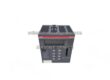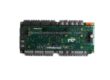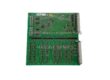
Application Scenarios
At a natural gas city-gate station, operators were struggling with pressure-control instability caused by wide swings in upstream pipeline pressure and rapidly changing downstream demand. The existing setup relied on a conventional positioner slaved to a remote DCS PID loop—but communication latency and DCS scan delays introduced oscillation, causing pressure spikes that tripped safety systems. The engineering team replaced the control strategy with a Neles CPR1 (A413280) mounted directly on the pressure-reducing valve. Because the CPR1 executes its own PID loop locally, it responded to pressure changes in milliseconds rather than waiting for a DCS scan. The result: downstream pressure stabilized within ±0.5%, safety trips vanished, and the DCS was freed from running the pressure loop entirely.
This real-world scenario captures the core value of the CPR1: it moves the control intelligence to the valve itself. For applications in oil & gas, chemical processing, power, pulp & paper, and water treatment—where pressure and flow must be held tightly despite disturbances—this processor module is not just a positioner. It is an autonomous, self-tuning controller that makes the entire process more stable, more responsive, and safer.
Parameter
| Main Parameters | Value/Description |
|---|---|
| Product Model | CPR1 (part reference A413280) |
| Historical Manufacturer | Neles Automation (Finland) → Valmet Automation → Flowserve Accord Controls |
| Current Brand | Flowserve (Accord Controls) / Valmet (depending on supply channel) |
| Product Category | Controlled Pressure Reduction Valve Positioner + Integrated Process Controller |
| Product Family | ND9000 Series (CPR1, NDX, ND9100H) |
| Core Function | Valve positioning + independent PID pressure/flow control |
| Control Architecture | Single-loop, closed-loop, microprocessor-based |
| Input Signal | 4–20 mA analog (process variable / setpoint) |
| Supply / Loop Power | 10–30 VDC (two-wire loop powered) |
| Communication Protocol | HART 5 + FITS (Field Instrument Tool Serial) |
| Control Algorithm | PID with auto-tuning, adaptive control, fuzzy logic, gain scheduling |
| Control Modes | Pressure control, Flow control, Cascade (w/ external feedback) |
| Process Connection | Integrated process connection (valve-mounted) |
| Operating Temperature | -40°C to +80°C (-40°F to +176°F) |
| Storage Temperature | -55°C to +85°C |
| Enclosure Rating | IP66 / NEMA 4X / Type 4X (corrosion-resistant) |
| Hazardous Area Certification | FM, FMEDA certified; SIL capable (IEC 61508) |
| Display / Interface | Local display & configuration buttons (ND9000 family) |
| Mounting | Direct valve mounting (linear or rotary actuators) |
| Weight | Approx. 1.3–1.7 kg |
| Configuration Tool | ND9100H / FITS-based configurator |
Technical Principles and Innovative Values
- Innovation Point 1: Control Intelligence at the Valve
The defining innovation of the is that it doesn’t just position a valve—it controls the process. With its integrated PID microprocessor, the A413280 reads the process variable (pressure or flow) and adjusts the valve stem position in a single, tightly coupled local loop. This eliminates DCS scan latency and frees host controller capacity for higher-level optimization. - Innovation Point 2: CPR (Controlled Pressure Reduction) Architecture
The name describes a purpose-built control topology: it accepts a 4–20 mA setpoint, compares it against measured process pressure or flow, and drives the valve to close the loop—all while simultaneously maintaining exact stem position. This dual control (process + position) is what enables stable pressure reduction even with fluctuating upstream conditions. - Innovation Point 3: Auto-Tuning & Adaptive Gain Scheduling
Commissioning a pressure-reducing valve used to require hours of manual PID tuning. The automatically identifies the process dynamics and tunes its PID gains—then adaptively re-tunes as operating conditions shift (e.g., as flow rate or pressure drop changes). The result is stable control across the entire operating envelope without manual intervention. - Innovation Point 3b: Fuzzy Logic for Non-Linear Valves
For valves with highly non-linear flow characteristics, the applies fuzzy-logic control strategies that conventional PID cannot handle well. This is particularly valuable for severe-service valves near their seat, where small position changes produce large flow effects. - Innovation Point 4: HART 5 + FITS Digital Communication
Beyond the 4–20 mA analog signal, the A413280 communicates digitally using HART 5 for asset management and diagnostics, plus FITS (Field Instrument Tool Serial) for configuration and parameterization. Technicians can read valve signature, performance data, and diagnostic alerts from the control room—enabling predictive maintenance. - Innovation Point 5: SIL-Capable Functional Safety
With FM and FMEDA certifications, the meets IEC 61508 requirements for use in Safety Instrumented Functions (SIF). Its diagnostics continuously monitor for internal faults, and the unit’s safe failure fraction supports SIL 2/SIL 3 architectures—critical for emergency pressure-control applications. - Innovation Point 6: Extreme-Environment Survivability
Rated for -40°C to +80°C and IP66/NEMA 4X enclosures, the operates reliably in Arctic pipeline stations, desert gas plants, offshore platforms, and corrosive chemical facilities where standard instrumentation fails.